What is Tinder and why did we even write it?
Tinder enjoys immense popularity, which also brings with it extreme emotions. Some use it, others ridicule it, and still others closely observe it. Regardless of their views, representatives of each group eagerly seek arguments to support their theories. Even if someone hasn't experienced this world from the inside, they often have formed an opinion based on what they've heard, or at least feel a certain amount of interest.
Why did we even undertake this task? Tinder is sometimes demonized, mockingly described as a Disneyland for adults, or more seriously categorized as synonymous with moral decay. The devil is not as black as he is painted. We talk about Google Ads campaign optimization and SEO on a daily basis . For Valentine's Day, we decided to take a closer look at a different environment – Tinder. For the purposes of this article, we treated dating as conversions, and all activity on Tinder as a classic advertising campaign. 🙂
Together, we've prepared a comprehensive publication that delves into the intricacies of this app. Here, you'll find a description of the technical aspects driving the entire mechanism, as well as a handful of tips and inspiration. For dessert, we've saved the subjective opinions of our employees, who cut their teeth in online marketing. We're sharing this with you just in time for Valentine's Day, because it's hard to imagine a more fitting term. We've added the term "conversion" to add a bit of marketing flair. Besides, what else could be considered a conversion on Tinder if not a date?
In the meantime, we wish you a pleasant reading and at least as much fun as we had writing this article.
(The rest of the article can be found below the form)
What is Tinder?
Tinder was born in a startup incubator in 2012. Initially aimed at American university students, its reach expanded over time, eventually encompassing the entire globe. The app was tailored to the needs of the consumer age and was intended to offer instant dating on a local scale.
After launching the app, you'll need to specify your location and surrounding area. The furthest point in this area can be 160 kilometers away. Then, you select the age range of your potential partners. Based on this, users who meet both criteria are displayed. Photos of individual people fill the majority of the available space. If you want to learn more, you can review their profile descriptions. Based on this information, you decide whether to initiate contact or not. Swiping right on your profile indicates approval. Swiping left indicates disinterest. If the other person likes your profile, you become a couple (for now, only in the app) and can start a conversation.
According to statistics, Tinder has a global audience of over 50 million. Last year, its creators earned $1,2 billion, largely thanks to its subscribers, who now number nearly 6 million.
In Poland, there's a lack of up-to-date analysis of the app's audience. The last report we found dates back to April 2017 and was conducted by IRCenter on a representative sample of 2100 Polish internet users. The study showed that 3,2% of Polish internet users used Tinder at the time. The largest group consists of men aged 18-24, hailing from large and medium-sized cities. Interestingly, only 58% of respondents declared they were currently single.
What makes Tinder stand out from other dating apps?
The shift of interpersonal relationships into the virtual space isn't a result of the proliferation of social media . Online dating is as old as the internet itself. People were searching for partners online long before Tinder was created. So why has this app gained such popularity?
Some people wonder why it's easier for people to connect online than face-to-face. Hundreds of answers can be found under every political news story shared by any news portal. There's nothing difficult about expressing your views, or even discriminating against strangers, when you're confined to a remote apartment. Face-to-face confrontation requires more courage. Dating is similar. There are countless potential mishaps that would make you want to sink into the ground. Online, you'll rarely encounter anything worse than a conversation that ends abruptly and a lack of response.
Tinder's creators have managed to create an attractive atmosphere around their concept. The app's image is truly relevant to today's reality. People strive to limit unnecessary commitments, especially online, where there are only strangers around. On Tinder, the rules are simple. Everyone simply wants to have a good time, and mutual demands early on in a relationship are frowned upon. This has made the app a natural fit for many young people. Initially, registration doesn't mean anything more than having a Facebook or Instagram account. These factors have earned the app a following among its youngest audience (don't worry, everyone is over 18), and they often decide what's cool and what makes you cringe. As a result, the dating project has become more aligned with lifestyle than its competitors.
Tinder's greatest asset is its highly intuitive matchmaking mechanism. Swipe right if you're in favor. Swipe left if you're in favor. Will the other person reciprocate? Great, you can now chat. This rule quickly gained iconic status. The word "swipe" is unmistakably associated with Tinder, and the phrase "swipe right" is familiar even to people who have never used the app.
Interestingly, on many other dating sites, you don't have to pass this initial test. You can communicate almost without limits. So why is Tinder attracting so much attention? It turns out, this "swiping" can be exciting. The process of judging and awaiting the other party's verdict creates an addictive thrill. This mechanism can generate similar sensations to video games or gambling.
Register
Initially, Tinder was only available on smartphones and tablets, but it eventually made its way to desktop devices as well. For the mobile version, go to Google Play or the App Store and download the app. If you're using a computer, check out their website.
Registration can be completed in two ways. If you're comfortable with this, use your Facebook profile to log in. Don't worry, Tinder won't post content to your feed. Also, remember to enter your phone number in your settings, which is used for verification purposes.
Of course, you don't have to share your Facebook profile. In that case, you'll begin registration by entering your phone number. Next, you'll be asked for your name, gender, and date of birth. You can skip the remaining fields and return to them later.
How do I set up a profile?
If you've already installed the app, you can start configuring your profile. First, check your settings and specify the maximum distance between you and potential partners, as well as the age range of those in your pool.
Many users skip adding a description and only post one or two photos. If you don't make the effort to write a few words about yourself, you can't expect much. Sometimes, even a minimal amount of effort is enough to stand out and meet interesting people.
Photography is the foundation of your profile and is responsible for the first impression you make on other users. Add a few photos, including your face and full body. Showcasing your hobbies or travel memories is also a good idea. A handheld selfie can diminish the final effect, so it's worth asking your friends for support. The best solution is to book a professional photoshoot with a local photographer. You'll find plenty of such offers on social media, and the cost shouldn't exceed 300 złoty. Also, avoid posting photos of people smoking, drinking, or members of the opposite sex.
When writing your profile, you need to decide how much you want to reveal to strangers. Be sure to ask a question or offer a call to action. This is a great starting point for starting a conversation. This makes starting a discussion more natural. The style of your profile can take any form. Users often choose to highlight their passions and various characteristics. This allows people with similar interests to easily find a topic of conversation. It's also a good idea to create a short but concise description with a humorous tone. This immediately identifies you as a friendly and open person, someone you'd enjoy spending time with. It's worth noting that there's no point in embellishing your profile, as this could easily lead to being exposed.
On Tinder, you can also share your profile on Instagram and Spotify. To do so, provide a link in your settings.
How does the Tinder algorithm work?
Even though love is at stake, Tinder is just a soulless app that must sort users based on objective factors. This keeps the whole mechanism running like a Swiss watch. What do you need to know about the algorithm?
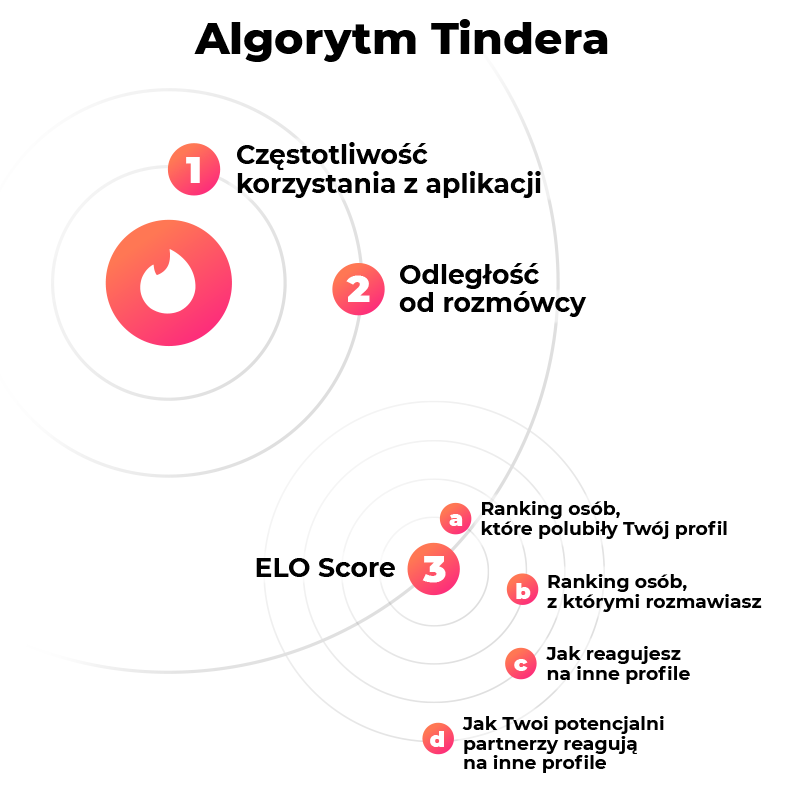
The foundation of our knowledge in this matter is the public information gathered on the app's official blog. We'll share our observations as a supplement. The most complex element of the algorithm is the so-called ELO score, which can also be called a popularity ranking. Its task is to rate users based on interactions in which they participate, either passively or actively. The components of the ELO score can be found in the graphic below. The total number of points earned indicates the user's attractiveness. Consequently, votes from higher-ranked users carry greater weight.
Interestingly, in the past, the ELO score was considered the primary factor. Over time, its importance has diminished. Consequently, the frequency of app use has become the most important factor. It's a form of bundled transaction. Users who spend a lot of time on the app benefit the creators, who can then reciprocate by increasing their opportunities. Furthermore, the algorithm takes into account the distance from the interlocutor. The closer the distance, the greater the chance of a meeting, and creators want to achieve the highest possible number of interactions.
It's also worth noting that the algorithm doesn't take into account hair color, skin tone, income, etc. Tinder strives to promote equality on many levels. This is evidenced by research showing that the number of interracial marriages increased as the dating app became more popular.

How to increase conversion?
- Spend as much time as possible on the app and be active. The algorithm rewards engaged users who send a lot of messages. Therefore, transferring the conversation to another messaging app could be detrimental, as Tinder will then be unused.
- Upload new photos. Professional photos that exude your enthusiasm and confidence are the best choice.
- Test different types of descriptions. If you're currently talking about your interests, opt for something more playful and engaging.
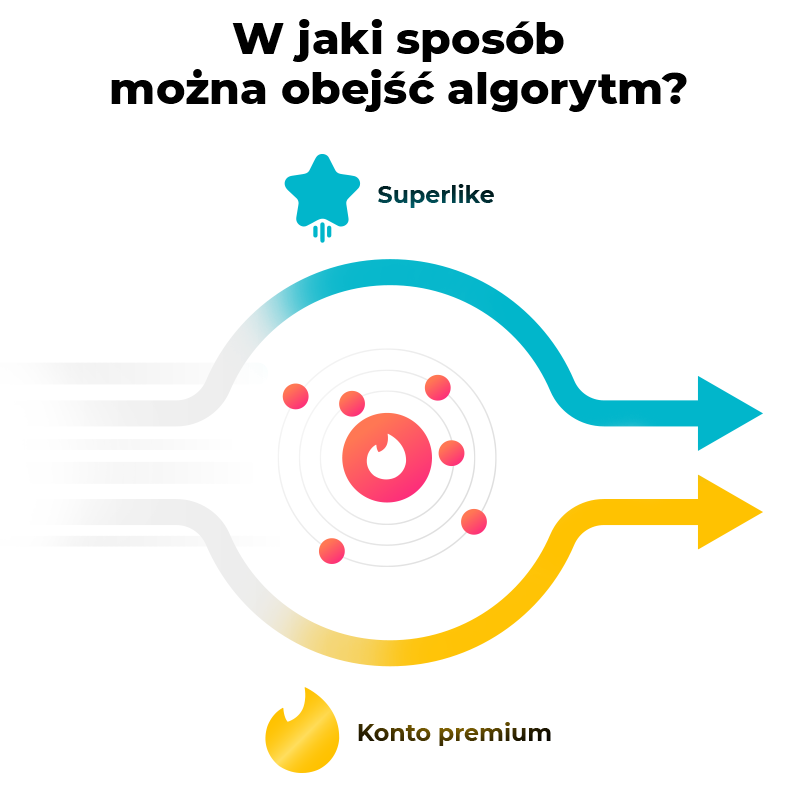
Another way to circumvent the algorithm is to use so-called super likes. They highlight the person you like the most on a given day. The user on the other end of the page then sees that you've super liked them. Free users can use this feature once a day.
Is it worth investing in a Premium account? (Tinder Plus, Tinder Gold)
Currently, the app's developers offer two packages that provide access to additional features. The range of options is as follows:
- Tinder Plus
- Unlimited number of likes (in the free version you can "swipe" a limited number of profiles),
- Possibility to undo the last selection,
- 5 superlikes per day,
- 1 boost per month (you are visible to all users in the area for 30 minutes),
- Passport feature (allows you to communicate with users anywhere in the world),
- No ads.
- Tinder Gold
- The complete set of features included in the Tinder Plus variant,
- The ability to check who liked your profile before you come across that person while browsing the database,
- New Top Picks every day (the algorithm suggests profiles that have the best chance of meeting your taste).
In addition to the above packages, you can also purchase individual "boosts," features that allow your profile to be displayed to all users in your area. Depending on the number of "boosts," prices range from 19 to 27,99 PLN. Okay, but is it worth it?
The answer to this question depends on your expectations for the app. If you're signing up out of curiosity or simply want to kill boredom, purchasing premium access would be a waste of money, at least at this stage. Find out if this is the right place for you and explore all the options. If your curiosity persists and your appetite grows even stronger, then reach for your payment card.
Many people, however, enter this world with clearly defined goals. Some are looking for a wife or husband. Others, on the contrary, tend to be unstable in their feelings and know they'll be spending a lot of time on the app. In both cases, the range of features available in the free version may prove insufficient. Many people can't imagine using the free version, even if it's limited by ads and limited features.
To purchase an extended package, go to the app settings and then click the desired package at the top. It's worth noting that the price varies depending on your age. Fees for those over 30 are double. The costs are as follows:
| Tinder Plus | Month | 6 miesięcy | 12 miesięcy |
| 25 years | 17,99 PLN | 64,99 PLN | 104,99 PLN |
| 35 years | 34,99 PLN | 139,99 PLN | 184,99 PLN |
| Tinder Gold | Month | 6 miesięcy | 12 miesięcy |
| 25 years | 59,99 PLN | 214,99 PLN | 339,99 PLN |
| 35 years | 122,99 PLN | 459,99 PLN | 599,99 PLN |
Is Tinder a good place for business activities?
Tinder is an unconventional tool for running marketing campaigns . Such an initiative would require target audience analysis and the development of a well-thought-out strategy. However, if you're looking to promote your business locally, there's no stopping you. The dating app can be successfully used to advertise various services, such as hairdressers, beauty salons, or restaurants. Restaurants might consider creating a special offer for app users, who often arrange to meet for lunch or coffee.
Tinder has also proven to be a valuable platform for social campaigns. Amnesty International Australia took advantage of this opportunity to raise awareness of the issue of forced marriages against women. The Polish company TBWA sought employees through the dating app, while an American animal rights organization sought new homes for shelter dogs.
Event promotion is also worth mentioning. Nergal used Tinder to inform women in Poznań that his concert was coming to their city. In other words, the app has significant potential for local advertising campaigns.
Verseo vs. Tinder myths – the app from the employees' perspective :)
You won't build lasting relationships here
Can single people meet their soul mates through anything other than Tinder? Many people answer yes. However, this doesn't change the fact that registering on Tinder is becoming a natural step after a breakup. You don't have to leave the house; you can add a few nice photos and a short description of yourself from your pajamas. Then you choose from hundreds of people who, like you, are looking for a partner. Ultimately, all that's left is to decide whether or not that person meets your expectations.
It's safe to say that Tinder is an app that meets the expectations and capabilities of today's fast-paced lifestyle. Often, there simply isn't enough time to go out partying or meet friends in the traditional way. As a result, many people speak positively about the app, adding that it was their only chance to meet their significant other.
The shallowing of interpersonal relationships and evaluation based on appearance
In this case, you can find arguments both supporting and refuting the above thesis. When you enter Tinder, you should be aware that each user could have created an account for different reasons. Among them, you'll find people looking for a "one-night stand," as well as bored people who simply want to pass the time and pretend to be someone they're not. Due to such easy access to the app, you can often encounter disrespect from the other side. First, you'll be judged based on your photo. Later, you might stumble upon a fake account and become part of someone's game. Also, be prepared for users who start a conversation by asking, "Do you like threesomes?" This isn't meant as a joke, but as a prelude to a serious proposal. Outside of the internet, you're unlikely to find such behavior. Establishing a relationship becomes very easy. Therefore, many people have no qualms about canceling meetings at the last minute or unsubscribing.
If Tinder is used by people who genuinely want to get to know the other person and respect each other's time, then, on the contrary, a relationship can quickly deepen. With some relationship experience and limited time for a social life, we have a chance to meet someone who will play it safe. In such a situation, we can openly reveal our expectations to the other person, share a difficult life situation, or mention our own shortcomings. This honest approach fosters healthy relationships.
The problem of judging based on appearance is directly related to the purpose for which a person creates a Tinder profile. Whether it's to meet someone for casual sex or to find lifelong love, physical attraction is essential. When meeting someone in a bar, library, or park, do we wonder what they do for a living, whether they have children, or are single? No, at first contact, we focus on appearance. Then we begin a conversation, which reveals personality traits.
The plague of fake profiles
Tinder is a social media app, so the presence of fake accounts shouldn't surprise anyone. Some profiles are created for testing purposes. Many people try to study the algorithm and repetitive behaviors. They also investigate which people are most likely to find a partner. Sometimes they document their activities on YouTube. Some Instagram users have multiple Tinder profiles to increase their chances of gaining new followers. Other fake accounts are created for fun. The scale of this phenomenon is quite large, but the problem itself isn't particularly serious. In most cases, you can quickly recognize the insincere intentions of the person you're talking to. However, if you fall for the trick but don't go too far in the conversation, you're in danger of nothing but wasted time.
Dangerous Strangers
Almost all of us were taught by our parents as children not to talk or go anywhere with strangers. The same rules applied to the internet and our first chats – for years, we were taught not to give strangers too much information about ourselves, especially our home address. However, it turns out that the age of mobile dating apps has erased all these warnings, and we're constantly meeting complete strangers. We think that just because we've exchanged a few or a dozen messages with someone, we're already friends, and our conversation partner is no longer anonymous. This often creates a false sense of security when meeting new people. Unfortunately, this lowered vigilance not only results in an increase in dating crimes but also exposes our psyche to many difficult experiences (seriously – if you suffer from low self-esteem or anxiety, it's best to give up on online conquests!).
So let's take a look at the main dangers that await us during our Tinder conquests:
- Fake identities – "You never know who's on the other end of the line," as a social campaign put it many years ago. Unfortunately, there's a lot of truth to this. While it's true that activating a Tinder account requires user verification via text message, you can provide any other information you want. This means you never fully know who you're actually dating, so if you need to (e.g., report your wallet stolen on a date), you might never find that person again.
- Engaged admirers – one in five Tinder users declares they are in a committed relationship (sometimes even married) and are looking for excitement on the site. If it suits both parties, there's no problem, but adventure seekers rarely openly admit their marital status. We can help. Facebook; it's worth checking what our new contact has published on his account (and whether these aren't photos with a happy group of children).
- Ghosting – a sudden disappearance without a word of explanation. This is when your perfect match suddenly stops replying or deletes you from their contact list. You don't know why or what happened – you can only guess. It turns out this phenomenon is very common, and many users find it incredibly upsetting – so before creating an account, consider how well you can handle rejection.
- Free psychotherapy – as is commonly known, access to therapists can be expensive and severely limited, which is why many people treat meeting a new acquaintance for dinner or drinks as an opportunity for free therapy. They flood the unsuspecting interlocutor with an emotional cesspool, treating them as a willing listener and demanding sympathetic agreement.
- MLM group members – you show up for a date, only to discover you're actually being recruited into one of the multi-level marketing groups. The person you're talking to has the appropriate forms with them and recites to you by heart the benefits of building personal sales structures for their miraculous supplements or cosmetics. You should quickly escape from such a meeting, because this business shark won't let up.
- Stalkers and perverts are among the worst threats posed by online dating. While unsolicited photos of someone's genitals can be easily ignored, the situation becomes more complicated once the meeting has taken place and we're followed and harassed with repeated calls. You never know when such obsessive fascination will turn into outbursts of aggression or a literal assault – and our authorities still treat stalking reports as "making things up."
- Theft and scams – what can happen when you invite strangers to your home, especially late at night? It turns out that the popularity of Tinder has also increased the number of home thefts; a dater might allegedly go to the bathroom, but instead of reaching it, they steal a few valuables, a wallet, a laptop, and disappear. Another issue is scamming people for free lunches, dinners, and movie nights. Some people have even become experts at disappearing at strategic moments during a date, when it's time to pay. You, too, may face the unpleasantness of sponsoring someone else's entertainment.
- Sexual violence – unfortunately, many people still believe that simply arranging a date with someone is tantamount to consenting to sexual intercourse. Because the psychological wounds of sexual violence take years (and sometimes never) to heal, consider meeting strangers in public places, at least until you get to know each other better.
As you can see, finding love or excitement in the world of dating apps isn't easy. Before taking the plunge, it's worth asking yourself if you can handle a large dose of unselective proposals, constant notifications on your phone, and frequent rejections. If you take other people's opinions too personally and spend long periods of time after a conversation analyzing what you could have said or done differently, this isn't the game for you. Some say we live in the instant age, and so are our relationships. If you don't see anything wrong with that, we invite you to try Tinder.
Random Users Who Will Waste Your Time
Tinderella Syndrome – people who create a Tinder account, but like Cinderella, they avoid meetings like they're going to a ball around midnight. For them, Tinder is just a way to kill boredom. In this case, instead of a slipper, all that's left is a bad taste in their mouth and the recurring question: "What am I doing wrong?" While creating an account doesn't guarantee that you'll meet anyone who swipe right on your profile, I know that some people take this app quite seriously, and if they're "lucky" enough to meet a few such people, their egos can suffer, and they'll think there's something wrong with them if a match ends after a few days of chatting.
The group of users who avoid meetings also includes those in committed relationships or marriages who simply need to feel like they were just starting out. In such a situation, they expect attention from others, and they begin to lack it in their daily lives. It's worth noting, however, that this isn't about cheating (although simply creating a Tinder account with a committed partner can be perceived as cheating by some). These individuals don't plan meetings because they often don't want to risk losing their anonymity. Faces are also typically hidden in photos.
Follower collectors are people who link to their Instagram in their Tinder profile and then try to gain new followers among users.
Attention seekers – they're conscious of their looks, boost their self-esteem with a large collection of matches, and crave compliments during conversations. This attitude translates into considerable popularity among users from the same location. In a conversation with a friend, you might hear, "I know her/him, I've texted her/him too."
Tinder and atavisms
The controversy surrounding Tinder stems from the fact that it primarily tests our self-image and who we really are.
Because yes, we want to be sophisticated, have diverse interests, express ourselves in the most flowery yet communicative way possible. We also want to smell good, look good, and be taken seriously, even though we have no obligations by which anyone could judge us.
On the other hand, we are animals. We need food, shelter, sex, and—since we are overstimulated—some form of escape.
We're simple, then, but our techniques for attracting partners, even unconscious ones, are complex. Tinder, however, favors speed. You have a moment to interest the opposite sex. If a conversation starts, you can't get bored, and so on.
Since it's fast, we have to condense all our self-images. This leads to bizarre descriptions that, like a lens, reveal how simple and similar we are – despite our best efforts to be different and present ourselves as broadly as possible. Instead of creating a neat summary, we often create caricatures.
What do we know thanks to Tinder?
Height
We all exaggerate our height. Men do it more often and on a larger scale. Tinder isn't immune. We naturally associate height with dominance, power, and as a key factor in achieving success. Taller people inspire greater confidence and seem more predictable. An innocent addition of a few centimeters might even go unnoticed, but it makes a difference at the selection stage. Especially if we're on the border between two height ranges. If a man is 177 cm, he'll easily enter 180 cm, instantly changing his perspective.
Women only exaggerate their height to a point. There are very few men who would feel comfortable with a taller partner.
Desirable features
Many anthropologists who deal with the development of societies in the so-called "Western culture" have noticed that there has been a revaluation of the desirable characteristics of a given gender.
In pre-war Warsaw, men in dating ads focused primarily on their financial status and generally orderly lifestyle. A good job, an apartment in a tenement building, and low or vague expectations for a partner were also emphasized, along with traits stereotypically attributed to men, such as strength, assertiveness, and leadership.
And indeed, these were the qualities – generally speaking – sought after by women.
Nowadays, however, women are increasingly economically independent, and statistically they are even better educated. Therefore, they are looking for partners, not stereotypical alpha males who will steer their lives in a direction known only to them. Research has shown that soft traits such as caring, warmth, a pleasant disposition, and predictability are increasingly valued in men.
However, the same research showed that men are only just beginning to adapt their ads to this “trend” and are reacting poorly to these changes.
At the same time, however, most men on Tinder declare their desire for a stable, long-term relationship. Subconsciously, they know that most women aren't looking for a one-night stand there. This hasn't changed much in hundreds of years. Why is this the case?
Parental investment theory explains everything . It assumes that the sex that invests more in raising offspring will statistically be more interested in stability. In humans, it's easy to determine who "risks" more. Nine months of pregnancy, the postpartum period, breastfeeding. A woman must choose her partner very carefully, ensuring that he is simply there and supportive. This once directly determined the survival of offspring, and that's how natural selection operated. Children who were cared for by both parents were more likely to survive. Traits and behaviors that supported gene transmission were passed on. Today, we navigate the same pattern. In fact, it's only been about 70 years since we began to suffer from widespread deprivation, hunger, or disease.
However, I realize that what I'm writing about may be increasingly irrelevant to the image of social behavior, as sex is increasingly being separated from the desire for children and generally being in a stable relationship. What matters is pleasure without major obligations.
However, this does not change the fact that navigating through atavisms makes it EASIER for us to enter into the desired interaction on Tinder.
Work
A well-paid job or the prospect of securing one in the future is still one of the main "ranking factors" for women. The stereotypical lawyer is slowly becoming a thing of the past, replaced by the IT guy who not only earns money but also lives off the computer. Generally, the better the perceived profession, the higher the "conversion." Men, on the other hand, pay absolutely no attention to what a Tinder user does.
It's becoming increasingly common to encounter "presidents" or "CEOs" who are, in fact, running their own businesses, but who create the illusion of Silicon Valley around them. After all, who wouldn't want an entrepreneur? :)))))))))
Photos
Photos are meant to attract attention and should be treated as such. Usually, we're simply in for a hard landing face-to-face. Tinder offers a whole range of things we might "like." From genes for blonde or red hair (which are recessive at our latitude and therefore sought after), to a bust or a defined jawline with a subtle stubble and a smile.
Expectations and reality
Tinder, for guys, is a "haha hookup app." For women, it's a place where—after filtering out the freaks, nerds, and losers—you can find a solid partner.
I think that's where the controversy surrounding this tool lies. It connects so many worlds and people we would never otherwise interact with. This ease is both its strength and its curse. Do I hold Tinder responsible for the shallowing of interpersonal relationships? No – it's always up to us. Tinder is just another layer of communication, and we shouldn't be afraid of it.
Tinder FAQs
Tinder is one of the world's most popular dating and social media apps. It relies on smartphone geolocation, allowing you to connect with people nearby.
The application is operated using a simple mechanism of swiping cards with other users’ profiles:
- Swiping right (or clicking the green heart) means you like it and want to connect.
- Swiping left (or clicking the red cross) means you reject and are not interested in that profile.
A "match" occurs when two people like each other's profiles (both swipe right). Only after such a pairing is created does the app unlock the ability to send private messages to each other.
Yes, Tinder's basic features (creating an account, browsing profiles, and chatting with matches) are completely free. However, the app does have daily like limits for free accounts.
Tinder offers paid plans (e.g., Tinder Plus, Tinder Gold, Tinder Platinum) that expand the app's capabilities. Some of the most popular premium features include:
- Unlimited likes,
- Possibility to undo the last (accidental) move,
- Visibility of the list of people who liked our profile before we rate them,
- Change your location (Passport), allowing you to search for matches anywhere in the world.
To create an account, all you need is a phone number or a Google, Facebook, or Apple ID link. For an effective profile, you should add several clear, high-quality photos and a short, engaging bio, which can be a great conversation starter. It's also worth connecting your account to Spotify or Instagram.
Summary
The above article covers the following topics:
- Tinder, a dating app, has been operating since 2012 and serves 50 million users. The ELO score algorithm evaluates user attractiveness and rewards frequent use of the app.
- Paid plans include Tinder Plus and Tinder Gold, which offer unlimited likes, super likes, boosts, and the Passport feature. Prices for users over 30 are twice those for younger users.