CTA, or Call to Action, is a marketing term that means "call to action." It's a communication element—usually a button, link, or short text message—intended to encourage the user to take a specific action. This could be purchasing a product, signing up for a newsletter, downloading an e-book, or filling out a contact form.
A call to action plays a crucial role in guiding a user through the conversion path. Even the most well-designed website or advertising campaign will be ineffective if the recipient isn't clearly informed about what to do next.
What is the function of CTA in marketing?
In simple terms, a CTA builds the bridge between interest and conversion. A user who lands on a website often needs a nudge to make a decision. A CTA delivers this nudge in a precise, visually striking, and linguistically clear manner.
A well-designed call to action often determines the effectiveness of a campaign. In online marketing, it's what "closes the sale," encouraging a user who has progressed through the entire marketing funnel to finally click, purchase, or register.
(The rest of the article can be found below the form)
How to create an effective CTA?
Designing an effective CTA requires a combination of three elements: content, design, and understanding your audience. The content should be clear, user-focused, and include an imperative verb, such as "Order now," "Download for free," or "Join today." This style energizes the message and commands attention.
The button's appearance is equally important. Its color, contrast, and position on the page are crucial. The CTA should be eye-catching but not overpower the overall composition. A/B testing often shows that changing a single word or even a shade can dramatically impact clicks.
Context should also be considered. The call to action must be consistent with the stage of the purchase journey. A different message will resonate with someone just learning about the brand, and a different one with someone ready to make a purchase.
Call to Action Examples
Call-to-action buttons are ubiquitous in the digital space. E-commerce uses CTAs like "Add to Cart" or "Buy Now," the service industry uses "Schedule a Consultation" or "Book an Appointment," and content marketing uses "Download an e-book" or "Subscribe to a newsletter."
The best CTAs share a common denominator: they are specific, tailored to the recipient's needs, and appear at the right moment. At the same time, they don't create pressure, but rather convey value. The user should feel that clicking is a natural next step, not a forced action.
Example of a CTA in a free quote form on verseo.pl:

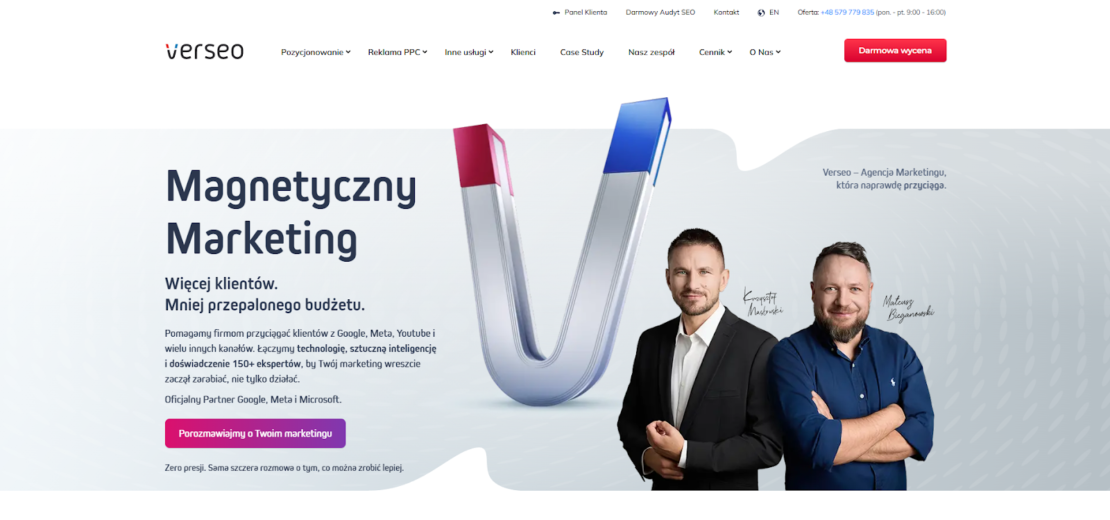
An example of a CTA on the verseo.pl homepage – more general. A user landing on the homepage is typically at a different stage of the conversion funnel than one requesting a quote for a specific service.

Where to place the CTA button?
The button's location on the page is just as important as its content. CTAs are most often placed above the scroll bar (i.e., in an area immediately visible on the screen) to avoid scrolling. It's also good practice to duplicate the CTA further down the page, after sections describing the offer, customer reviews, or the benefits of purchasing.
This is what the verseo.pl homepage looks like – the purple CTA button is located in a place that does not require scrolling, but low enough for the user to read the content of the marketing messages above the button.

Landing pages often follow the "one main action" principle—one main intention, a single CTA. Too many buttons distract and reduce the effectiveness of the message.
CTA and conversion
Ultimately, CTAs are the point where marketing meets sales. While they may seem like a minor design element, in practice, they directly impact conversions and campaign ROI. That's why it's worth constantly testing different variations—copy, color, positioning—and analyzing the data.
The effectiveness of a Call to Action can be measured by the CTR (Click Through Rate) indicator – i.e. the percentage of people who clicked the button in relation to the number of its views.
Every improvement that increases clicks translates into greater effectiveness of the entire marketing strategy. A CTA is a decision, a moment, and an emotion captured in a single click.
Frequently asked questions about CTAs in marketing
A CTA, or call-to-action, is a short, direct message addressed to the recipient, intended to persuade them to take a specific action. It typically takes the form of a clickable button, a link in text, or a graphic on a website, email, or advertisement.
A well-designed call to action is a key element of the customer journey. It acts as a virtual signpost – without it, a user might read an offer and then leave the page, unsure of their next step. An effective CTA eliminates this confusion, directly translating into higher conversion rates, lead generation, and increased sales.
The content depends on the campaign goal and the stage of the sales funnel. Some of the most popular and effective include: "Buy now," "Download a free e-book," "Subscribe to the newsletter," "Get a discount," and "Request a quote." Avoid slogans that are too general and don't promise a specific benefit (e.g., "Click here" or "More").
Above all, it must be highly visible. It should stand out from the rest of the website with a strong, contrasting background color. It's also important to maintain adequate white space around the button to ensure it's not obscured. The text message should be short, concise, and preferably phrased in the imperative mood or first-person singular (e.g., "I want a free quote").
The location should reflect the user's natural behavior. Best practices suggest placing CTAs, among other things, immediately after presenting the brand's main promise (so-called above the fold – visible immediately after the page loads, without the need to scroll), at the end of a substantive article as a logical step after reading, or in a fixed, floating menu that follows the reader's gaze.
The most effective method for optimizing calls to action is A/B testing. This involves creating two versions of the same button that differ in only one detail (e.g., button color or text). Analytical tools then measure the click-through rate (CTR) of both versions, allowing you to objectively, based on hard data, choose the variant that generates better business results.
Summary
The above article covers the following topics:
- CTA (Call to Action) is a key element of marketing communication that uses a short message or button to persuade the user to take a specific action.
- CTA is a key impulse that, through a clear message, turns the recipient's interest into a specific action, such as a purchase or registration.
- An effective CTA is created by combining a clear, beneficial message with an eye-catching design and matching the content to the customer's stage of the purchase journey.
- Effective CTA examples like “Buy Now” or “Download eBook” are specific and tailored messages that are a natural next step in the conversion path.
- It is best to place the CTA button above the scroll bar and repeat it after key sections of the page, remembering the rule of one main action to avoid distracting the user's attention.
- An effectively optimized CTA directly increases conversion rates and ROI, so it is crucial to constantly test its variants and analyze click-through rates (CTR).