Accelerated Mobile Pages – what is it?
At the end of the year, the world of SEO and online marketing was electrified by the news of MOBILE FIRST INDEXING (we wrote about it HERE ). All sorts of tools were launched to check various elements of our mobile sites. Industry-specific texts advising on how to improve mobile page views began to emerge from every corner of social media. There are many ways to prepare for Mobileggedon. One of them – apparently favored by Google – is AMP – ACCELERATED MOBILE PAGES.
What is AMP?
As the name suggests, these are accelerated mobile pages, or rather, a way of building them that significantly improves their speed. There are three important elements here – AMP HTML, AMP JS, and Google AMP Cache.
- AMP HTML is primarily comprised of standard HTML tags, enriched with elements specific to the technology being presented. They allow for the standardization and simplification of source code, adapting it to mobile devices. Using AMP tags eliminates the problem of graphics that are poorly suited to tablets or less popular phone sizes. It also limits the use of JavaScript code, preventing excessive load on the mobile site.
- AMP JS – one of the most important advantages of using this solution is asynchronous functionality. By using AMP, we can be sure that JS code that doesn't work correctly won't cause the entire page to crash, but only the corresponding fragment. Website owners who tested their site through Google tools, they have probably seen the red text there more than once – "remove broken Javascript code". Using AMP JS eliminates this problem.
- Google AMP Cache – thanks to the previously mentioned tags, Google is able to capture the content of the page and load it from the cache, thus shortening the path of the content to the user.
Information about the project and documentation can be found on the official website: https://www.ampproject.org/ and on the Google Chrome Developers channel, from which this video is taken: https://youtu.be/lBTCB7yLs8Y.
How to use AMP?
At https://www.ampproject.org/pl/docs/get_started/create, an easy tutorial will guide mobile beginners through the ins and outs of AMP and allow them to quickly implement the technology into their website. With cleanly designed pages, adding AMP tags shouldn't be a problem. However, if your page is full of "flowers"... it's probably time for a little code cleanup 😉
(The rest of the article can be found below the form)
WordPress users can use it without interfering with the code – AMP is already available in the plugin database ( https://wordpress.org/plugins/amp/ ) – unfortunately, for the time being, it mainly supports entry pages, but in the future it should also cover WP pages and archive content.
What do I need it for?
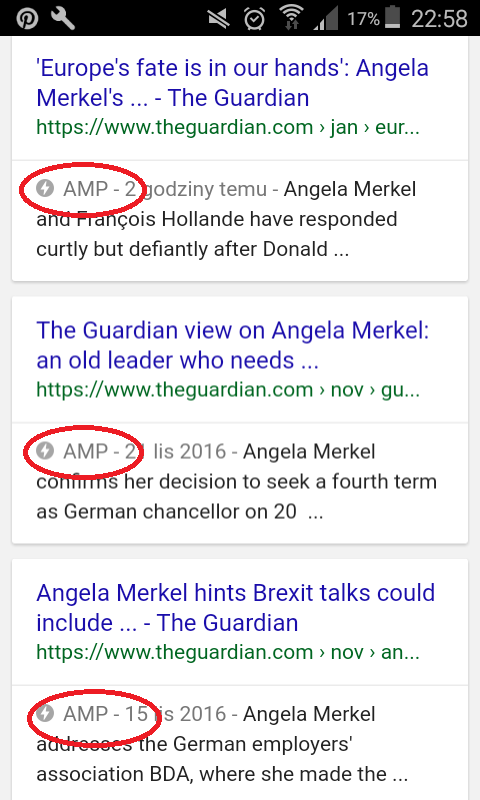
Accelarated Mobile Pages is an open-source project supported by Google, which claims to speed up websites by up to four times! The solution is already used by some of the world's largest media companies, including The Guardian, as well as Poland's Onet and Gazeta Wyborcza.

As I mentioned earlier, AMP can be a path to higher rankings in the SERPs . Faster page loading, meaning fewer bounces (and curses from disgruntled users), and a clean site full of good, readable content are what Google values. Furthermore, AMP-enabled pages can be highlighted by being featured in "Top Stories"—one of the newer additions to the search engine results pages.
The carousel can include articles from a given page, logos, and miniaturized images from the page. The goal is to help users receive the page's content as quickly as possible and without using bandwidth.
Of course, AMP is just one way to overcome the challenge of mobile responsiveness (or lack thereof) on our websites. Many website owners will undoubtedly stick with basic, responsive solutions, while others will decide to build a mobile version of their website from scratch. Regardless of the method, it's worth considering the issue as soon as possible to avoid penalties for not adapting websites to the growing number of mobile users and Mobile First Indexing, which can reshuffle search results at any time.
Summary
The above article covers the following topics:
- Accelerated Mobile Pages as a solution supporting the optimization of mobile websites,
- the mechanism of AMP operation and its impact on user experience and SEO,
- implementation of AMP technology and available tools to facilitate its implementation,
- the impact of fast mobile pages on SERP positioning and user engagement.