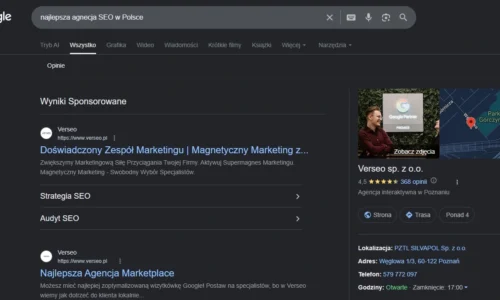
Internet search engines are similar to library book catalogs. The mechanism is similar, but the factors determining ranking are significantly more complex. The scale is also different – after all, we're not talking about a few hundred titles to sort through, but rather... billions of websites from around the world. Search engine optimization is therefore – like library science – an entire field of study!
Unlike traditional catalogs, internet search engines are capable of cataloging information in greater detail. Using web crawlers—programs that absorb information about websites—they can gather data on the structure and content of a page. Thanks to the knowledge gathered by the bot, the search engine can tailor its responses to its users' queries. A library equivalent of a search engine would be an employee manually (using knowledge and experience) searching for books for the reader.
What is website positioning in search engines?
Search engine optimization aims to show search engine crawlers that our website best answers a given question while also being user-friendly. The SEO process primarily involves adapting a website to the rules set by search engines—the algorithm that determines the order of results in the SERPs.
What influences ranking? Initially, keywords and the number of links leading to a page were important. With the growing database of websites and changing user expectations, the number of factors influencing search engine positioning has increased. Google estimates that today, search engine robots analyze approximately 200 different signals , based on which they determine a website's ranking. To limit the possibility of manipulating results, some of these factors are shrouded in secrecy, and Google employees are rather evasive about them. Information on what helps websites climb up search results is therefore obtained not only from the search engine's official guides but also from external tools and tests, the results of which SEO specialists share in industry media and forums. The experience of a specialist who has already experienced more than one ranking drop also plays a significant role here!
(The rest of the article can be found below the form)
O search engine positioning is primarily discussed in the context of Google. This search engine is the most frequently chosen way to search for information. However, services of this type are provided by, among others:
Yandex – a Russian search engine with significant influence in Russia and its neighbors. In this region, Yandex holds a 50% market share. It operates on a similar principle to Google – website indexing can be controlled through the equivalent of Google Search Console, here called Yandex. Webmaster. The search engine also has its own set of rules for creating websites. It derives its revenue primarily from advertising.

- Baidu – a browser created for the needs of Chinese users.

- Bing – a search engine created by Microsoft. It is much more popular in the US than in Poland, for example. Its market share in the US is approximately 30%,

- Yahoo – another search engine whose importance is primarily felt overseas. It commands 10% of the market, placing it third in the ranking of the most popular search engines in the United States.

In addition, there are also Ask, DuckDuckGo and AOL on the market, but the number of searches through these services is a small percentage of the total.
Search engine positioning and the state of your business
Statistics show that the average person performs around 3-4 searches a day, and according to another source, approximately 93% of online experiences begin in a search engine. Both pieces of information are valuable from a business perspective and can only lead to one conclusion: search engines are the place where customers need to be found.
Business in 2020 doesn't exist without the internet and Google. Search engines are the primary source of knowledge for the average internet user – most of us search for information for personal use, some also for work and business. If you want to open up to new customers and increase your revenue, it's worth playing with Google and trying to adapt to the rules imposed by the search engine.
Skillful use of search engines allows you to expand the advertising space in which your company can appear. A properly prepared and positioned website can not only inform about the services your company offers but also support the process of establishing an expert position in a given industry and increase brand awareness. Search engine optimization works in conjunction with other marketing activities and brings results not only during the campaign itself, but also when a potential client needs it.
First Steps in the World of Google – SEO for Beginners
Getting listed in search engines isn't difficult, and Google is happy to share knowledge about taking your first steps in their environment. Guidelines and tips can be found not only on support pages but also in courses like Internet Revolutions . The materials, prepared by Google and its partners, provide an accessible introduction to basic internet marketing knowledge—SEM, SEO, and tools provided by the search engine, such as Analytics.
General knowledge of the search engine environment helps you understand how search works, why it's important to create a map, and how ad prices are determined in search results. Understanding the terms used in Google and the search engine's capabilities helps you establish marketing goals. Even basic knowledge of search engines also facilitates collaboration with an SEO specialist or AdWords specialist.
Where to begin? First and foremost, build a modern, secure, and fast website. The size of the website and the technologies it uses should be tailored to the industry and the website's goals. And then...
1. Invite the robots – By making your website accessible to web crawlers, you consent to its appearance in search engines. The crawler analyzes the website's structure, content, and incoming links, allowing it to appear in search results.
2. Learn how you're perceived – data collected by web crawlers can be monitored on the search engine's website – in Google's case, this is Google Search Console. This is where you'll find statistics on your website's indexing, search activity, and alerts on errors or issues detected by other tools. Monitoring your page's status in the Google index allows you to quickly respond to issues in the event of a data breach or a domain traffic stoppage.
3. Focus on the content and user-friendliness of your website – absolutely. Website content is crucial not only for achieving high search engine rankings, but also for the end user – the potential customer. They are the ones who asked the search engine a question and are looking for the best answer. Preparing content that introduces them to the world of services offered and clearly explains all the complexities of the industry usually generates a very positive response from customers and search engine crawlers. It also helps build a positive company image and increase brand awareness.
Positioning on steroids
So much for SEO for beginners. Search engine optimization is a process that requires time, knowledge, and experience. While for small, local, and one-person businesses, working independently can be effective, expanding your reach and achieving more effective results would require adding another day to your schedule. Would you rather set aside some time for relaxation? Seek professional help from a Verseo specialist who will select the right methods and actions to increase your website's visibility, and consequently, traffic and sales!
Knowing the intricacies of the Google search engine can save you a lot of time and money – years of experience allow you to develop a strategy tailored to the type of business you run and use methods that are effective in the fight for better positions in search results.
Positioning a website or online store in virtually any search engine begins with selecting the right set of keywords – phrases that lead users to the appropriate page of the website. Keyword phrases can be divided into:
- short tail – phrases consisting of one or two words. They are characterized by high search volume and high competition;
- long tail – phrases consisting of more keywords, with fewer searches and less competition.
Positioning for "short-tail" keywords looks attractive at first glance – after all, every shoe store would like to rank first for the search query "shoes." These keywords are typically occupied by large websites with the financial resources to pursue extensive efforts to achieve top rankings. Interestingly, phrases like "shoes" are not as effective as positioning for "long-tail" keywords, which more often lead to the purchase of the appropriate model. Why is this? A specific query indicates a desire to learn about answers with similar characteristics, for example, "children's pink sports shoes, size 26." Search results direct users to subpages containing the products they are looking for. Customers save time, and if they find a shoe model they like, they are likely to make a purchase.
When choosing keywords, it's worth considering words from both groups. It's also worth remembering that during the SEO process for the phrases we choose, the website inadvertently begins to rank in search engines for other phrases as well. This involves a whole set of activities, the main goal of which is to improve the overall website's performance. Search engine optimization, therefore, has a much broader impact than you might initially imagine.
On Page – Google Metro page
On-Page activities are precisely the aforementioned "adaptation to Google's rules of the game." Website optimization has a technical dimension, which includes:
- improving page rendering speed,
- control of website display and indexing on all devices,
- selecting appropriate titles and descriptions for subpages,
- adapting headlines to the art requirements and Google guidelines,
- customization of friendly links,
- selection and implementation of structured data…
…and so on. The strategy and set of optimization activities are selected individually, according to the work required for a given website.
On-page activities also include content creation and optimization . During this process, the SEO specialist identifies areas that should be supplemented with additional content or optimized for keywords with the greatest potential.
Off Page – all roads lead to your website!
Off-page activities are all about gaining links pointing to your domain. Sounds easy? In the old days, yes! Today, however, not all links are created equal. Here, too, you need a strategy that allows you to collect links of various types and from various sources.
Off-Page activities include, for example, creating sponsored posts, exchanging links with contractors, adding services and companies to directories, and obtaining reviews and opinions. Off-Page activities are also indirectly linked to activity in social media – a well-managed Facebook profile is an excellent support for SEO and another source of traffic.
Website positioning – be first in search engines!
In the first paragraph, I mentioned what connects a library with an internet search engine; now let me highlight the differences between them. Just one word will do. "Changes." The order of library drawers isn't constantly changing and evolving; the Google index and its counterparts in other search engines are.
The search engine algorithm is constantly being refined, and Google is changing its approach and placing a stronger emphasis on various factors. A few years ago, the main focus was on "mobilegeddon" and Mobile First Indexing; today, UX issues are receiving significant attention. Various minor and major changes are also being monitored on an ongoing basis, including by tools like MozCast, which provides... SEO weather:

Due to these changes, trends in user behavior, and other factors, website positioning in search engines should be treated as a process. Once optimized, it will often not stand the test of time—especially during peak periods. To achieve high rankings and increase traffic, it's essential to stay on top of your game, monitor results, and modify your strategy as needed.
Is it worth it? Statistics say YES!
Summary
The above article covers the following topics:
- the specific operation of internet search engines,
- why without an online presence a company loses sales opportunities,
- basic SEO activities for beginners,
- transition from SEO basics to a professional strategy based on experience, selection of methods and specialist work,
- maintaining a high position through ongoing analysis of results and modification of activities.