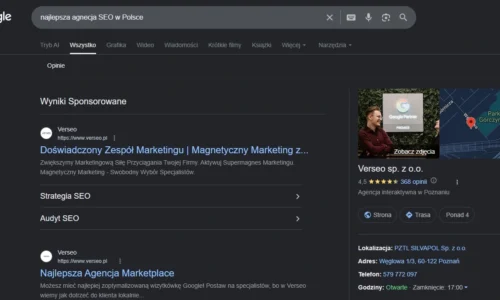
Search results – paid, free, local shopping, hotels, flights… what you see in Google search.
The search results displayed in Google vary significantly. They all share a common function: they serve to facilitate access to the information we seek, which is available online. However, it's worth noting that specific result groups are associated with different types of services. This determines their appearance, character, and accessibility during advertising campaigns. What types of results will we encounter in the search engine?
Text ads in the search network – belonging to the Google Ads family (until recently Google AdWords)
These are paid results – meaning that if we want to appear in the search engine space reserved for Google AdWords results, we must run an advertising campaign. That's why Google AdWords ads are sometimes referred to as sponsored links.

This type of results appears above and possibly below (if there are enough entities willing to advertise for a given keyword entered into the search engine) the organic search results. Ads are visible not only on the first page of the search engine. In the past, ads also appeared on the right side of the search results (until early 2016). Currently, Google AdWords ads are not highlighted with a colored background; they are only identified by a green "ad." For clarity, it's worth mentioning that Google regularly experiments with the display of AdWords ads, but they always stand out from other search results and, to the trained eye, are distinguishable from organic results.
Google AdWords text ads can occupy varying amounts of space in the search engine. This largely depends on the skills of the certified specialist managing the campaign, who can configure it to take up more space and, logically, be more noticeable/highlighted. In this case, we're talking about an expanded Google AdWords ad.
(The rest of the article can be found below the form)
Organic results in a search engine are free results.
This portion of the results takes up significant space in the search engine. Traditionally, a single page of search results is considered to contain 10 records. Hence, it's common to speak of, for example, the top 10 results. In practice, there may be fewer than 10 results per page. This is rare, and the decision to display results in a particular way in the search engine is made arbitrarily by Google.
Appearance in organic search results doesn't depend on whether we're running an advertising campaign or not. Simply put, any website that meets Google's acceptable standards and has no indexing issues should appear in organic results.
Common situations that prevent a page from being included in the Google index are: the page is excluded from indexing – this is visible in the robots.txt or meta robots file, or the page has been penalized by being removed from search results.
Organic results are the domain of SEO specialists . While indexing a website—placing it in the pool of results that Google will display after entering a relevant query into the search engine—does not involve additional costs (though it may require appropriate expertise), bringing a website to the top of the search engine—the most visible search results—may require the support and work of an SEO specialist.
The highest rankings in Google are achieved by websites that meet the Google algorithm's guidelines for the ideal website. This takes into account factors such as links, domain age and history, subpage addresses, the level of development, header optimization, and content. Interestingly, the Google algorithm considers over 200 factors when determining website rankings, which translates into search engine results. This algorithm is regularly updated, meaning some factors gain in importance, while others lose importance. The role of a SEO specialist is, of course, to adapt their work to the changing conditions dictated by Google.
A single organic result consists of a title, description, and a link to the homepage or subpage. Google may, as a reward, expand it to include links to subpages within a given site. However, the SEO specialist has no control over this, unlike a Google AdWords specialist with expanded sponsored links. Naturally, such an expanded organic result is highly desirable because it attracts more attention.
Google Hotel Ads, i.e. results visible in the search engine after entering keywords related to the hotel industry
Google Hotel Ads was previously known as Google Hotel Finder. This tool is integrated with the Google browser. Google Hotel Ads ads appear among organic search results , on Google Maps and Business Cards, and on mobile devices. Google Hotel Ads are considered paid search results – they appear in the search engine as a result of running a relevant advertising campaign.
A Google Hotel Ads result occupies a significant amount of space in the search engine, is highly visible, and provides key information in a convenient and concise format. It's safe to say that Google Hotel Ads is a way to quickly present a hotel's offerings. Potential customers will see not only contact information and hotel class, but also the price and room reservation options, customer reviews and ratings, photos, a map with directions, and even a Google Street View view.
Google Shopping is a service related to the activities of online stores
It capitalizes on the popularity of price comparison sites. Price information is a key factor in many customers' purchasing decisions. A well-displayed and attractive price is often the key to success. Google Shopping results appear above the organic results, in a prominent and eye-catching spot. They focus on presenting a photo of the product being searched for, along with its name, a link to the online store, and the price. This approach presents the offer in a highly visible place in the Google search engine, both on desktop and mobile devices.
Just like Google AdWords or Google Hotel Ads, the results visible in the space reserved for Google Shopping only appear after you start a paid advertising campaign.
Local results, i.e. Google My Business and map results.
In this case, we're dealing with two search engine spaces reserved for local businesses . Google My Business is a comprehensive listing for a given business, including basic address and contact information, photos, opening hours, customer reviews, and more. Creating and publishing a listing is free. It's located on the right side of the page, next to Google AdWords and organic results.

Google Maps also features pins with the locations of selected local businesses within a given industry. This map includes mini business cards containing basic information about the industry, address, contact details, opening hours, and distance to the company's headquarters. There's also the option to plot directions – a useful feature in the mobile version. The aforementioned map with business labels is placed at the very top of the search engine, in a highly visible location. This is also a free option, although not every business is listed on the map and marked with a pin. Companies with a higher number of reviews, for example, have a greater chance of being featured on the map.
Google Flights is another type of result posted in the search engine space
For clarity, it's important to note that these are paid results, meaning they result from an advertising campaign . They are, in fact, described as sponsored. You can find them by entering search terms related to flight searches. Google Flights results occupy the space below sponsored links and above organic results. They visually stand out from the rest. They combine the features of a flight search engine and a price comparison tool.
Summary
The search results visible in search engines differ significantly. The first division is between organic and sponsored. Organic search results primarily include organic results and results related to Google My Business and Google Maps. Appearing in search results in the space reserved for Google AdWords, Google Shopping , Google Hotel Ads, or Google Flights requires running and paying for an advertising campaign.
A line of demarcation can be drawn between "universal" results and those specifically related to a specific industry. Organic results or Google AdWords will appear in the context of any industry and type of activity (in the case of Google AdWords , provided that someone is willing to pay for the advertising and the industry, service, or product in question is not on Google's prohibited index). Google My Business, on the other hand, is a service dedicated to local entrepreneurs, Google Shopping to online stores, and Google Hotel Ads or Google Flights to the travel industry. It's important to be aware that this specialization means that not every search engine space may be available to your company.
It's worth keeping your finger on the pulse. Google is systematically expanding the range of services it provides, modifying the way search results are displayed, and creating solutions dedicated to popular industries. This translates into new advertising spaces within the Google search engine and the digital marketing landscape in general.
Summary
The above article covers the following topics:
- the possibility of using different types of search results in advertising activities,
- how Google Ads text ads are displayed,
- factors determining the visibility of a website in organic results,
- Google Hotel Ads paid advertising format for the hotel industry,
- how Google presents products and prices in search results,
- the functioning of local search results and the importance of Google My Business listings for the visibility of businesses,
- using Google Flights to search and compare flight connections.