There are countless ways to increase conversions in e-commerce. Your online store has probably undergone a facelift to its ordering process or introduced new modules, such as a recommendation system or abandoned cart recovery.
You can also increase your sales results thanks to product configurators – this is a response to the strong personalization trend.
Do you have a mug at home with a personal message from a friend or a calendar with family photos? Can you imagine searching for a new car without configuring it on the manufacturer's website, even if only to check the options or the price of the top-of-the-line version?
Exactly! In many industries, configurators are already standard, while others are just beginning to emerge. And that's a good thing, because they can benefit both parties – customers and manufacturers themselves.
(The rest of the article can be found below the form)
Product personalization is money
The relationship between personalization and money is best illustrated by these 3 simple equations:
MONEY = TIME
TIME = AUTOMATION
AUTOMATION = PERSONALIZATION
The most valuable currency today, both in life and in business, is time. We convert time into money and vice versa.
Every opportunity to save time is a benefit to your company. One way to achieve time savings is to automate processes within your company.
Automation in e-commerce encompasses a diverse set of practices, from production itself, through shipping and service. One possibility is also the personalization of product offerings and sales, and this leads us to product configurators that provide both.
Consider this – too many options to choose from in an online store creates confusion for customers and wastes time browsing entire product categories and reading through all the descriptions. Nobody likes wasting time, and for many people, shopping itself is stressful. This can lead to lower conversion rates.
What if you could replace the difficult task of choosing from among numerous options with a customized product configuration? Perhaps it's worth having a tool in your business that will match order items for your customers, ensure accurate calculations, and even inform you about product stock levels?
What is a product configurator?
The configurator is an e-commerce tool that helps sell non-standard products, i.e. those that the manufacturer prepares to order for a specific customer.
It may be a personalized product, such as engraved jewelry or a printed hat, or a product consisting of many elements, such as a piece of furniture.
There are many benefits that configurators provide, but from the entrepreneur's point of view, two are particularly important - savings and earning, and here we come back to the three equations above.
How do product configurators automate sales?
Sales automation through personalization is based on three pillars. If you focus on just one, the results won't be significant, but if you approach the issue holistically, you'll quickly experience increased productivity and higher conversions.
The first pillar – communication automation
It takes place both in the pre-purchase phase and during the order process. Its purpose is to expedite the exchange of information and lead the customer to a purchase, without tiring them or you as the seller along the way. What are the benefits of communication automation?
- 24-hour availability – The customer has access to the configurator and the entire online store without interruption – 24 hours a day, 7 days a week.
- Help when ordering specialized goods, For example, in construction, the configurator automatically identifies the required components, asks for their dimensions, and suggests what else is necessary to place a given order. In the case of technical or construction industries, the configurator replaces a qualified advisor, assisting the customer during the purchase process.
- Less human error This benefit is particularly evident in B2B businesses, such as the construction or furniture industries, where products consist of many components and orders are placed regularly by customers. Until now, sales automation was unheard of in these businesses, with salespeople taking orders. And as is often the case, the human factor played a role, leading to a number of very costly errors. Implementing configurators in such companies saves a significant amount of money because the configurator "asks" customers for all the information needed to complete the order. This eliminates misunderstandings, incorrect measurements, or mistakes. The human factor also plays a role in B2C online stores – configuration eliminates lengthy email exchanges between the customer and customer service, as well as between the customer service department and, for example, a graphic designer. The configurator allows customers to "click" the order manually.
- Excluding nmismatched elements – Ordering a product that consists of multiple components isn't easy. You have to remember to add them all to your cart and make sure they're compatible. The configurator does this for you, preventing you from ordering incompatible components. No more disappointment and replacement costs.
- Real-time visualization of the final product – The configurator continuously shows how the product changes as new parameters are added. The customer knows exactly what they're ordering and what the final product will look like.
The second pillar – offer and order automation
Automating quotes and orders allows us to move beyond the "we've always done it manually and it worked" mode of operation. People used to travel exclusively on foot and get by. And while we know the benefits of walking, cars make our daily lives much easier.
Such examples could be multiplied, but the conclusion is simple: it's worth using technology that improves life and work. How do configurators accelerate business operations?
- Wholesale updating the offer (photos, descriptions, parameters, price lists) – Anyone who has ever had to manually update a selection of thousands of products knows what that entails. It's a waste of time to spend on work that can be done by an algorithm.
- Caring about availability – In large manufacturing companies, it's impossible to track inventory levels of all products without technology. Configurators communicate with the warehouse in real time and update the availability of components and goods. This ensures that both the seller and the customer ensure that only available products are displayed, and unavailable ones disappear from the website.
- Product price calculation – configurators continuously calculate individual product prices based on component prices or more complex algorithms (e.g., volume, length, and weight calculations). In B2B, calculations can also be made based on individual price lists per customer.
The third pillar – production and delivery automation
For the seller, this pillar is just as important as the previous two, but for the customer, it's the most visible part. Therefore, ensure that the customer's interaction with your store is pleasant, convenient, and responsive to their needs.
On the configurator side, automation means completing the elements needed to fulfill the order placed by the customer, which are:
- Configuration components and their location in the warehouse – especially important for large manufacturing companies, e.g. furniture or construction companies.
- Generating previews/vectors and files e.g. PDF for use in production – an incredibly useful, yet less obvious, functionality. Configurators allow you to generate and then send a product specification file to the production department immediately after placing an order. This significantly speeds up the entire process.
- Courier service and delivery cost optimization – Configurators also allow for optimized shipping costs for both customers and sellers. This is especially true for stores selling large or oversized products, which are difficult and therefore expensive to transport.
An example from the furniture industry – a 5 m long strip:
- The base strip is 5 m long and does not fit in a standard courier vehicle.
- The configurator forces cutting into two parts (one can be max. 2600 mm).
- Savings in time and delivery costs for the customer and the manufacturer.
In which industries is it worth personalizing products?
The number of businesses that have decided to implement product configurators into their e-commerce is growing. Typically, these investments are made by retail stores (B2C) that hear and respond to their customers' needs.
More and more B2B businesses are beginning to recognize both the demand for product personalization and the availability of technology.
Product configurators particularly support industries that produce goods to order, in accordance with customer requirements, tastes or needs, e.g.:
- car,
- home & decor (e.g. blinds and shutters),
- food (e.g. chocolate, muesli),
- digital printing, gadgets,
- fashion (e.g. clothing, jewelry, watches, fashion accessories – handbags, phone cases),
- construction (e.g. garage gates and carports, modular houses, windows and doors),
- furniture – furniture and interior design elements,
- photovoltaic.
Examples of earning/saving with e-commerce personalization
Fashion – shoes
Klient
They create a unique shoe design they can identify with. The creation process itself generates positive emotions – the client becomes the designer. They see how the shoes change as they add new parameters. The WOW effect is guaranteed 😉
Manufacturer
By implementing a configurator into their e-commerce platform, the manufacturer can communicate the uniqueness of their offering to customers (after all, not every footwear brand boasts the option of ordering shoes according to the customer's design), thus enabling them to increase prices. Customers are willing to pay more for the excitement associated with the brand and a unique product.
source: https://www.nike.com/pl/u/custom-nike-metcon-7-by-you-10001101/6492373061#Builder
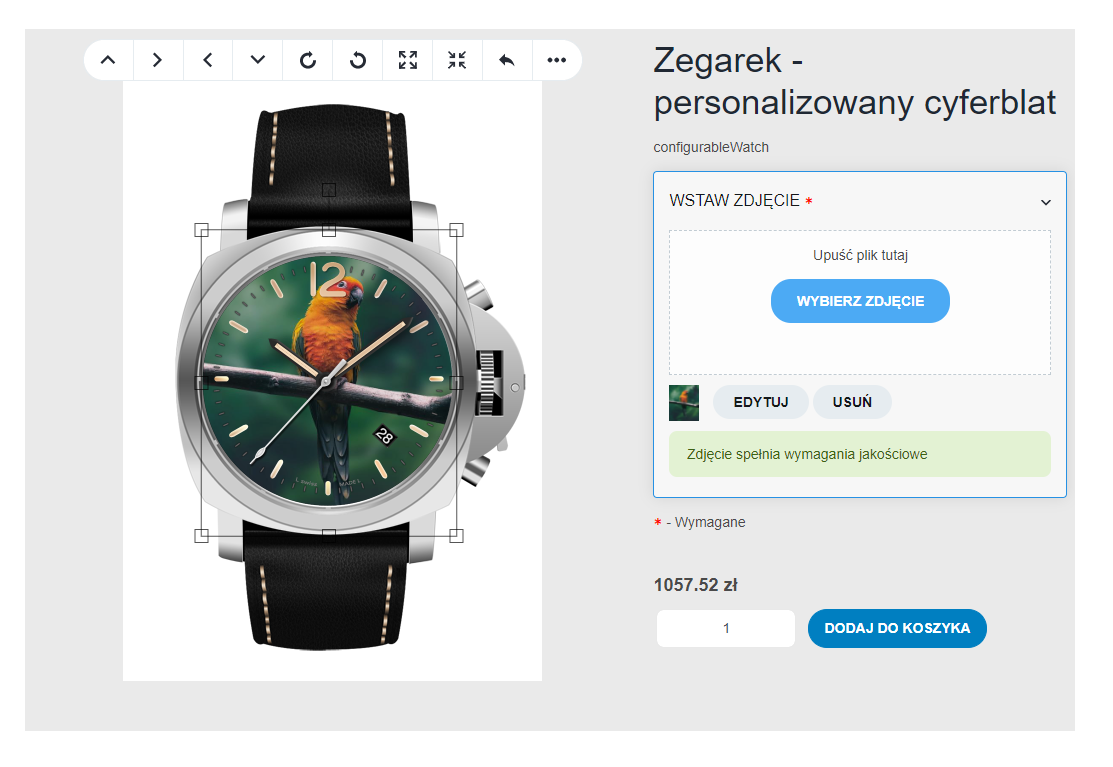
Fashion – watch
Klient
She expresses her individuality and designs her own unique watch. Customers love personalized fashion accessories. It's one way to express one's style and personality, and the higher price tag is often no barrier to purchase.
Manufacturer
There's no need to hire a graphic designer to visualize the client's idea. Thanks to the configurator, the client visualizes their design themselves and then places the order. No unnecessary email exchanges, quickly, and within production capabilities.
source: https://fifny.com/konfiguratory/zegarek-personalizowany-cyferblat
Gifts - Chocolate Telegram
Klient
The configurator manages the availability and stock of letters. Customers can see which letters they can use to create their chocolate message, preventing customers from placing an order for an item that's out of stock.
Additionally, the configurator visualizes in real time what the chocolate telegram looks like after each change.
Manufacturer
The configurator provides a summary of all the elements of the placed order at current prices. The configurator also allows you to "boost" sales with additional options, such as:
- offers customers the option to personalize the packaging by adding their own photo,
- suggests telegram content for selected occasions, which can be ordered immediately or uploaded and modified - for many buyers, such predefined content makes placing an order much easier and faster.
source: https://chocolissimo.pl/do/choco/chocotelegramConfigurator
Printing, printing, advertising gadgets
Klient
They evaluate the final product using a real-time visualization and make an informed purchase. Using the configurator eliminates unnecessary disappointment for the customer after opening the package ("I didn't know it would look like this...") 😉
Configurator
Automatically generates PDF files and sends them to the printer for printing. Every minute saved in production is your profit.
source: https://fifny.com/konfiguratory/konfigurator-wizytowki
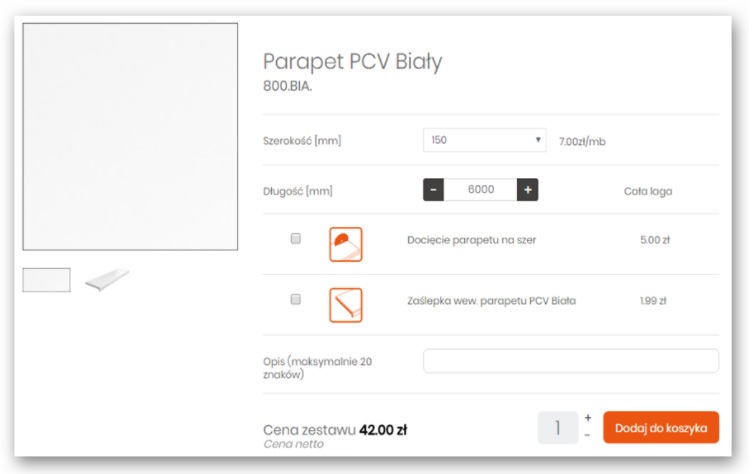
Construction – windows, window sills
Klient
It defines the window/window sill installation parameters, and the configurator asks for everything necessary to complete the order. In the construction industry, customers place orders regularly, which makes them even more appreciative of automation and the time it saves them. For you, as a manufacturer, this means more loyal and, importantly, satisfied customers.
Configurator
It prepares a set of all compatible components needed for window/window sill installation, eliminating errors that are very costly when using materials like wood or glass. Furthermore, the configurator simplifies waste management (of which there is no shortage in technical industries), which also leads to savings. Automation in B2B sales also reduces the workload for salespeople, allowing them to devote their time to other responsibilities, such as building customer relationships.
source: https://fifny.com/konfiguratory/konfigurator-okna
source: https://fifny.com/konfiguratory/konfigurator-okna
Would you like to earn more through personalization?
The answer is obvious – everyone wants to earn more, and everyone who sells wants to grow their sales. So, to conclude, I'm proposing a short test that will help you assess whether product configurators will work for your company:
- Have customers ever asked about modifying your products? Perhaps they wanted to slightly change their dimensions or add a specific element?
- Or perhaps you've always made products to order, but accept orders by phone or email, wasting a lot of time coordinating details? Are errors and customer dissatisfaction occurring?
If you answered yes to any of the above questions, it is a clear signal that either your customers expect personalized products or your business requires automation through configurators.
Summary
The above article covers the following topics:
- Personalization, through automation, saves time for customers and companies, which directly increases sales and conversions.
- The Product Configurator is an e-commerce tool that allows customers to personalize and order custom-made products.
- Communication automation speeds up and simplifies the purchasing process, reducing errors, replacing the advisor and guiding the customer to purchase 24/7.
- Offer and order automation streamlines business operations through automatic updates, availability control, and precise price calculations.
- Automating production and delivery speeds up order fulfillment, optimizes warehouse and transportation, and improves customer comfort.
- Product personalization is particularly useful in industries that produce custom-made goods, such as fashion, construction, furniture, food, automotive, printing, and gadgets.
- If customers want to modify your products or order processing is time-consuming and error-prone, product configurators can increase your profits.