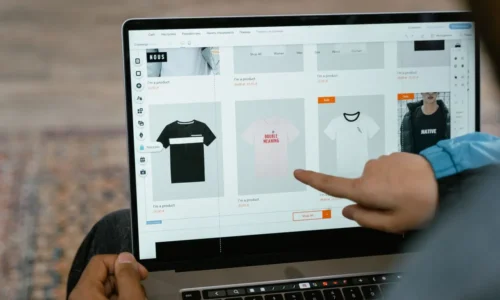
These days, owning an online store isn't a major challenge. Not so long ago, online sales were shrouded in programming knowledge, clunky support tools, and required significant investment. Today, however, virtually anyone can create their own online store for just a few thousand zlotys and reach an unlimited number of customers with their small offerings. And this is where the real challenge comes in: online store marketing.
At Verseo, we support over 500 online stores, so there's no time to be coy about modesty. We simply know what works in a given industry and at a given scale. Google Analytics doesn't lie. Therefore, in this post, we'll focus on what's worth investing in when marketing an online store.
Online store marketing – what budget?
What's the ideal budget for launching effective online store marketing? I probably won't surprise you if I give you the Solomon-esque answer that... it depends.
We have clients who have invested tens, even hundreds, of thousands of zlotys in their online stores, but they forgot to inform customers about this, and initially had 3,4 zlotys for advertising. A deeper investment in the website itself makes sense if it includes, for example, providing engaging content from the outset or SEO optimization. However, if the technology itself, graphic design, and programming are costly, and we haven't secured marketing funds, then we may struggle to generate sufficient traffic for even the most beautiful store.
(The rest of the article can be found below the form)
Many clients approach online advertising with skepticism because they simply don't have enough knowledge of how different advertising systems work. The key points that reinforce the idea that it's a real investment, not just an expense, are as follows:
– by advertising your online store, we can precisely measure the effectiveness of each campaign or advertising channel,
– you can choose any time to broadcast your ads, reacting to market changes or specific events,
– you can flexibly manage your budget and, seeing that it “works”, gradually allocate more funds for advertising,
– you can and even should test new solutions that have sales potential,
– you can more easily determine how much it costs to acquire a customer and optimize your campaign accordingly. This is the most interesting piece of the puzzle – many entrepreneurs who approach Verseo don't know how much they can actually spend to acquire a single customer. For some products, it can be hundreds of zlotys, while for others, it's pennies.
Considering the above, one conclusion immediately emerges. Too small a budget at the beginning will make the test unreliable and you might be discouraged from using a given advertising tool. Let's assume you have an online store with a strong competitor that spends 10 PLN on Google Ads alone . However, you have 500 PLN per month dedicated to this environment. This amount will mean that the traffic generated in a given category will be insufficient. What if, on average, acquiring a customer in that category costs, say, 250 PLN? Too small a sample size means you might simply waste 500 PLN at random.
In order to draw the right conclusions, it is therefore necessary to determine at the outset – preferably in consultation with a specialist in a given field – how much money needs to be spent so that the “trial” gives us the actual size of the potential profit.
When it comes to online advertising, the issue is simple: a budget that's too small for a given area will be a waste of money we don't have anyway. But is there such a thing as an advertising budget that's too large? Yes! At a certain level, with a given ad targeting, it may turn out that we can't spend more on advertising indefinitely because converting traffic will remain at the same level, while expenses will increase. This will simply make customer acquisition more expensive.
That's why it's so important to balance your advertising investment and monitor it over time.
Okay, so what if you have, say, 3000 PLN for advertising, but you know that there are companies in your industry spending 20.000 PLN? Then the most sensible solution is to focus on the advertising channel that converts best for your industry. Sometimes it's Google Ads text ads, sometimes collaboration with micro-influencers or affiliate marketing, and sometimes relying on YouTube video views . It all depends on the store, your target audience, your goals, and a dozen other factors.
So, if you have a limited budget, my advice would be to consult the topic with a specialist or even on a public forum (e.g. Facebook groups) and find out where to invest first to obtain resources to expand your advertising activities.
The larger your advertising budget, the more holistic advertising activities you can undertake, and it will also give you the comfort of taking a long-term view of your business and, for example, investing in the positioning of your online store (if it makes sense in your industry).
Below I discuss the basic forms of advertising for online stores that work.
Online store positioning
I'm starting from the end. Online store positioning will only bring benefits—depending on the industry you operate in—after a long time, which is why many entrepreneurs don't pay attention to it first, as they want to quickly monetize their brand-new store. However, positioning is worth considering because you don't want to be in business for 3 or 6 months, but for many years. Therefore, it's worth knowing that online store positioning is the cheapest long-term method of acquiring potential customers. So, if you have the extra budget for this type of investment, it's definitely worth it.
What does it mean to position an online store? Simply put, it's ensuring that users searching for a specific phrase in a search engine land on your website first. In practice, this means you need to be on the first page of search results, and as high as possible. Of course, the trick is to position for phrases that convert—in the case of an online store, they simply sell. A user who is more specific in their search—for example, a product—is more likely to make a purchase than one who enters a more general query into a search engine. It's also worth remembering that attractive phrases are often occupied by strong brands and competitors, which makes it often worthwhile to consider long-tail SEO—keywords and phrases that are less frequently searched for but, at the right scale, will generate significant traffic.
Organic results – those that Google "naturally" displays in the search engine – are characterized by a high degree of credibility with potential customers. A well-positioned phrase will work to your advantage in the long run, and maintaining it in that position will require some care, but not as much as simply "pushing" it to the first page of search results.
Google Ads for an online store
Google Ads – formerly Google AdWords – is Google's advertising system and currently the most widely used online marketing tool. Multiple channels, numerous targeting options, a multitude of ad formats, and exceptional measurability. Ads should be your first priority if you want to start earning money quickly.
There is a lot you can do with Google Ads, so I will discuss areas that will be particularly valuable at the outset and worth exploring further.
Google Shopping Ads
Online store marketing is often based on Google Product Ads, also known as Google Shopping . Enter any product query into Google—for example, "men's watch"—and you'll see images of specific products advertised by specific online stores at the top or right, tailored to your query and whether you fall into a specific interest group.
This type of advertising is very effective for three reasons. First, we often buy with our eyes. Second, we immediately see the product's price. Third, such advertising—if well-optimized—is well-tailored to my intentions, meaning it meets my needs.
It's hard to imagine a better product presentation, right from the user's search engine browsing stage.

Text ads
Google text ads typically appear above organic results. Because they are identical to "natural" results except for the small "ad" tag, many Google users simply treat them as search engine results. However, behind a text ad is also an advertiser. A properly optimized ad will drive valuable traffic to your website, which will ultimately convert into real buyers. Text ads are usually the most commonly associated tool with Google Ads (previously, they were considered synonymous with the Google AdWords brand). Various other terms also exist, such as sponsored links.
Youtube
You know YouTube, and that's saying something. Even if you treat it purely for entertainment, this platform has many more uses. YouTube is the world's second-largest search engine, serving us not only as a music player but also as a resource for many things – from finding cooking recipes to car and paint reviews. Of course, it's also a place where companies build their own content and choose to collaborate with creators. Video advertising appeals to multiple senses, but it also has the potential to engage viewers on a completely different emotional level. All of this means that YouTube ads are increasingly being used by advertisers of all sizes – from budgets worth millions to limited campaigns costing a few thousand złoty.
For a reasonable price, you can build a truly impressive reach and view count for your videos, resonating with potential customers. Enough of the writing, let's see what our customers think:
Remarketing
Remarketing is a way to reach people who have already visited your online store. The system collects a list of such people, which you can then use in various ways. For example, you can reach people with a promotion who abandoned their cart with products already added or who dropped out at the checkout stage. Offering a small discount or reminding them about a sad, abandoned cart can encourage them to return to their unfinished shopping. You can also apply remarketing broadly – to anyone who simply visited your store, over a variety of time frames. You can target remarketing banners to people who were there 500 days ago, as well as those who left yesterday or just a few minutes ago.
Remarketing is widely used, not only in Google Ads but also in social media. In today's world, we're constantly on the go, and we're surrounded by countless distractions. We add products or browse on our smartphones, only to forget about them because... our bus stop has just missed and we have to move on. 🙂 Hundreds of situations distract us from finalizing purchases. Remarketing cleverly and relatively inexpensively reminds us of your store, and therefore nicely supports online store marketing.
Social Media and Online Store Marketing
Facebook, Instagram, and even LinkedIn, Snapchat, or TikTok – all social media platforms are quite good, and sometimes even the first choice, for online store marketing. Each of these portals requires a different approach. However, due to their proximity to potential content recipients and the opportunities for interaction, social media is a valued marketing channel.
Facebook offers the broadest and most targetable user group of all. As an agency, we resisted implementing this type of service for a long time, but ultimately, our clients forced us to do so. 🙂 And that's a good thing. We see that combined campaigns across Google and Facebook are intertwining beautifully, and we've gained a comprehensive view of where and how to invest resources for specific industries. For example, it might turn out that Facebook remarketing works better for one store, while Gmail ads work well for another. We have a team of specialists on board who recently certified in the Facebook Blueprint program, which guarantees our clients top-notch care.
Facebook offers a variety of advertising objectives and formats tailored to specific needs. By installing Facebook Pixel, you can also measure the effectiveness of your campaigns down to the penny and approach your online store marketing on Facebook with flexibility in terms of time and budget.
Allegro
Sales platforms like Allegro have the potential to generate significant traffic around your products. Online store marketing, at some point, may need to focus not only on quality but also on scaling and finding customers in new locations.
Allegro, once a "free American" portal, has recently significantly redefined and professionalized itself. The platform also created the Allegro Ads advertising ecosystem, which allows you to advertise within the Allegro website and direct users to your offers. We are an official Allegro Ads partner, and we must admit, the results are very good.
It's important to remember, however, that Allegro also charges a commission on purchased products, and that by investing money there, you're effectively investing in another platform, not your store. This is important and requires in-depth analysis to determine what makes more sense in the short and long term. For example, investing 5.000 PLN in Allegro Ads can yield significant short-term benefits, but in the long term, this amount alone can significantly improve your search engine rankings. Therefore, each case should be treated individually.
Summary
You can commission us to handle any of the above examples. If you have any doubts about which one to choose and what would be right for you, please let us know. We'll be happy to help, and we'll provide a free quote.
Summary
The above article covers the following topics:
- the dependence of the advertising budget on the competitiveness of the industry and the cost of acquiring a customer,
- positioning as one of the cheapest methods of acquiring customers in the long term,
- why Google Ads is one of the most frequently chosen e-commerce tools,
- using YouTube in companies' marketing activities – from their own materials to collaborations with creators,
- what is remarketing and how does it work in practice (reaching people who have already visited the store),
- social media in online store marketing and the selection of platforms (Facebook, Instagram, TikTok, LinkedIn and others),
- sales platforms (e.g. Allegro) in generating high traffic and scaling sales.