Influencer marketing or terra incognita
Just a hundred years ago, there were still many blank spaces on the world's maps. Territories about which only stories circulated—and always secondhand—were enticing and alluring. Surrounded by an aura of wealth, filled with dangerous "wildlife" and adventure.
Everyone dreamed of conquering all this – from the mythical Marco Polo to Korzeniowski, who sailed up the Congo River and later explained to us in Heart of Darkness the disastrous influence of the primal on the human psyche.
It's in our nature to develop new territories. New things always mean progress. And whoever dares to do so first has the chance to reap fame, wealth, or recognition.
Influencer marketing remains a bit of an uncharted territory in the advertising world . Everyone's heard about the fabulous brand-celebrity collaborations, how much revenue they generate for the latter, and how everyone over the age of a teenager wants to record videos, take photos, and make money from it.
(The rest of the article can be found below the form)
Relax.
The goal of this article is to fill in the gaps in influencer marketing. When does it make sense, how does it promote branding, what does a model collaboration look like, how much does it cost, and how can it be measured?
What is influencer marketing?
The essence of influencer marketing is leveraging the influence of popular online users (influencers) on the decisions of others. Repeated studies clearly show that recommendations and information received from influencers are among the most important sources of purchasing impulses.
Influencers are individuals who run blogs, vlogs, Instagram accounts, or other similar platforms—channels that are characterized by high viewership. They are usually experts in a given field, sharing knowledge about specific products, etc. Although they have much in common with so-called brand ambassadors, they belong to the group of opinion leaders.
What distinguishes influencers from other online users—besides, of course, their reach—is the relatively high level of trust they enjoy from their audiences. This stems from a simple fact: internet users treat them as equals. They are also perceived as completely objective individuals whose goal is to present the actual characteristics of a given product, not to maximize their own profits.
It's worth emphasizing that influencers aren't just celebrities. They also include "ordinary" people who, thanks to regularly posting valuable content, have managed to build a large audience.
Influencer marketing is enjoying significant popularity, particularly due to the results it achieves. According to a study by Influencer Marketing Hub, 84% of marketers believe influencer marketing is effective. However, for those new to this advertising channel, many topics can be confusing.
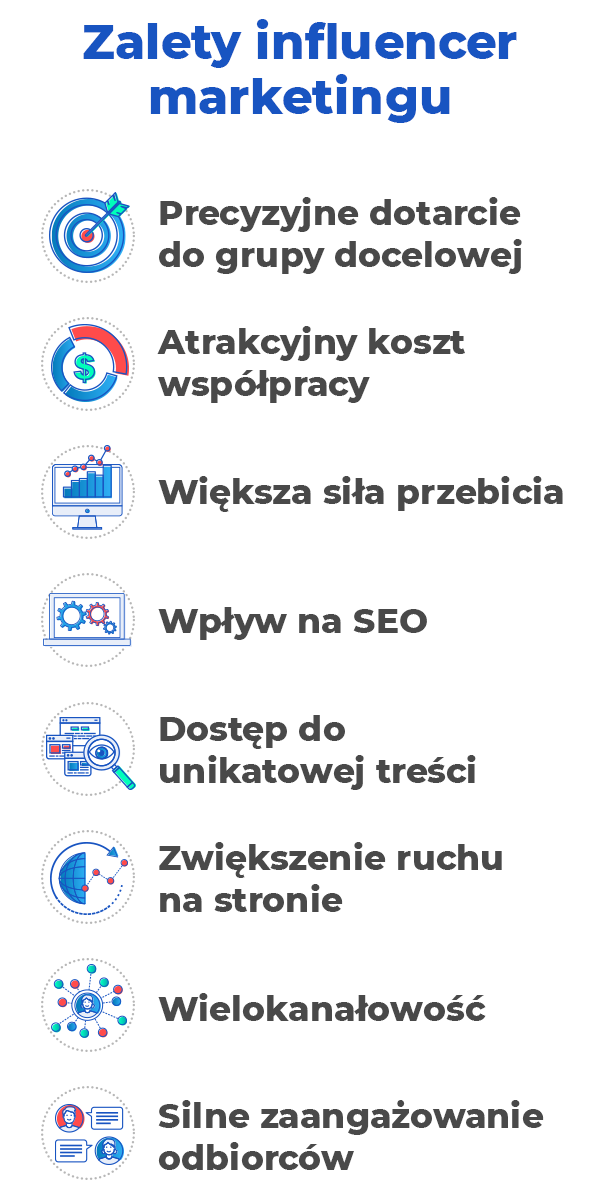
Advantages of influencer marketing
 advantages of influencer marketing
The ability to precisely reach the target group
The effectiveness of marketing efforts depends largely on reaching the right audience. Influencers facilitate this because their blogs and vlogs are followed by people interested in specific topics that your brand may also target, at least indirectly.
If your target audience is expectant mothers or those who have recently welcomed a baby, they're easy to find on a parenting channel. If you want to reach photography enthusiasts, partner with a photography expert or someone who has built a passionate community around their photography.
These are the first examples that come to mind and are effective strictly from a sales perspective, but of course, collaborations can be much more sophisticated and aimed at resonating with perception. I'll use my favorite example – the collaboration between Mercedes-Benz Polska and the author of the novel, Szczepan Twardoch.
On the internet, Twardocha could easily be called an influencer. For many, he serves as a navigational beacon; he is read, listened to, and discussed. His novels open new threads, even wounds. Silesian, German, Polish. Despite everything, he offers moderate views, yet expressed powerfully.
On his social media accounts , he often expresses his fascination with motoring – primarily the emotions behind driving. He's a representative of the intelligentsia and one of the new wave of Polish writers. In short, he's cultured, yet also "something," and his fan base includes (I'm guessing) 30-50-year-olds from larger cities, with higher-than-average incomes.
Mercedes neatly fits into all this, automatically capturing everything Szczepan Twardoch has been building over the years with his narrative among a group that partially overlaps with the brand's target audience. This collaboration was communicated primarily online, and it sparked a lot of controversy along the lines of "but how? A writer and an ad? He sold out!"
Honestly, I wouldn't be surprised if it turned out that these controversies were also generated by Mercedes, as thanks to this, not only fans of the brand and the author but also all of Poland learned about the collaboration. But we'll probably never know.
Potentially attractive cost of cooperation
Influencer marketing often proves to be significantly cheaper than other forms of brand promotion. It's impossible to pinpoint a single price, as everything is individual. However, there are several factors that determine the price. These include reach, channel of collaboration, scope of activity, and industry. The influencer's recognition is also important.
Typically, payment takes the form of a fixed fee. However, influencers sometimes operate through affiliate programs or barter.
It all depends on the internal policy of the company and the influencer himself.
Greater "breakthrough" power
The spread of the Internet has led to significant changes in the brand-consumer relationship.
While many years ago all advertising messages were one-sided, much has changed in this regard. People want to know who is behind a given message, they want to interact, and so on.
Therefore, influencer marketing has a much greater impact and impact than traditional marketing messages. Furthermore, product or service recommendations are often perceived by followers as simple recommendations rather than paid "collaborations."
Of course, customer awareness is improving and they are more and more sensitive to unnatural moves by influencers.
Influencer marketing and SEO
Influencer marketing is also worth exploring because of its impact on SEO . Collaborating with influencers not only positively impacts brand image and contributes to product promotion, but a good strategy allows for significantly better rankings in search results. Why?
Collaborating with influencers offers the opportunity to acquire high-quality links, for example, to an online store. These links originate from blogs and other external websites that enjoy a high reputation and popularity among internet users. Influencer marketing can, incidentally, support the SEO process for your website or store.
Access to unique content
Influencers create high-quality content showcasing a specific product or brand. This is a welcome development from Google, so access to unique content can boost search engine rankings and the reputation of the website itself.
Possibility of increasing website traffic
There are quite a few opinions on whether website traffic is a ranking factor. Regardless, influencers help generate traffic by recommending specific products and posting links to their website. Interested individuals will click through and visit the brand's website, etc.
Multi-channel
Influencers reach their audiences through various channels. Before collaborating, it's worth examining the advertising landscapes they operate in. Influencers have learned that, yes, they can be known for one advertising channel, but they can't afford to stick to that one channel. Therefore, it's worth partnering with people who operate in multiple ways.
Involvement
Influencers care about the quality of their content and other formats, actively participating in discussions, responding to comments, and being able to skillfully defend the brand in case of any crises.
However, it is worth remembering that the above-mentioned advantages apply to model campaigns with experienced and quality-tested influencers.
Each such collaboration requires in-depth attention and examination from various angles. The benefits of a given collaboration also depend on our goals, metrics, and product fit. The methodology for selecting appropriate influencers is explained in the appropriate chapter.
Disadvantages of influencer marketing
Lack of control over the influencer's image
A problem that has become abundantly clear more than once. By associating a brand with a specific person, you have very limited influence on how they will navigate the coming days, weeks, or months of their lives.
Unfortunately, influencers are human too – they have their weaknesses and passions, and they sometimes make mistakes that impact not only their image but also that of their business partners. This threat is best illustrated with specific examples.
The latest—and most spectacular—example is Jessica Mercedes. When she created her own brand, Veclaim, she intended to tie it to her popularity. The brand was to be made in Poland and offer high-quality products.
Unfortunately, some fans and customers noticed that the T-shirts likely came from China, produced by a company that offers the same T-shirts (without the prints) for just a few or a dozen złoty. Regardless of the price, the brand and Jessica Mercedes herself were providing misleading information to consumers. As of this writing, the case has already been referred to the Office of Competition and Consumer Protection (UOKiK), which is investigating the validity of the customer allegations.
Unfortunately, despite their extensive experience in communicating with their fans, they also failed to deliver on their crisis management skills. As reported by Wirtualnamedia:
After this information was revealed, the Veclaim website removed the information that the clothes were manufactured in Poland. Jessica Mercedes blocked fans from commenting on all of her Instagram accounts. The internet was swarming with comments criticizing the blogger. Angry fans wrote that they felt cheated because the influencer had built the Veclaim brand on locality and premium quality from the start (which was also used to justify the clothing prices).
This example demonstrates how a brand's dependence on an influencer and influencer marketing itself can essentially destroy it. Furthermore, it's worth noting that social media loves charismatic personalities—somewhat borderline. The pressure to constantly be "someone" can cause even the most experienced influencer to simply drift away.
costs
In the case of small influencers, the costs of cooperation usually include time spent and product shipping or a small fee.
Collaborating with top influencers, however, comes at a significant cost. This isn't just because the influencer's salary is high, but such collaborations only make sense if they're long-term.
If we're paying 100 or even 300 złoty for a given collaboration, it would be a shame not to consume that image in as many ways as possible. Therefore, we also need to invest in a meaningful photo session in a stylish setting, with the intention of using it for Facebook banners, display ads, or outdoor advertising.
You also need to record several or a dozen videos for advertising on YouTube , Facebook , or even television (which significantly increases costs). Therefore, if a brand decides to sign a long-term contract with a given influencer, the influencer's fee alone can typically only constitute between one-third and one-third of the actual costs of preparing such a campaign.
Remember, this isn't just a financial investment; it also consumes human resources within the company. Your employees' time also costs money, as does sidelining other projects.
That's why, as a rule, the biggest merge with the biggest. First, they want to strengthen their "brands" with strong names that somehow align with the image they're building. Second, they can simply afford the capital.
Thirdly – unfortunately – BIG companies rarely have everything mapped out from A to Z – as a result, they engage in broad and far-reaching collaborations that aren't necessarily well-targeted, but at the same time build widespread recognition. A trade-off.
You might like it
Measurability in influencer marketing
A relatively significant problem in influencer marketing is the measurability of activities. This isn't because it's impossible to implement, but rather because influencer marketing specialists often lack analytical skills.
This is a highly underestimated area among marketing professionals. They often leave analytics to e-commerce and performance campaigns. As a result, they have significant difficulty demonstrating the effectiveness of their efforts.
That's why it's so important to understand at least the basic functions of Google Analytics , which will prove or disprove the effectiveness of certain advertising channels. Tracking website traffic will also allow you to identify areas where, for example, a surprisingly high user churn occurs. Generally, even basic analytics can significantly improve not only your marketing messages but also your user experience.
Regardless of whether the collaboration takes place on a blog, Instagram, Facebook , TikTok, or anywhere else, make sure that when a given creator links to, for example, a product card, they use the link you defined.
You can expand it with the name of the campaign and the specific source. The best free tool for doing this is Campaign URL Builder from good old Google, available at this link.
By using this tool, you can be sure that when analyzing a given campaign in Google Analytics, you will not miss any users from a given link.
However, there are places where linking is limited. In such cases, one analytical method is to add a discount code to the video, for example, which will be communicated only on that channel.
This isn't a perfect method, and marketers often don't want to create dozens or even dozens of discount codes for a single campaign . Nevertheless, it's better than nothing.
Why measure at all?
Example : Adam Nowak, known in the bookstore community as "Tektura," is tasked with boosting sales of a new book. His best friend, Zenon, once achieved spectacular success by selling 100 copies of a steam cleaner on Instagram. Zenon suggested this path to Adam, and he's already rubbing his hands together.
He sent 20 books to industry Instagram accounts and blogs and then waited for the results. After two weeks, he had recorded a total of 200 book purchases. Since he wasn't conducting any other advertising activities, he concluded that this was due to Zenon's divine intervention and the Instagram ad. It sounds logical.
But Adam didn't bother to provide his creators with a dedicated link and he doesn't really know what analytics is.
Meanwhile, the publishing house that published the book sent out a newsletter around the same time to those interested in new releases. In the case of this book, it linked to Adam's store, a fact the publisher was completely unaware of.
What's more, the publishing house took care of the analytics of its mailing and knows that over 700 people reached Adam's store just from this link.
Next time, Adam will be convinced that sending books to the same influencers will be a good idea, and afterward, he'll wonder why it didn't work out this time. It didn't work out because it didn't work out the first time either, and he simply doesn't know about it.
Finding the right influencers
How do you choose influencers who are credible in their message, won't eat up your entire marketing budget, and will still effectively benefit your company? There are two ways to go: choose large influencers in small numbers, or small influencers in large numbers.
Recently, several studies have come to light, which clearly show that in the context of sales and reach, it is better to cooperate with a hundred micro and small influencers with a smaller but loyal fan base than with one influencer with hundreds of thousands of fans.
It turns out that smaller communities resonate much more strongly and are more engaged with what a given figure posts. They're also generally easier to monitor and moderate depending on the circumstances. Ultimately, they're also simply cheaper, although collaborating with hundreds of accounts will undoubtedly be time-consuming.
A few big ones or many small ones? Large influencers have essentially accustomed their fans to paid campaigns , which somewhat reduces reach and engagement. The broader the fan base, the greater the chance that the target audience will be less targeted.
On the other hand, if you want to give your brand a specific "image," then it's worth considering collaborating with large companies. They have a "style" and values that are already recognized nationwide.
Collaborating with a large influencer will certainly take less time than coordinating 100 contracts with smaller ones. It all depends on the goals of our campaign and what we actually want to promote.
EXAMPLE : Imagine you're a book publisher and want to create a "seed" in the market before a given title's release. Micro-influencers and small influencers in this industry will be willing to share photos and reviews, usually in exchange for review copies of your upcoming book. Sending it to 30-50 friendly influencers is enough to raise awareness of a given title in this category at a relatively low cost among people interested in reading.
Selecting a larger influencer for such a campaign, and for a fee, could generate higher reach and even greater product awareness, but at the same time in a group with lower conversion rates, which would ultimately not translate into good financial results of such an experiment.
If viewers sense that the posts lean too heavily toward simple sponsorship, they may become discouraged or even turn away from the influencer. Furthermore, research has already emerged indicating that the larger a person's audience, the less engaged they are and the less likely they are to replicate their purchasing decisions.
It turned out that, at least in some cases, organizing a campaign with a hundred micro or small influencers yielded better results than collaborating with two relatively large influencers. What's even more interesting is that in the former case, it was also… cheaper.
Where to look for influencers?
You should probably start your search for optimal influencers with the channels you care about most.
Typically, these are blogs, YouTube videos , and Instagram accounts. It also happens that our brand isn't represented on a new channel—currently, TikTok—and we want to present our message there, at least as a test.
Blog
When it comes to blogs, it's best to start your search with the search engine itself. Enter keywords that might be potentially interesting to your target audience and see which blogs rank for them on the first pages of the search engine (not necessarily just the top 10, as you're only looking for a broad base right now – you'll narrow it down later).
Let's imagine you run a small electronics store and want to boost sales of new headphone models and leverage influencers. So, enter the phrase "best on-ear headphones under 500 PLN" into a search engine – in this case, you'll find that the top results are occupied by entries directly linked to specific online stores.
However, it also turns out that online forums also rank very well for certain phrases. Perhaps this is a good idea to create an account there, find people with a good reputation, and offer them tests of new headphones?
As you continue down the search results pages, you'll also find blog posts unrelated to any specific online store. Collect these domains and then analyze them for visibility using tools like ahrefs or senuto. If your company doesn't have access to a tool that allows you to analyze a given domain, ask your SEO agency for help.
When analyzing a given domain, pay attention to the phrases it ranks for – perhaps there's already a post that's performing well and has a reasonable number of searches, and at the same time, there's room for your brand to develop. In that case, there's no point in reinventing the wheel, but joining a speeding train and updating the post a bit.
When analyzing a domain, remember that the actual traffic on a given website differs from that estimated by the analysis tools.
That's why influencers often connect their websites to Google Analytics and, when asked about website traffic, provide brands with their data for a given period. It's worth asking about this before entering into a partnership. GA can provide very detailed data, even for a single article.
If a search engine isn't enough, you can also expand your database of potential bloggers using platforms like REACHaBLOGGER or Whitepress. These sites group influencers by industry, and you can also use them to collaborate.
Youtube
YouTube – something still not everyone knows – is not only a video-sharing platform but also serves as a search engine. It's the second most popular search engine in Poland and globally. Therefore, searching for influencers/YouTubers will be similar to Google.
You can also search for videos on a specific topic by tag or playlist. It's also worth monitoring each channel for comments—whether the creator responds to them and what their overall tone is. Is the community truly engaged, does it have a family feel, and how well the creator can appeal to audiences' emotions?
Instagram
Warning! Instagram requires vigilance, as it's increasingly becoming a hotbed for accounts with hundreds of thousands of fake followers. Although the platform tries to counteract this in various ways, there's currently no effective mechanism to automatically reject such accounts.
Therefore, it's always recommended to manually audit a given account—checking engagement, comments, frequency and quality of shared content, as well as whether the entire profile is consistent and has been on the platform for more than a few months. Holistically, all of this will give you a better idea of the account's credibility.
You can use #hashtags to navigate Instagram – influencers make sure their posts are tagged correctly, so you can find their posts under specific tags. Simply find one relevant influencer in a given industry and, for example, navigate further using the hashtags they use.
While in the case of blogs or YouTube everyone more or less knows how things work, in the case of platforms like Instagram or Tik-Tok, it is worth spending some time there yourself before taking action.
These are more dynamic environments than traditional search engines, and their users are much more sensitive to their "netiquette." What's acceptable today may become a reputational embarrassment tomorrow. Furthermore, the more modern the channel, the more difficult it is for a brand to fit in "naturally." This simply requires intuition.
Aggregates or individual cooperation?
A few years ago, several agencies – aggregators – were established to group influencers under their wings. Some of them were founded by the creators themselves, who wanted to professionalize the brand-creator relationship on the one hand, and partially monopolize access to certain high-reach accounts on the other, allowing them to dictate rates.
Like everything, working with an influencer agency has its pros and cons. The workflow itself is definitely a plus. You complete a brief, define your goals, industry, and budget. In return, you can receive a reach estimate, recommended creators, and even a strategy with a preferred message that aligns with the message.
Agencies like these have taught brands the importance of giving creators a great deal of freedom in their actions. They know their community best and what will resonate well with their fans. The problem with influencer marketing for a long time was that brands treated creators instrumentally. They imposed rigid frameworks on them to ensure they adhered to corporate standards. This was a mistake that, thankfully, is no longer repeated.
The downside of agencies, however, is that these services require additional fees. Commissions depend on budget, and naturally, the higher the amounts, the lower the percentage. It's also often impossible to work with a given creator outside of a given agency. However, if you have a choice, which option should you choose?
It all depends on your goals – the broader the campaign, the more justified the decision to have it run by an agency that coordinates all broadcasts and messages, and selects the right people for your project. In this case, your role will be reduced to that of a coordinator. This is convenient, but also more expensive.
However, if you want to run a more "intimate" campaign – in terms of reach or budget – then choose a more economical version in which you leave everything – from signing contracts to setting publication dates and their subsequent verification – to yourself.
Terms of cooperation
forms of remuneration for influencers A separate category is the terms of cooperation that both parties to a given contract are willing to agree to. The last thing you can afford is any ambiguity or room for interpretation within a given contract.
When it comes to settlements with influencers, we usually encounter two forms:
- barter In exchange for sending products or using services, the creator shares their opinion/review on a given topic. This is, of course, a beneficial form of payment for the brand from a financial perspective. Smaller influencers or mid-sized influencers operating in topics valued less by advertisers are typically interested in such payments.
Often, bartering also means less control over the message, both in form and content, as it's not bound by a contract. This, of course, has its advantages and disadvantages. Such cooperation is much faster and more flexible, as you don't have to consult with lawyers, wait for your boss to sign contracts, and so on.
The creator usually has much greater freedom in expressing his or her view on a given product or service, which can be good, but sometimes problematic.
- Remuneration – The second frequently accepted form of payment (no surprise there) is regular financial compensation for a review or opinion on a given product or service. This form is usually subject to contractual restrictions.
Of course, it also happens that in the case of collaboration, we're dealing with a mix of both – i.e., barter and financial cooperation. Influencer marketing is quite flexible in this context.
What is worth remembering in a contract from a brand perspective?
- If the creator is also preparing the material for use in YOUR advertising channels, then specify all possible fields of use. Leave no room for interpretation, but name each of them separately.
- include in the contract a schedule and individual cut-off dates for subsequent stages of the campaign,
- specify the amounts,
- specify exactly what the creator commits to within the framework of a given collaboration,
- you can even specify in the contract a specific link that should appear in posts or materials related to campaignRemember, however, that such technical matters can be easily negotiated outside of the contract.
What is worth remembering in a contract from the creator's perspective?
- specify whether the brand can freely manipulate a given video or other format you are preparing (this includes using quotes, cutting scenes from videos, etc.),
- the issue of using materials created by the creator in the brand's advertising materials,
- specify exactly what the brand is committed to as part of a given collaboration (e.g. providing the product, accompanying materials, descriptions, etc.),
- the brand's consent to add information about the cooperation.
Influencer Information Summary
It's time to wrap up this lengthy post. I hope it sheds some light on the subject of influencer marketing, and armed with this knowledge, you can set out to find your first influencers. If you have any questions, feel free to leave them in the comments and I'll respond within 24 hours.
Summary
The above article covers the following topics:
- Influencer marketing is a new advertising space, full of opportunities and challenges, which brands are currently trying to conquer and develop.
- Influencer marketing is the use of the trust and reach of opinion leaders to effectively influence audiences' purchasing decisions through credible recommendations.
- Influencer marketing ensures precise target group reach, builds strong engagement and trust, while optimizing campaign costs and supporting brand positioning in search engines.
- The main disadvantages of influencer marketing are the image risk associated with the lack of control over the creator's behavior and the high costs of long-term campaigns and the accompanying production of materials.
- Effective influencer marketing requires proficiency in analytics and the use of tracking links, and the choice between high-profile celebrities and cheaper, more engaging micro-influencers depends on the campaign's goal.
- Influencer marketing requires precise searches for creators in selected channels and clear definition of the rules of cooperation, whether carried out independently or in cooperation with an agency.