A well-managed blog is one of the most effective ways to build your brand and increase your visibility on Google. There are very few industries that don't benefit from blogging content marketing .
It is worth remembering that a company blog is, above all, a strategic activity – that is, a skillful combination of ideas with an analysis of readers' needs and SEO principles.
Why run a company blog at all?
There are several reasons, but the three described below are considered the most important.
By running a blog, you build an expert brand image
On a blog, you can share your knowledge and experience, demonstrating that your brand truly understands its industry. You can write guides, comparisons, and descriptions of mechanics or products. In other words, instead of claiming to be an expert, you demonstrate this through examples and practical advice.
(The rest of the article can be found below the form)
Every entry supports SEO
Each article becomes a new page visible in Google, optimized for specific keywords. This makes your blog a constant source of organic traffic, and users find your site looking for answers to questions in your industry. The more quality posts you have, the better your internal link network and domain authority will grow.
The blog strengthens sales activities
A blog is an excellent sales tool – although it doesn't do so directly. Guide articles and case studies (possibly with the client's company logo and name in B2B cases) showcase the benefits of a product or service without intrusive, spammy self-promotion.
Posts can link to offer pages, generate leads, or at least encourage newsletter subscriptions. Well-planned content marketing on a blog is, in practice, the cheapest channel for customer acquisition in the long run.
How to start writing a blog?
Every blog should have a clearly defined purpose. Writing a corporate blog is different from writing an expert blog, and writing a lifestyle or technology blog is different still. The most important rule is simple: before writing your first piece, define who you're writing to and what value you want the reader to gain from reading your posts.
Helpful questions to get you started:
- What problems can I solve for my audience?
- What tone will I use: expert, collaborative, or perhaps light and approachable?
- What topics related to my business are broad enough that I can expand on them in multiple articles?
This planning phase is the foundation of any content marketing strategy . Without it, it's difficult to maintain message consistency and systematic publishing.
Sure, you can create a blog that simply exists "just to be on the site." This is actually a fairly common mechanic – in practice, it only leads to wasting (admittedly, a small amount of) effort on setting up the blog and creating semi-random content.
It is worth remembering that an empty blog with the last entry dated 3 years earlier acts as a deterrent rather than an incentive for customers – it is, in fact, a digital content graveyard.
How do you start writing a blog that someone will actually read?
The biggest challenge isn't the writing itself, but creating content that arouses curiosity and holds attention.
Text structure is the key to engagement
Writing blog posts requires the ability to organize content. Even the most complex topics can be presented in a way that's easy to understand.
A well-written post has a clear structure: an engaging introduction, a body divided into logical paragraphs, and a conclusion that summarizes the whole.
Avoid walls of text
One of the most common mistakes on blogs is publishing gigantic blocks of text. This can make even the most well-written article less readable. Online users don't read line by line—they scan the content. Too dense text is discouraging, and in a straight line, it can quickly cause readers to leave the page.
Therefore, it's worth breaking up content into short paragraphs, adding subheadings and highlighting. Each screen should be visually "light." A well-formatted post not only improves reading comfort but also aids SEO.
Google appreciates logical text structure and appropriate use of headings.
Enrich your texts with images
Graphics in content aren't just decorative. Well-chosen images explain, complement, and visually organize the article. It's worth using step-by-step illustrations, infographics, and adding product photos or charts.
Users will understand your message more quickly, and the article will look professional as a result. Furthermore, each image offers a chance for visibility in image searches and increased organic traffic – especially if you remember to fill out the ALT attribute.
Focus on originality
Analyses, comparisons, expert opinions, and original compilations are more valuable than copied information from other sites. Google rewards uniqueness, and readers value a personal perspective.
Make sure you have catchy titles, but avoid clickbait like the plague.
It's best to avoid clickbait, as it damages the author's trust and credibility. Headlines that promise more than the content actually delivers may increase clicks in the short term, but quickly discourage readers. A reader who feels deceived once won't return for more content. We wrote more about this on our blog.
Update content
Every few months, go back to older posts, add new data, remove outdated information, and improve linking. This is a simple way to refresh your organic traffic and maintain high Google rankings while maintaining value for your readers.
Place a CTA (call to action)
Good blog content attracts traffic, and ideally, it converts—that is, it converts readers into customers. Include products (for e-commerce) or forms (for service businesses) in your posts to help your blog support sales.
The key is to balance your messages. Striking a balance between the blog's substantive value and its direct promotional tool is a very difficult art.
Remember about internal linking
Internal linking, or creating connections between related articles, is crucial on a company blog. This allows readers to easily continue reading and explore a topic step by step, and allows Google to better understand the structure of the content.
It's a simple way to increase user engagement, boost SEO , and increase time spent on your site. An example of this type of linking is this link, where you can read more about internal linking.
SEO on the company blog
Since a blog is intended to be a source of organic traffic from search engines or AI models , a fundamental question needs to be asked: "What is my customer searching for on Google or GPT Chat?" This perspective ensures that each post acts as a response, not an advertisement.
The idea is to create texts that solve specific problems, not just describe general phenomena. First, however, you need to be aware of these problems – and this can be achieved with dedicated tools that identify keywords worth including in a given post. The most popular are Senuto, Semstorm, and Ubersuggest, but the range of SEO tools available is vast.
Keyword selection platforms are essential for driving real, "caloric" traffic to your blog. They identify sets of different, related keywords. However, this presents a trap that many businesses starting with a blog fall into.
This refers to the intrusive saturation of articles with these keywords, making the text sound unnatural. An extreme example of this is, of course, the legendary "news" about Sunday shopping.
Figure 1. Example of the title of an article about shopping Sundays – source: fakt.pl
Long tail SEO on a blog (long tail keywords)
Keywords can be divided into short-tail, or short, general phrases, and long-tail, or longer, more specific queries. The former face intense competition, such as "blog marketing," making it difficult to rank for.
Meanwhile, long-tail phrases like “how to run a company blog in the construction industry” attract users with specific intent and a higher chance of conversion.
A blog ideally supports a long-tail strategy, as each article can target a different, more specific query. By systematically posting topics that are diverse, you build a broad network of visibility and reach niche audiences, avoiding the most crowded phrases.
What is the appropriate text length?
In theory, more is better – more space allows for deeper exploration of the topic and the natural integration of more keywords. However, there's no point in pouring water just to make the text longer.
A reasonable, but absolute minimum, text length seems to be 3 characters with spaces, when the topic is short and presents a specific fragment (e.g. a case study from a short collaboration – who the client was, what goals were achieved together, and there will also be room for a short statement from the client summarizing the whole thing).
There is basically no maximum text length and the sky is the limit here, but if the article is supposed to be 20 characters long, it may be better to split it into 2-3 smaller texts.
When to add texts?
While the time of a post can mean the difference between life and death in terms of reach on social media, it's completely irrelevant when it comes to blog posts. A post is intended to generate traffic over time, and whether you publish it at 9:00 a.m. or 21:00 p.m. won't affect its long-term performance.
How to measure the effectiveness of actions?
A company blog doesn't make business sense without analyzing how the content performs in practice. It's worth monitoring your Google Search Console results to see which phrases the blog is ranking for and which posts generate the most clicks from the search engine.
Figure 2. Example of click and impression statistics in Google Search Console.
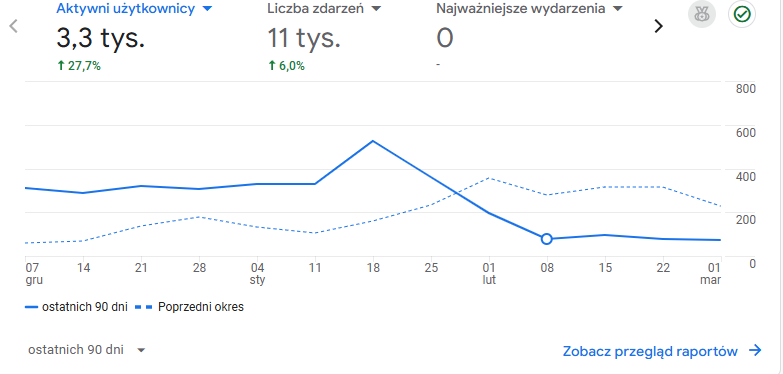
Google Analytics, in turn, will show where users come from, how long they stay on the site, and which articles attract them most. It's worth remembering that since the introduction of Google Analytics 4 and the restrictions related to data processing (Consent Mode), data from this tool is sampled, meaning it doesn't reflect the entire traffic.
Figure 3. Example of website traffic statistics in Google Analytics.
In addition, there is conversion data that you will see in the company CRM: the number of completed forms, newsletter subscriptions, or quote requests from a specific entry.
Only such a holistic view allows us to assess which content actually supports business goals and which requires improvement or change of direction.
A blog is long-term brand capital
A blog is an investment in visibility while also supporting customer experience. Treat every valuable post as a digital asset that can thrive for years, generating traffic and sales.
Unlike paid advertising, a blog doesn't disappear after the campaign ends. On the contrary, its value increases with the number of posts.
Frequently asked questions about blogging
It starts with precisely defining your target audience (persona). Before you write your first word, you need to know who you're talking to, what problems your reader faces, and what language they use daily. Writing "to everyone" makes your text bland and unengaging.
A good headline promises a benefit or solves a specific problem. It should pique curiosity but not deceive (avoid cheap clickbait). Numbers (e.g., "5 ways to..."), questions (e.g., "How to effectively..."), and authority-building phrases (e.g., "A complete guide to...") all work well.
This technique, borrowed from journalism, involves placing the most important information, the essence of the article, and the main conclusions at the very beginning – in the lead (introduction). Modern internet users don't have time for long introductions. If they don't understand what the text is about and what they stand to gain from it within the first three sentences, they'll immediately close the tab.
People online rarely read articles from cover to cover—they usually scan them for specifics. To make it easier for them to digest, it's important to ensure high scannability:
- Create short paragraphs (maximum 4-5 sentences).
- Regularly use interstitial headings (H2, H3) that divide the text into sections.
- Bold key phrases and most important ideas.
- Introduce bulleted lists, tables, quotes, and trivia boxes.
Naturalness is key. Keywords should be woven into the content so that they are unnoticeable to the reader while reading. Focus on the user's intent (User Intent) and the topic's completeness. If the text is substantive and retains the user, Google's robots (and modern AI engines) will automatically recognize it as a valuable resource and increase its ranking.
Leaving readers without a clear direction on what to do after reading an article is wasted marketing potential. At the end of a post, there should always be a call to action: an encouragement to discuss in the comments, sign up for a newsletter, read a related post, or a direct link to your offer or product.
Summary
The above article covers the following topics:
- Running a company blog is a strategic tool that effectively builds your image as an expert, supports your Google positioning, and generates sales at a low cost.
- Running a company blog is a strategic tool that effectively builds your image as an expert and generates sales at a low cost.
- An effective blog requires a clear structure, unique content enriched with graphics, and regular updates and linking, which, combined with an appropriate call to action, builds reader trust and supports sales.
- Effective blog SEO involves responding to specific customer problems using long-tail keywords, which, while maintaining the naturalness of the text and analyzing the results, allows you to build valuable, converting traffic.
- A blog is a lasting digital asset that, unlike paid advertising, builds long-term brand value and generates continuous traffic for years.