Contents
You are now reading:
Geolocation – what is it, how does it work (GPS, IP, Wi-Fi) and why is it important in Geomarketing?
Close
Properly matching the goods and services offered to the needs and preferences of potential customers is very important from the point of view of marketing activities.
Various factors influence the level of demand for specific goods. One of the most important is geographic location. Geolocation helps determine this . This practical tool is widely used in various fields. Learn what geolocation is and how it is used in advertising and marketing!
What is geolocation?
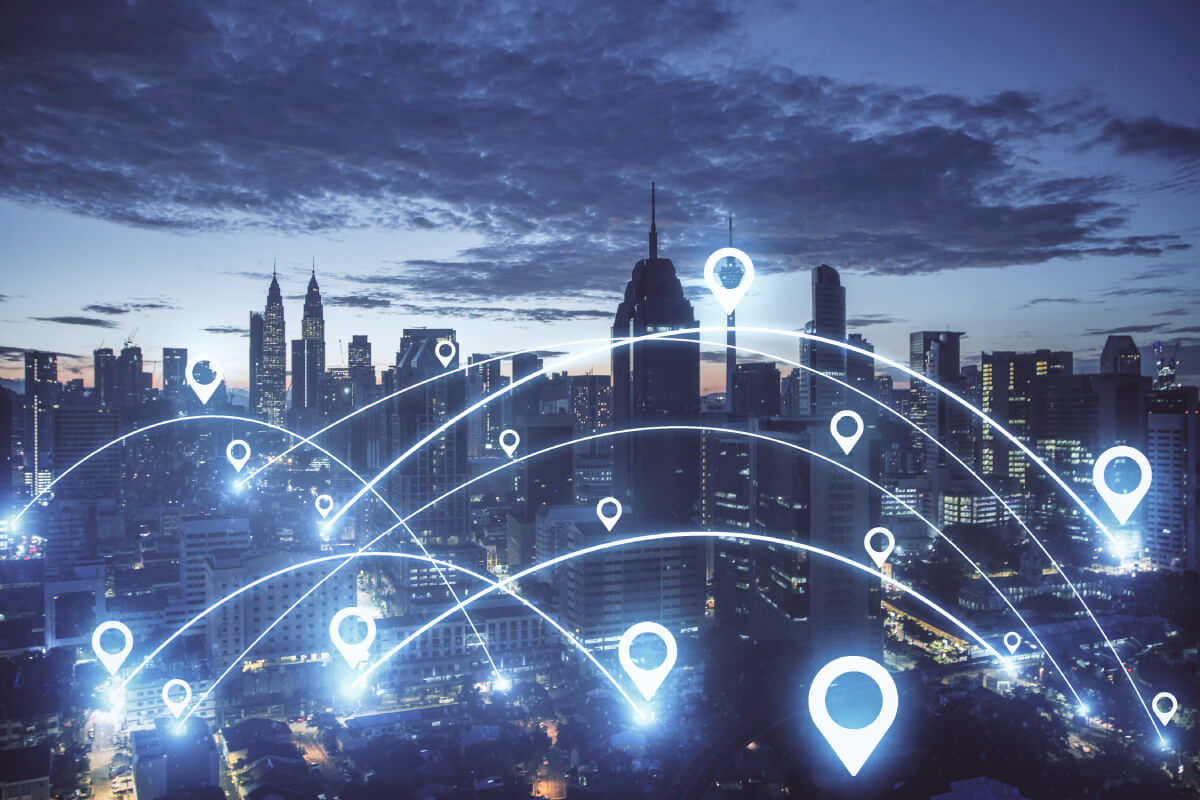
Geolocation allows the physical location of a given device, such as a laptop or phone, to be determined using modern technology. Various methods are used to determine the user's physical location.
Correct geographic identification of a potential customer allows us to send them an offer of products and services personalized to their location.
(The rest of the article can be found below the form)
Fill out the form and schedule a call with an expert
We'll get to know your business and prepare a personalized quote for the optimal marketing mix. Completely free.
The controller of your personal data is Verseo, a limited liability company with its registered office in Poznań, at ul. Węglowa 1/3.
About Verseo
The Company's registered office is located in Poznań. The Company is entered in the Register of Entrepreneurs maintained by the District Court for Poznań – Nowe Miasto and Wilda in Poznań, 8th Commercial Division of the National Court Register, under KRS number: 0000910174, Tax Identification Number (NIP): 7773257986. You can contact us by mail at the address provided above or by email at: ochronadanych@verseo.pl
You have the right to:
- access to your data,
- rectification of your data,
- request deletion of data,
- processing restrictions,
- object to the processing of personal data,
- transfer of personal data,
- withdrawal of consent.
If you believe that we are processing your data contrary to legal requirements, you have the right to lodge a complaint with the supervisory authority – the President of the Personal Data Protection Office.
We process your data for the purpose of:
- handling your inquiry, pursuant to Article 6(1)(b) of the General Data Protection Regulation (GDPR);
- marketing purposes consisting in the promotion of our goods and services and ourselves in connection with the consent you have granted, pursuant to Article 6(1)(a) of the GDPR;
- securing or pursuing possible claims in connection with our legitimate interest, pursuant to Article 6(1)(f) of the GDPR.
Providing your data is voluntary . However, without it, you will not be able to send us a message, and we will not be able to respond to you.
We may transfer your data to trusted recipients:
- providers of tools for: website traffic analysis, sending marketing information.
- entities responsible for hosting (storing) the website and personal data.
We will process your data for the period of:
- necessary to achieve the specific purpose for which they were collected, and after its expiry for the period necessary to secure or pursue any claims
- in the case of data processing based on consent until its withdrawal. Withdrawal of consent does not affect the lawfulness of processing prior to withdrawal.
We do not process personal data in a way that would involve making solely automated decisions about you. More information regarding the processing of personal data can be found in our Privacy Policy.
Geolocation uses various technologies to identify a user's location. These include:
- GPS (Global Positioning System) – a method that uses satellites to triangulate the user's position,
- telephone towers (BTS) – the signals they emit allow for the precise location of mobile devices,
- sieć Wi-Fi – Google determines the location of the device based on the Wi-Fi network to which the device is connected,
- IP address – IP address geolocation allows you to determine the approximate location of the user at a given moment.
Geolocation data is collected continuously from mobile devices, IT systems, and web browsers. This collection is usually automated. However, user consent is sometimes required.
Address geolocation – invaluable advantages
Geolocating potential customers' addresses offers businesses a number of benefits. Primarily, it allows for the personalization of offers.
Geolocation on Google allows you to send customers offers that are perfectly tailored to a given region. It also significantly increases the effectiveness of promotional campaigns . Geolocation facilitates the targeting of ads to specific cities or towns.
Companies that use geolocation data to determine user locations gain valuable information about regions where their offerings are more sought after. This allows them to focus all their marketing efforts on that area.
Geolocation can also be used by businesses to display mobile ads tailored to the needs of a given market. It allows users to learn which services a given company provides in their area of residence.
Geolocation in marketing
Address geolocation is useful for targeting Facebook ads. It's a frequently used tool in Facebook Ads campaigns.
Google's geolocation is also used to analyze market data from a given region. For example, it can be used to compare sales of a given product across different locations or to examine consumer behavior based on where they live.
However, the possibilities for using IP address geolocation in marketing don't end there . This technology is used, for example, to create local ads on social media.
These advertising messages reach users living and working in a given geographic area. These ads are targeted to cities and areas with a relatively large number of potential customers.
Geolocation is also widely used in the creation of mobile applications (e.g. maps, navigation or information systems about nearby attractions).
Geolocation also plays a crucial role in e-commerce . Information gathered through it informs advertising campaigns targeted at residents of a given region. Examples include special promotions targeted at customers from a given city or region.
Geolocation in Google
The possibilities offered by geolocation are also appreciated by Google, as evidenced by the various tools it creates that utilize location information to improve service quality. These include:
- Google Maps – they allow you to easily search for various services and commercial outlets in a given area. This applies to restaurants, shops, and hotels, for example. IP geolocation in Google also allows you to plan your route and use navigation;
- Google Ads – this tool allows for targeting ads to a specific location, thanks to which companies can easily reach different customers in a given region. IP address geolocation is an irreplaceable tool for local companies that focus their advertising activities on the local market;
- Google search engine – Google search engines use geolocation data to deliver search results tailored to a given region. This provides potential customers with information about businesses, services, attractions, and events in a given area, allowing them to find the best option for themselves;
- Google My Business – this tool is used by entrepreneurs to manage local profile in search resultsIt allows customers to obtain the most necessary information about the company, such as address, opening hours, reviews, and photos. Geolocation in Google plays a very important role here, as it allows companies to easily reach a local group of potential customers.
As you can see, IP address geolocation is widely used at Google. It seems that the tendency to use it on various occasions will steadily increase over the years.
Geolocation in marketing – how to use it effectively?
Effective use of geolocation in marketing depends on various factors. Among the most important is the use of appropriate Google tools, such as Google Search Console, Google Analytics, and Google Ads.
It's also important to optimize your website . In particular, you should ensure the proper internal link structure and the loading speed of individual elements on your site. You should also constantly monitor the effectiveness of your activities, adapting your marketing strategy to current trends if necessary.
- SEM Advertising – How Does Geolocation Specify Campaign Targeting?
- Google Discover – how does user location affect the content displayed?
Geolocation has many advantages. However, its use comes with its own challenges. These include limited precision. Accurately determining a user's location is not always possible in practice, despite rapid technological advances.
Additionally, it's crucial to remember to protect user privacy. Businesses must exercise particular caution in this regard, ensuring compliance with all legal regulations regarding the protection of potential customers' personal data.
Frequently asked questions about geolocation
Geolocation is the process of determining the physical geographic location of a given device (e.g., a smartphone or laptop) using modern technologies. It allows the identification of the user's current location.
The most popular methods of identifying location include:
- GPS – a system that uses satellites for precise position triangulation,
- Cellular towers (BTS) – allowing the location of mobile devices to be determined based on the signals they emit,
- Wi-Fi network – based on it (and access points), Google, among others, determines the location of the equipment,
- IP address – the most common method for determining the approximate location of an Internet user.
Yes, geolocation information is typically collected and retrieved automatically on an ongoing basis by web browsers, IT systems, and mobile devices. However, please note that in many cases (e.g., upon first use of the app), the user's voluntary consent is required.
User location is one of the key factors influencing purchasing decisions. Thanks to geomarketing, advertisers can precisely personalize their messages, serving potential customers with services, products, and promotions perfectly tailored to their current location and local needs.
Managing location sharing is typically done through the privacy settings on your device (e.g., on Android or iOS, under "Location"/"Location Services"). You can also control these permissions through your web browser, manually allowing or blocking specific websites from accessing your location data.
Summary
The above article covers the following topics:
- Geolocation is a technology that determines the user's location, allowing advertisements and offers to be precisely matched to their current location.
- Geolocation allows companies to personalize offers and precisely target ads, which significantly increases the effectiveness of marketing activities in a specific area.
- Geolocation in marketing enables precise targeting of social media ads, analysis of regional consumer behavior, and creation of personalized e-commerce campaigns and mobile applications.
- Google uses geolocation in tools like Maps, Ads, and Business Profile to provide users with precise search results and make it easier for local businesses to reach customers in their immediate area.
- Effective use of geolocation requires website optimization and analytical tools, while taking into account technical limitations and ensuring user privacy.