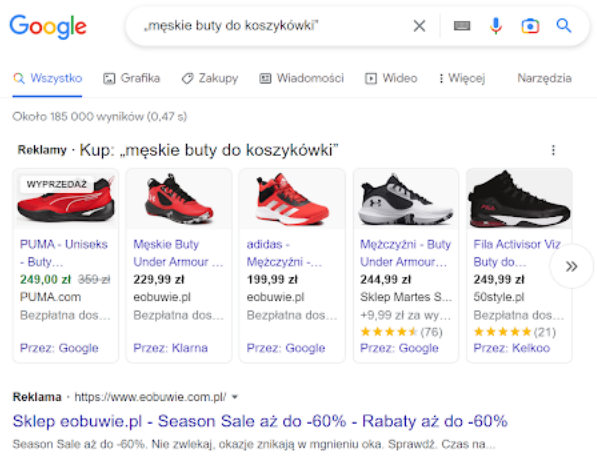
When entering the phrase "men's basketball shoes" into Google, users aren't immediately taken to the organic results page. They first see a dedicated module listing products from various brands, each with a photo of the shoes, price, store name, and shipping information.
These are Google Ads (Shopping Ads) , one of the most effective advertising formats on the entire web.
This ranking is higher than traditional text ads and even organic results, giving stores a huge advantage. In e-commerce, such exposure can be crucial – visibility in the first section of Google results is often the difference between a sale and a lost customer.
Product advertising – why is it worth investing in this type of campaign?
Figure 1. Example product advertising in Google search engine.
(The rest of the article can be found below the form)
A prominent example is a classic product ad , where the key elements are the product: its appearance, price, and availability. Users don't have to read long descriptions or analyze the offer—they get the specifics: real photos of shoe models, their prices, and the option to immediately go to the store.
This distinguishes product ads from other formats: text advertising, which is based on verbal messages and arguments, and graphic advertising, which attracts attention with its aesthetics and form.
Shopping ads shorten the decision-making process by presenting a ready-made sales offer. This is why Google Shopping Ads are so frequently chosen by online stores – users get what they're looking for before they even click on the page.
Why is this example effective from a marketing perspective?
Shopping ads work because they capitalize on the moment of highest purchase intent. A user typing "men's basketball shoes" isn't looking for inspiration—they want to make a purchase as quickly as possible. Google knows this, so it shows them real products, not generic advertising slogans.
In this case, advertising meets several key principles of effectiveness:
- is visual – products are presented in photos, which increases interest and the likelihood of clicking,
- compares offers – thanks to the comparison of several stores, the user immediately sees price differences and can make a decision without looking further,
- shows specific information – price, delivery, store name, everything important for a quick purchase,
- matches the search intent – the ad responds exactly to what the user entered.
As a result, the ad not only attracts attention, but also simplifies the purchasing process, which is one of the biggest advantages of Google Ads over other advertising systems.
What does an advertiser gain from product ads?
Shopping Ads are not just a visually appealing format – they are a tool that impacts real business metrics:
- higher click-through rate (CTR),
- lower cost per click relative to traffic quality,
- more conversions,
- shorter purchasing path,
- higher quality traffic – users are closer to making a purchasing decision.
Additionally, shopping campaigns are based on data from Google Merchant Center.
Thanks to this, the system automatically matches products to queries – the advertiser does not have to create separate ads for each phrase.
Why is this example a good representation of how Google Ads works?
The ad shown in the graphic is a perfect illustration of how Google Ads can connect user intent with a specific offer. This format works primarily because it eliminates barriers: it doesn't require reading text, clicking on irrelevant results, or searching for products on the website.
Users get everything upfront – and therefore make decisions faster. This means a real advantage for stores, as they gain traffic, pay only for clicks, and reach audiences with high purchasing potential.
Google Ads Shopping Ads FAQs
Shopping ads are a special format in Google Ads, designed for online stores. Unlike traditional text ads, they immediately present users with key information about your product range: a product image, its exact name, the current price, and the name of your store.
Shopping campaigns enjoy prominent placement in search engines. They typically appear at the top of search results (above organic results and text ads) in a scrolling carousel, in a dedicated "Shopping" tab (Google Shopping), and on display partners (depending on the campaign type).
To run this type of advertising, you need two connected accounts: a standard Google Ads account and a Google Merchant Center account. The key element is the product feed, an automatically generated list of all your store's products, which is then sent to Merchant Center.
No. In classic Shopping campaigns, you don't bid directly on your chosen keywords. Google's algorithms decide when to display your product, based on the information in your product feed (primarily the title and product description). Therefore, it's crucial to optimize your feed and use precise terms in your product names (e.g., brand, model, color, size).
Primarily, this is due to purchase intentions and budget savings. When a user clicks on an ad, they already see the image and price. If they decide to click, it's highly likely they accept these terms and are seriously considering a purchase. Such transparency from the outset effectively filters out "empty clicks" and significantly increases conversion (sales) rates.
Summary
The above article covers the following topics:
- Google Ads Shopping Ads provide e-commerce stores with crucial visibility and sales advantage by giving their products high exposure above search results.
- Google Shopping Ads shorten the shopping journey by presenting specific product information before clicking on a link.
- Google Ads Shopping Ads effectively close sales because they perfectly respond to the customer's immediate purchasing need thanks to specific visual information.
- Google Shopping Product Ads increase sales and campaign effectiveness by automatically tailoring the offer to the customer and shortening their shopping path.
- Google Ads Shopping ads are effective because they instantly remove barriers to purchase by connecting user intent with a specific, visual sales proposition.