Online content typically has a very short lifespan. This applies not only to social media and formats like Stories, which are designed to disappear after a few hours, but also to content traditionally posted on websites.
While articles or videos on a given topic remain on servers and are usually still available years after their original publication, the brutal truth is that they often simply no longer interest any audience. They have passed their expiration date for online consumption – a fate shared by the vast majority of news, reviews, sports reports, political commentary, and content from hundreds of other categories. The internet generates enormous amounts of information that is simply not useful to us – even information that the audience currently deems relevant and valuable will, in the vast majority of cases, soon lose its attention.
However, there are individual pieces of the web that enjoy unwavering popularity. Such content is called evergreen, as the name suggests, being evergreen and thriving in recognition, and therefore, in terms of organic website traffic. A post, page, or video defined as evergreen content generates visits continuously. There's no trick to it, although such an article must, of course, be created in accordance with good SEO practices and be full of carefully selected keywords. Most importantly, however, its content never becomes outdated, remaining relevant despite the passage of time.
In the case of pop culture portals, evergreen articles would include, for example, journalistic pieces about timeless book or film classics that are considered canonical in their field. However, in the technology industry, for example, the situation is a bit more complex. Both software and hardware change so rapidly that such texts quickly become outdated. An article about the best programs for a given task may simply be based on outdated data a year after publication, and therefore useless to the user. From the perspective of a website administrator, a guide to a specific version of a given application loses its potential when customers migrate to the updated version of the program.
(The rest of the article can be found below the form)
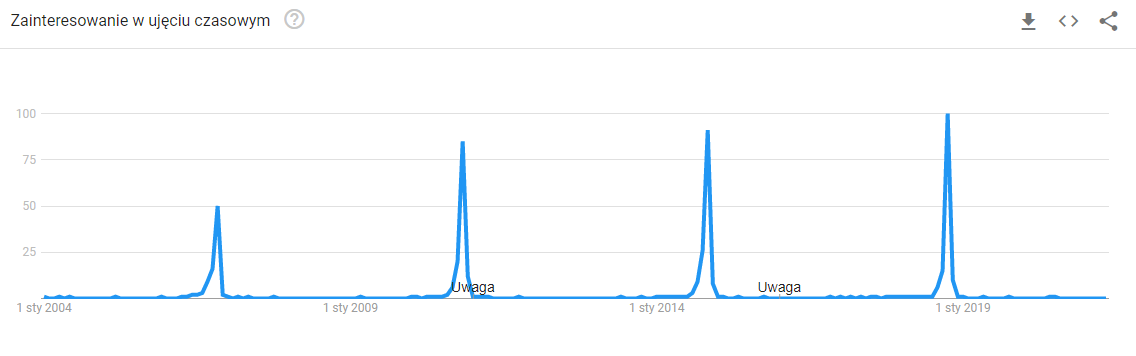
It's important to remember that seasonal content isn't classified as evergreen content. A Google Trends graph for the phrase "local elections" shows a dramatic increase in interest every five years, yet few users search for content on this topic between elections. A similar situation occurs with other cyclical events—the FIFA World Cup, the Nobel Prize ceremony, the Golden Globes, recipes for Christmas poppy seed cake, or death anniversaries of famous people.

Evergreen content examples
- Diet articles – what to eat to lose weight, how to gain mass, etc.;
- Recipes for popular dishes – from scrambled eggs, through chili con carne, to preparing lobster;
- Articles about training – sets of exercises for a specific target group and for a specific purpose;
- Dictionary content – definitions and translations of words or phrases;
- Various guides – e.g. gardening, renovation, computer;
- Instructions for using specific tools.
This is, of course, just the tip of the iceberg – an article can be described as evergreen when its relevance (and therefore its potential audience interest) persists over time. This doesn't mean, however, that once written, the text shouldn't be updated. While the premise of evergreen is long-term, perpetual relevance, expanding content with new data will always be desirable – both by the audience and by crawlers. However, well-written evergreen text doesn't require frequent updates, saving you time.
For this reason, the vast majority of shopping guides with product recommendations, for example, cannot be considered evergreen content. Of course, guides about "what's worth buying – [month, year]" can also generate valuable traffic and increase conversions in a given online store, but this certainly contradicts the idea of evergreen content.
Apart from a few industries, current trends and store supplies change so dynamically that such texts need to be updated very frequently – even every few weeks.
How to write an evergreen article?
The primary source of traffic for this type of content is organic traffic from search engines. Intuition is crucial in online marketing, but it loses out to something much more powerful: data analysis. Search engine optimization is primarily based on this.
- Keywords
Choosing the right keywords will be a priority, as they will be incorporated into the text to make it easier for users to find the article. Therefore, you need to answer the question: what phrases are people typing into search engines when looking for content on a given topic? If the topic has already been covered on competing websites—and let's be honest, it most likely is—you can analyze the content and structure of the text using various tools and use the collected data to build your own project. Tools like Google Trends, Ahrefs, Senuto, or Semstorm are useful for this purpose.
We wrote in detail about keyword analysis in a separate article on our blog: Keyword analysis – what is it?
- Text adaptation in line with SEO best practices
An article must be filled with valuable keywords, but beyond content, its form is also important. To fulfill its purpose—not only generating traffic but also preventing readers from immediately turning the page and turning to other sources of information—it should be presented in an attractive structure. This structure encompasses the entire visual aspect—text layout, paragraph division, graphics, font and color, and many other factors.
- Linking
Even the most well-written and presented text won't reach the top of search results if it's not linked to from various sites – especially in a competitive industry where many other players are vying for high rankings. If the article is truly valuable to the user, many links will appear naturally, leveraging the social power of the internet. However, even this isn't usually enough to propel a page to its intended position – at the very top. For this reason, it's worth seeking the help of professional SEO specialists with experience, resources, and link-building skills.
- Copywriting and sales decency
When writing articles intended as evergreen content, it's easy to overdo it and resort to clickbait to further entice users to read. Sure, the main goal of blog articles is often, beyond generating traffic, to encourage—directly or indirectly—recipients to purchase products, utilize a company's services, or build brand prestige. However, an evergreen article must deliver not only sales value but also substantive value.
- Protection against obsolescence
It's worth avoiding references to current events – although the country or the world is currently commenting on a particular issue, sensation, or behavior, in a few months, public attention will shift completely. References to a currently popular TV series or political dispute are very catchy and often perfectly justified from a marketing perspective, but in the long run, they do more harm than good. There's no greater signal that a text was written long ago than a worn-out joke or a catchphrase popular only at the time. Do you sometimes recall "Jozin z Bazin," the "snarling" cat, or the third season of "Dexter"? If so, you're definitely in the minority.
Summary
The above article covers the following topics:
- What works in SEO as evergreen content across different sectors?
- Checklist for Creating the Perfect Evergreen Article