The rules of the Google game are relatively simple – your goal is to deliver high-quality content quickly. Speed is primarily a matter of optimizing the code and components that make up a website. When it comes to content quality, nuances play a more important role… Don't worry, the search engine has a few guidelines up its sleeve!
Medic Update and its SEO echo
Let's go back to August 2018… that's when search results were shaken once again. The SEO community was in a frenzy – websites related to certain industries were rapidly changing their rankings. The victims included not only smaller websites but also large players that had occupied the top spots for years. These changes were caused by an algorithm update, quickly dubbed the " Medic Update ."
Why "Medic"? The spikes in visibility were most severe on health-related sites. Losses were also noticed on portals related to finance, law, politics, e-commerce, and others. Google soon confirmed that the update primarily affected sites like YMYL—"Your Money, Your Health."
The update coincided with a refresh of the guide for Google testers, responsible for assessing the quality and credibility of website content. The guide is available on the search engine's website and was last updated in October 2020. The document provides detailed guidelines on how to evaluate and classify websites.
(The rest of the article can be found below the form)
YMYL Pages – Your Health, Your Money
The acronym YMYL first appeared in 2013, but it only became a hot topic with the "Medyk" scandal. This category includes websites that potentially impact a user's well-being, safety, health, and financial stability.
According to information from official Google sources, websites such as:
- newsy – websites presenting information about current events in the world, politics, business, science, technology, and so on… Interestingly, not every type of news fits into this category – entertainment and general lifestyle are not taken into account here, nor is sports news;
- law and politics – sources of information on state policy, voting systems, public institutions, etc., as well as portals dealing with law and publishing articles with legal advice on issues related to family law, property law, and others;
- funded – Market analysis websites reporting on the latest changes in global stock markets, as well as websites containing information on loans, retirement plans, insurance, and other financial services. Special attention is given to websites that facilitate money transfers, such as online currency exchanges;
- shopping – online stores and websites containing information about e-commerce;
- health and safety – portals with health-related articles, information on disease symptoms, and descriptions of medications—composition, effects, and adverse reactions. This collection also includes sites focusing on diets and weight loss methods;
- groups of people – websites that discuss topics related to race, origin and religion, and other sensitive topics such as sexual orientation, nationality and disability.
The list is not exhaustive – there are many topics that can be considered in terms of YMYL, and the final assessment in this regard belongs to the testers.
Google assumes that the information contained on YMYL websites may potentially impact user well-being. Hence, it is imperative to maintain high standards in both the way information is presented and its content. Site verification and information control are also one way to eliminate "fake news" from the search engine.
EAT the quality of information on your website
EAT was created to assess the quality of website content. In English, this acronym is clearly associated with the word "eat," and any metaphorical connections are perfectly appropriate. In this case, the food will be the data shared within the website.
EAT is:
E – Expertise – Expertise
A – Authoritativeness – Authority
T – Trustworthiness – Credibility
Let's decipher what is hidden behind the three slogans listed above:
Expertise refers to the person responsible for the text posted on the website. Content is assessed based on the writer's competence – their education, knowledge of the topic, and experience. Including this type of information and carefully selecting the authors is crucial, especially in the context of sites like YMYL.
Sites dealing with less sensitive topics are given lenient ratings, and Google allows for "less formal expertise" based on everyday user experiences. This favors, for example, extensive product reviews in online stores, which—though not signed by a qualified professional—are a valuable source of information for potential buyers of the equipment being reviewed. The same applies to restaurants and service establishments—here, "common sense" and a willingness to provide a detailed description of the establishment visited are sufficient.
Google also doesn't penalize websites created by people without formal education in the subject they're discussing, but "merely" with life experience that allows them to be considered "experts." Examples include topic-specific forums, which bring together people interested in a given topic and share their insights. In the case of websites related to medical topics, for example, these spaces are treated as a space for exchanging experiences and are not evaluated based on expertise.
Authority refers to the author of the content, the content itself, and the page on which it was posted. Website evaluators are encouraged to seek out external sources that can attest to the high quality of the content and its creator. Interestingly, Google indicates Wikipedia as a source of information about companies, organizations, and authors. It assumes that wikipedia.org is a neutral source, publishing verified information and covering topics that organizations want to be proud of, as well as information about controversies and issues within a given entity.
Building the authority of an organization or an employee, however, shouldn't rely on a single source. Google notes that in order to form an opinion about a website being evaluated, it's also worth checking reviews and opinions related to it posted on independent portals.
It should be noted here that while reviews on independent portals will be posted by users who are not necessarily related to the industry and do not have specialist knowledge, when building the website's reputation, Google will rely on the opinions of experts working on a given topic.
Credibility , or the assessment of the legality and transparency of information, also encompasses the level of accuracy of data, and applies not only to the content but also to the website as a whole.
The basis for assessing credibility is primarily information about the author of the information posted on the website. This is especially important for sites dealing with sensitive topics, which fall under the YMYL category. In the case of e-commerce sites, the authenticity of the store will be demonstrated by the office or warehouse address, as well as other information allowing direct contact with employees. Other solutions that allow for assistance during transactions, such as chat, are also rated positively. Low credibility, on the other hand, will be indicated by problems with the website's operation and oversights on the part of the webmasters, such as a lack of a secure connection during transactions.
When it comes to the credibility of a website's/article's content itself, it's the accuracy of the facts surrounding a given topic that counts. The more accurate the information is with external sources, the better.
EAT means… “it depends”
It's a common misconception that when it comes to SEO, most problems can be answered with the phrase "it depends," in every possible way. E-A-T is no exception:
- The analysis is based on general guidelines, which may not apply in every case. The specificity and level of formalization of industries and topics discussed online vary considerably;
- the assessment belongs to a Google employee who has the final interpretation of the website.
This also has its advantages. Despite its high level of complexity, Google's algorithm still operates on a binary basis. The basis for evaluation is guidelines, which, however, in the real world, don't take into account "all shades of gray." The solution to this potential problem lies in testers who analyze search results and verify how the program managed to construct the SERP. These evaluators not only check the credibility of websites but also consider the local color of the results.
EAT analysis and quality testers are another way for Google to ensure that the results published in the search engine best answer user queries and provide them with reliable information.
EAT and website quality in practice
The EAT concept only covers part of the guidelines for awarding websites "medals" for high quality. Suffice it to say, the guide itself is over 170 pages long…
There's no simple formula for improving your website's quality, but you can extract tips from the content that should help your site. So let's get started:
- Sky Google's primary goal is to provide users with reliable information. The search engine also imposes this goal on our websites, emphasizing the need to create pages with user needs in mind. This idea applies to both the technical and textual layers of a website.
The most popular goals include:
- providing information about the topic being discussed,
- providing information about people,
- sharing photos, videos,
- expressing opinions,
- entertainment,
- sales,
- questions and answers,
- sharing documents and software.
Of course, this is just a fraction of the list of ideals that guide the creation of websites. The task of the algorithm and Google's employees is to determine how well a website fulfills its stated purpose. The better the presentation and value of the information, the higher the website's quality rating.
In the case of websites that are solely aimed at causing harm (extorting money and data, misleading), the rating will be lowered accordingly.
- Who you are? Sites that share information about their activities are more credible. The same is true for content creators. It's a good idea to include a few words about the authors in the bio next to the article or on a dedicated page.
It's worth mentioning the company, its origins, and mission in an About Us section or similar. Another subpage could be dedicated to introducing individual teams and employees. Content about the company's activities should be supplemented with information about successes—publications, exhibitions, awards, and more.
- Take care of your image! Reputation is built not only on the information contained within our website, but also on data from external sources.
Considering more than just Google recommendations, it's worth taking care of your social media, not just those focused strictly on communicating with customers (Instagram, Facebook) but also those that allow you to be recognized as part of your industry (LinkedIn and others). Publications in topical magazines, participation in conferences, training sessions, trade shows, and other forms of presenting your brand or yourself also help build your expert position. Independent publications are also excellent sources of links.
When collaborating with external experts and influencers, it's important to choose individuals with industry connections and recognized influencers. Collaboration doesn't always have to involve advertising; sometimes an interview or article addressing issues of mutual interest will suffice.
- Opinions and reviews… The number of websites where users can express their opinions about services and products is constantly growing. This situation benefits consumers, who can not only share their impressions but also conduct appropriate research before making a decision.
A large number of positive reviews and opinions help strengthen the brand and convince new customers to choose our company. Good ratings lend credibility to a company's activities and facilitate building authority. Google's guide highlights the particular value of longer reviews that detail the pros and cons of a product or service.
Note – a large number of reviews doesn't always confirm the credibility of a company or website. Google, testers, and potential customers are increasingly "catching" sponsored comments, especially if they're posted on a large scale.
Negative reviews arise from strong emotions, which provide a powerful motivator to vent frustration on a larger forum. In the case of more neutral and positive experiences, users may not always feel the need to share them publicly. It's worth encouraging them to do so, for example, through email requests sent a few days after a transaction or visit to a branch.
- Update – not just the CMS, but also the content. High-quality information is demonstrated by its reliability. Abandoning older blog posts or articles is considered bad form. Supplementing content or directing users to a subpage with more up-to-date information positively impacts the reputation of our website and increases trust in our business.
By the way... it is also worth remembering to check the information provided by our domain and, in the case of external data, to place links to the websites from which they were downloaded.
- Contact! As I mentioned earlier, one of the key ways to make your online business more credible is to provide users with the information they need to contact you – your email address, phone numbers, and physical address.
More contact details are necessary especially for websites that fall into the YMYL category.
Another ranking factor?
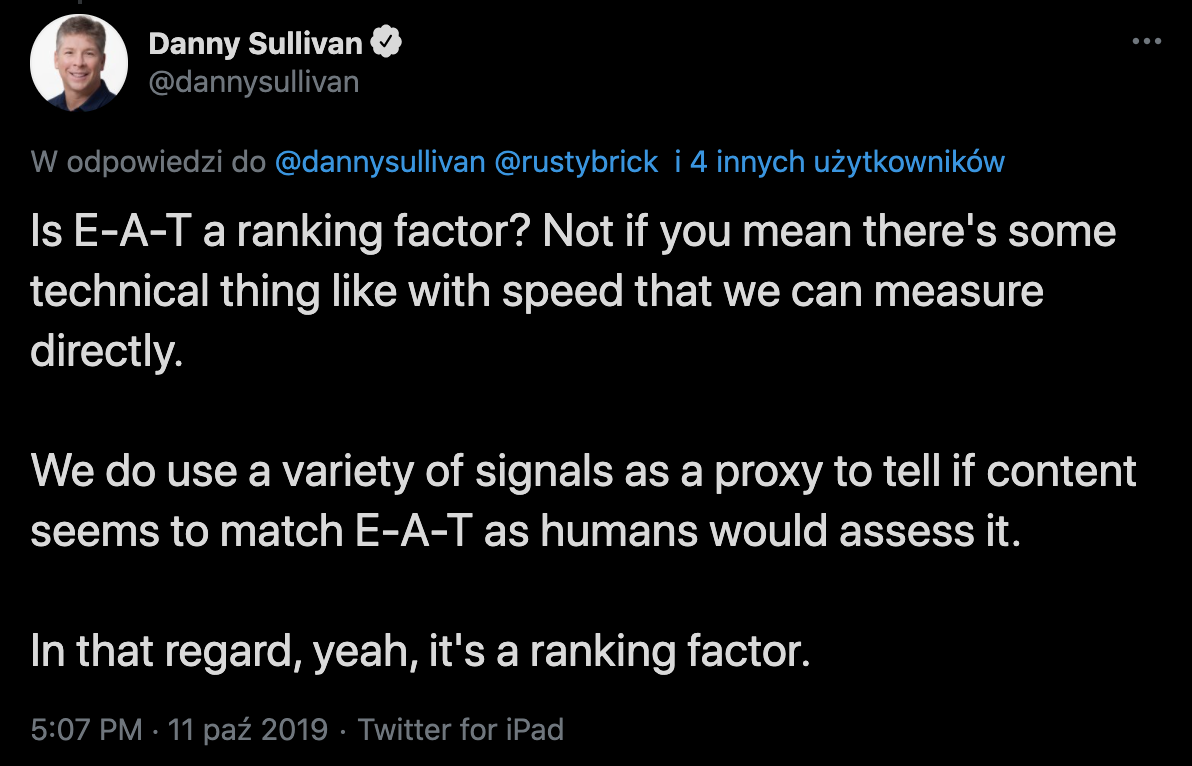
Debates about whether or not EAT is a ranking factor have been ongoing since the tester guidelines were published. Danny Sullivan, among others, has weighed in on this. 
Unlike the technical aspects of a website, which can mostly be assessed in very specific ways, EAT standards are more fluid. They cannot be described by awarding points.
A website is a kind of business card that allows us to present our business. Its attractive appearance, its adaptability to user needs, and the reliability of the information provided reflect our approach to customers and can influence their decisions. Providing high-value information presented in an accessible manner naturally generates user interest and a willingness to share, i.e., link to our website.
The bottom line? High quality = more engagement = natural links = more time on site = higher ranking.
Summary
The above article covers the following topics:
- The effects of the Medic Update on website positioning
- EAT – why following the guidelines is not always enough?