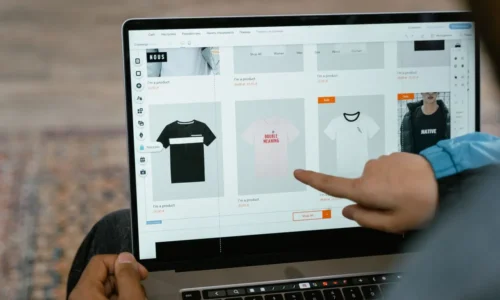
The e-commerce market in Poland is constantly growing – currently estimated at nearly 100 billion złoty! Seeing numbers like these, you immediately think about grabbing a piece of the pie. You're not alone. Every year, new online stores spring up like mushrooms after the rain, and some close just as quickly. This doesn't mean the market is saturated. It's a good business, as long as you have an idea, start-up money, and a head on your shoulders. And this will be useful for navigating all the related formalities: regulations, GDPR, taxes. No e-commerce business can do without them.
E-commerce regulations
If you think an online store's terms and conditions are a link to a page no one reads, you're probably right. Terms and conditions are like the Yeti – everyone's heard of them, but no one's seen them. However, that doesn't mean you can ignore them. Just because no one reads them doesn't mean you can't have them.
Without the online store's terms and conditions, a purchase agreement won't be concluded ... And here's a tidbit that will make you shine at many a house party. In Polish law and economics, there's no such thing as a PURCHASE-SALES AGREEMENT!
There's simply a sales contract, which is described in the Civil Code. So the next time a friend tells you about a signed sales contract, you can be eloquent and use the most sophisticated insults.
(The rest of the article can be found below the form)
But let's get back to the point. Without regulations, a sales contract won't be properly concluded. Furthermore, even short regulations won't meet statutory requirements.
The Consumer Rights Act imposes dozens of disclosure obligations on e-businesses. The main ones include:
- a detailed description of the electronic services provided in the e-shop;
- a detailed description of the terms and conditions of the sales contract;
- payment terms and methods;
- terms and costs of product delivery;
- conditions and methods of submitting complaints;
- conditions for withdrawal from the contract;
- processing of personal data.
>> Increasing your e-commerce conversion rate <
What are the consequences of not having the regulations in place or for errors in their content?
You might ask: Why do I need professional regulations if no one will read them? There are several answers to this question:
- If a customer doesn't read the regulations, that's his problem.
- An online store without professional regulations is not credible.
- A customer will not make a purchase in a store that does not inspire confidence.
- And finally, last but not least, you don't want to spend money on fines. And these are quite substantial, amounting to 10% of the company's revenue from the previous year.
Terms and conditions are a standard contract. The Office of Competition and Consumer Protection (UOKiK) oversees their accuracy. This office reviews your terms and conditions and imposes fines if it deems anything amiss. Fortunately, there's a simple way to avoid them. Equip your online store with professional terms and conditions. You can do this yourself if you enjoy crying in front of your computer and have the money to spend on psychoanalysts. A better and more affordable solution is to hire a lawyer who can write professional terms and conditions for your online store and take responsibility for them.
Do you sell on Allegro?
If so, don't think the Polish e-commerce giant has everything covered. Of course, Allegro has its own terms and conditions, but they only cover some of the disclosure requirements. Remember that a customer buying something from you is entering into a sales contract with you, not with Allegro. Therefore, you must inform them about delivery terms, returns policy, complaints, etc.
E-commerce and GDPR
I feel equally sad when I watch The Lion King and read about GDPR. So, when someone catches me crying during Mufasa's death scene, I say I just remembered I have something to do at work.
>> GDPR-compliant Cookie Banner. Important Information! <<
Almost every entrepreneur has heard of the GDPR, but almost none of them know exactly what it's about. The GDPR is the General Data Protection Regulation, which—in a nutshell— defines the rights and obligations of businesses regarding the protection of their customers' personal data. The difficulty in understanding this regulation lies in its very general nature and wide scope for interpretation. For example, it recommends using plain language when communicating with customers, but at the same time, it doesn't define what constitutes plain language. One thing is certain, however: If you want to run an online store, you need to have a privacy policy. Here's some advice: don't do it yourself. It's too complicated for a layperson.
You can outsource the creation of an e-commerce privacy policy to specialists. There are many companies and law firms online that will do this for you, and the service is reasonably priced.
>> E-commerce: Where to set up an online store? <<
E-commerce and taxes
PIT, CIT, VAT – if you are starting e-commerce, you should know these abbreviations.
Taxes are another crucial issue to consider before starting a business – not just e-commerce. The form and type of taxation depend on the legal form of the business. Taxation differs between a limited liability company and a sole proprietorship. For example, companies are required to pay corporate income tax (CIT). There are two rates: 9% and 19%, plus income tax on dividend payments to shareholders. However, with the Estonian CIT, the company does not pay income tax if it does not pay dividends. Sole proprietorship also offers several taxation options – a scale, a flat tax, or a lump sum.
It's worth taking an interest in taxes before starting a business, so you can choose the right taxation method from the very beginning, one that's tailored to your business's legal status . For this purpose, it's a good idea to consult a lawyer or tax advisor. It's better to spend a small amount of money on professional advice upfront than to pay much larger sums later for mistakes resulting from ignorance. Otherwise, when you ask your lawyer after a year of operation, "How do you assess my tax optimization?", you might hear the response, "For 25 years, sir!"
Summary
Do you feel like this post isn't providing you with concrete answers to your burning questions? True, but that's not the point. Without a thorough understanding of your business idea and expectations, it's impossible to provide a ready-made recipe for a properly functioning e-commerce business. Rather, we're providing roadmaps to help you find the right path to the pinnacle of business potential without any unpleasant incidents along the way.
It's worth seeking advice from experts. The world is full of bankrupts who knew better.
Good luck!
Summary
The above article covers the following topics:
- Why does an online store need to have terms and conditions?
- What are the consequences of the lack of regulations or errors in their content?
- What is required from a seller when selling products on Allegro?
- The GDPR Regulation and the functioning of online stores
- Taxes applicable to online sellers