Contents
You are now reading:
Cookie banner and conversion drops – how to recover lost data with Google Consent Mode?
Close
Privacy protection must be an integral part of every website. In 2022, efforts to modify the appearance and functionality of cookie banners to ensure they remain GDPR-compliant were intensified. Information about cookies used on a website is no longer sufficient. Users must now choose whether to accept them or not.
The implementation of the new cookie banner version is resulting in a decline in conversions. What does this mean for businesses in real terms? Klaudia Zielke, Head of Web Analytics at Verseo, explains how to tighten the process of collecting information about domain visitors despite their rejection of cookies.
What has changed regarding cookie banners?
Changes in the interpretation of GDPR and ePrivacy provisions mean that users can make informed choices :
- consent to the collection of all cookies,
- not to give such permission,
- accept consent to use only functional cookies.
This decision will not affect further browsing of the site, which is the greatest convenience, but also a change from the perspective of the recipients.
(The rest of the article can be found below the form)
Fill out the form and schedule a call with an expert
We'll get to know your business and prepare a personalized quote for the optimal marketing mix. Completely free.
The controller of your personal data is Verseo, a limited liability company with its registered office in Poznań, at ul. Węglowa 1/3.
About Verseo
The Company's registered office is located in Poznań. The Company is entered in the Register of Entrepreneurs maintained by the District Court for Poznań – Nowe Miasto and Wilda in Poznań, 8th Commercial Division of the National Court Register, under KRS number: 0000910174, Tax Identification Number (NIP): 7773257986. You can contact us by mail at the address provided above or by email at: ochronadanych@verseo.pl
You have the right to:
- access to your data,
- rectification of your data,
- request deletion of data,
- processing restrictions,
- object to the processing of personal data,
- transfer of personal data,
- withdrawal of consent.
If you believe that we are processing your data contrary to legal requirements, you have the right to lodge a complaint with the supervisory authority – the President of the Personal Data Protection Office.
We process your data for the purpose of:
- handling your inquiry, pursuant to Article 6(1)(b) of the General Data Protection Regulation (GDPR);
- marketing purposes consisting in the promotion of our goods and services and ourselves in connection with the consent you have granted, pursuant to Article 6(1)(a) of the GDPR;
- securing or pursuing possible claims in connection with our legitimate interest, pursuant to Article 6(1)(f) of the GDPR.
Providing your data is voluntary . However, without it, you will not be able to send us a message, and we will not be able to respond to you.
We may transfer your data to trusted recipients:
- providers of tools for: website traffic analysis, sending marketing information.
- entities responsible for hosting (storing) the website and personal data.
We will process your data for the period of:
- necessary to achieve the specific purpose for which they were collected, and after its expiry for the period necessary to secure or pursue any claims
- in the case of data processing based on consent until its withdrawal. Withdrawal of consent does not affect the lawfulness of processing prior to withdrawal.
We do not process personal data in a way that would involve making solely automated decisions about you. More information regarding the processing of personal data can be found in our Privacy Policy.
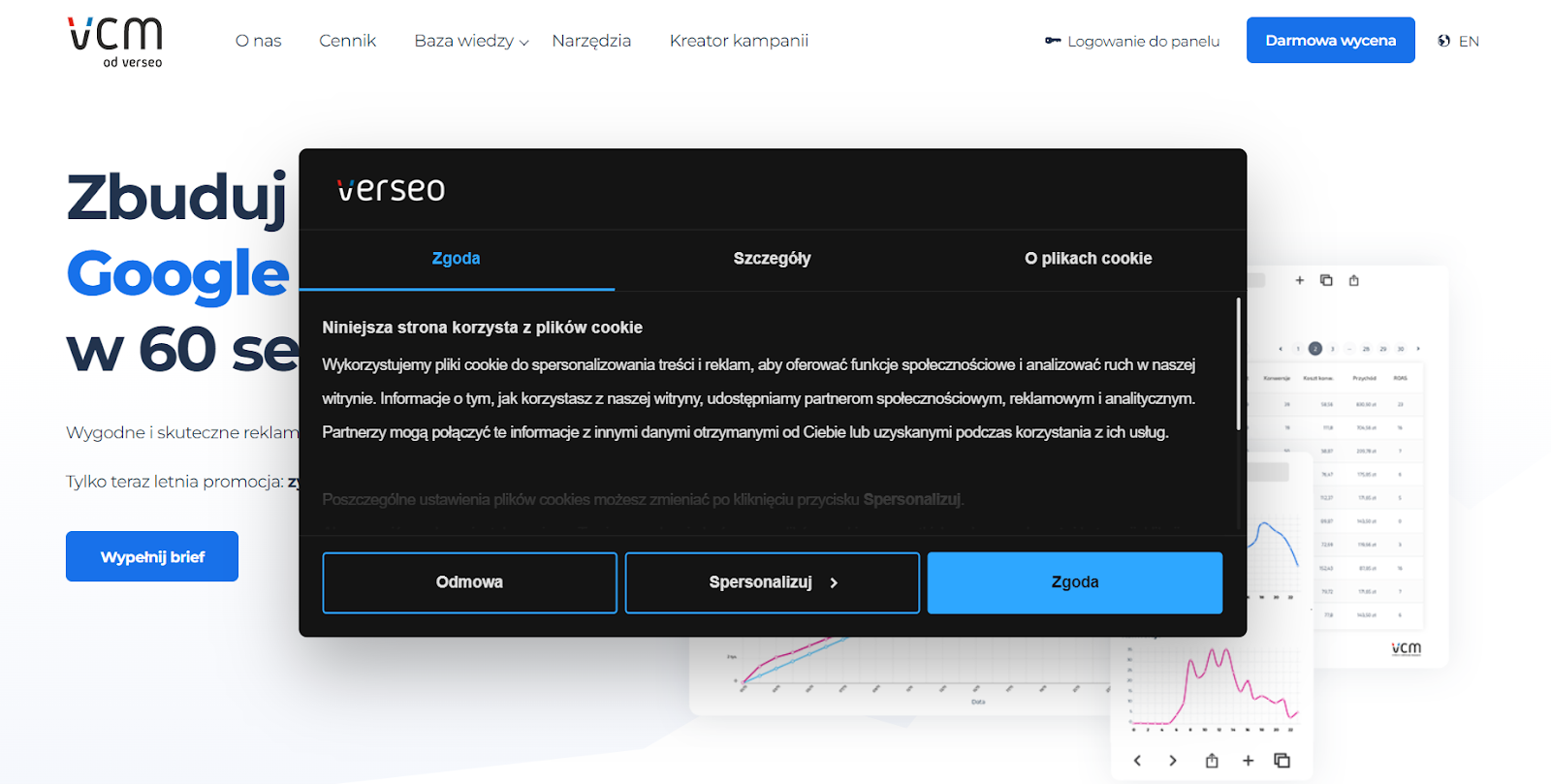
For the website owner, this means adapting the cookie banner to current requirements . You can read HERE how to do this in accordance with GDPR policy, for example, using Cookiebot.
Consequences of violating the regulations
Publishers and advertisers operating in the European Union or the United Kingdom are required to comply with the new privacy policy. Failure to comply may result in a fine from the Office for Personal Data Protection or the suspension of a Google Ads account and the suspension of a campaign. For the website owner, this means reduced revenue from the sale of promoted products and reduced website traffic. As you can see, this is a costly loss.
Implementation of a cookie banner on the website
To create a cookie banner, you can use a special tool that manages user consent, the so-called Cookie Management Platform, such as Cookiebot. It provides three basic functions that will ensure your website complies with GDPR regulations:
- obtaining consent to cookies,
- monitoring,
- controlling.
The first part of the implementation involves uploading code to the website. Automatic website scanning detects the cookies it uses. These cookies are then categorized (for example, analytical, statistical, or marketing).
A banner appears on the page, giving the option to accept or reject cookies. The second part of the configuration involves adapting the tags to the user's consent. Tracking tags, such as Google Analytics, Google Ads , or Facebook Pixel, will fire when someone gives their consent. If they don't, their activity within the domain cannot be tracked. Our experience shows that proper implementation of a cookie banner is associated with a minimum 10% decrease in conversions. The average acceptance rate for all cookies [in the absence of a "reject all" button – editor's note] remains at 70 to 90% ," explains Klaudia Zielke from Verseo.
Implementation of cookies and data accuracy
If the cookie banner has been incorrectly placed, you will observe the following on your website:
- Fast conversion peak – resulting from conversion tags being fired too frequently. The collected data will not reflect actual actions taken on the website because it is duplicated.
- Strong decline in conversion – This also occurs when you implement a cookie banner well, but it's too small or placed at the bottom of the page, making it practically unnoticeable to users. This prevents interaction between the banner and the recipient and prevents them from consenting to the cookie.
Cookie Banner – How Much Does an Incorrect Website Implementation Cost You?
Let's assume you're a thriving entrepreneur. You run a company, manage a team, delegate tasks, and do a million other things related to business development. You've heard about changes to your privacy policy, but haven't had a moment to address it.
- Changes to cookies – what do you need to know?
- GDPR-compliant cookie banner – how to implement it correctly?
- CMP – Cookie Consent Management Platforms
Let's briefly explain how implementing the new cookie banner will translate into conversions, how you will feel this pain, and what you can do to prevent it.
If you're running Google Ads campaigns and your conversions are measured as part of your Universal Analytics setup, you'll see a drop in conversions after implementing the new cookie banner. Using Google Analytics Universal (without relying on Ads and GA4 conversion codes), if a user declines cookies, you won't receive information about their conversions, so you won't be able to optimize your campaign. If the drops are significant and the campaign doesn't receive the appropriate data, the algorithm will start searching for a new audience, even though the one you previously set up was actually the right one. The campaign will simply lose its effectiveness," explains Zielke.
Who will pay for this...? Mr. or Mrs.!
It's best to illustrate the point with concrete numbers. Let's assume that before implementing the new banner, the return on every złoty invested in advertising was 9 złoty . After implementing the cookie banner, this return is, for example, 6 złoty. However, in reality, it could be 9, 11, or even 7!
Why is this happening? The campaign isn't collecting reliable data to ensure smooth operation . A drop in conversions causes the tool to raise bids, and when that doesn't yield the desired results, it searches for new audiences. However, it still doesn't collect data on whether the goal is achieved or not. And you're the one paying for it.
>> VCM Optimization Strategies <<
Why is it worth tracking conversions?
As Google support explains , they allow you to see, among other things, which keywords, ads, ad groups, and campaigns are most effective at attracting valuable users.
This is a simple answer to questions about:
- profitability of advertising activities,
- number of customers interacting with your ads,
- deviceswhich they use for this purpose.
By setting a goal, you can optimize your campaigns automatically.

Conversion Code Tracking 4 options
If you run advertising campaigns, you can configure the goals they achieve using Google Analytics and/or Google Ads. Check out these four scenarios:
- You base your goals on Google Analytics Universal and transfer them to Google Ads.
- You have configured your campaign conversions using standard Google Ads conversion codes.
In these two cases, if a user doesn't consent to cookies and converts (i.e., performs the expected action on the website), your tags won't register this event. This means you'll see a drop in conversions. The magnitude of the drop depends on how many people dismiss the cookie banner.
- You are transferring goals from Google Analytics 4 to the advertising panel because you are not tracking them using Google Ads conversion codes.
Data gaps related to cookie rejection will be partially filled. However, this approach won't allow you to measure conversions after an ad is displayed, meaning you lose the ability to fully understand how the Display channel is resonating with your audience.
- You measure your goals using Google Ads Enhanced Conversions (primary action) and Google Analytics 4 Conversions (secondary action) – the best option and recommended by specialists.
Conversions measured using Google Ads tags have an advantage over those set up in Google Analytics because they also count conversions after a video or display ad is viewed, not just after a click. This allows you to better plan your budget for cross-platform ad types and see the impact of individual campaign types on your campaign performance. If you're running a YouTube campaign, Google Ads conversions will allow you to see if it's effective after viewing, has an impact on the user, and whether it's worth investing in further, explains Klaudia Zielke.
The specialist suggests that it is always a good idea to implement Google Ads conversion codes, especially with the currently available campaign bid optimization strategies:
Google Ads algorithms and strategies are evolving, with optimization using artificial intelligence. Bids can still be set manually, but the effectiveness of such campaigns is significantly lower. The algorithm collects information from hundreds of different touchpoints simultaneously. It examines, among other things:
- user location,
- when he enters the website through an advertisement,
- when converting and from what device,
- what are his interests according to Google.
When setting bids manually, this is virtually impossible.
Importantly, if you're pulling conversion data from Google Analytics 4, specify in Google Ads that it's only an additional check (option: additional action) for which the algorithm shouldn't optimize ads. Otherwise, data will be collected twice.
>> B2B e-commerce: 6 most common mistakes <<
Recommendations
If your conversion rate drops after updating your cookie banner (this is normal) , and you still want to collect data about users visiting your website and optimize your campaigns based on it, follow the advice of Verseo's Head of Web Analytics:
- Implement GA4 on your website
This will allow the system to continue collecting key information about users who consent to cookies and fill in data gaps resulting from those who decline cookies. This is made possible by the Consent Mode system.
How does the Consent Mode system work?
By using machine learning and behavioral modeling, the system will allow us to estimate the data we lose as a result of users rejecting cookies , including:
- Daily number of active users who visited the website,
- The number of those who were acquired thanks to the last campaign,
- Customer purchasing path.
"The implementation of the new version of Google Analytics will allow us to fill the data gap resulting from users rejecting cookies. This is possible thanks to machine learning and behavioral modeling. We will obtain estimated data based on modeling the behavior of users rejecting Analytics cookies, paired with the behavior of similar users who accept them. All this to find a balance between the growing need for privacy and the ability to use data to make business decisions," explains Klaudia Zielke.
The estimated data will be tracked across the entire site and each channel, not just Google Ads. Analytics seamlessly integrates modeled and actual data in reports. You can find out whether your data has been estimated by clicking the data quality icon below:

Important…
This solution is global for the entire website, not specific to advertising activities. GA Universal won't allow you to view data with estimated values.
- Set up Google Ads enhanced conversions
This feature improves conversion measurement accuracy and enables more effective bidding. This Google-recommended solution allows you to estimate lost data and fill the information gap, which in turn translates into better campaign optimization.
Importantly, enhanced conversion data takes time to process. It can take up to 30 days from the time you launch to be included in your reports. During this time, tracking will continue as normal.
Improving Conversion Accuracy in Practice
I recommend implementing enhanced conversions via GTM. In the Google Ads dashboard, you can configure the code to automatically collect data. However, you'll lose control over what the system actually recognizes as additional information during the conversion, i.e., its so-called enhancement. If you're not familiar with this topic, seek expert support. They will work with your IT department to determine which data in the website's data layer can be used to set enhanced conversions, says Klaudia Zielke from Verseo.
Google Ads Enhanced Conversion – Customization Price
The price of the service depends on the amount of information contained in the page's data layer, or dataLayer, and starts at 500 PLN. If it turns out that the data required for configuration is unavailable, you'll need to contact our developers. If this isn't possible on the client side, Verseo specialists retrieve it using the page's CSS elements," explains Zielke.

Price of upgrading Google Analytics Universal to GA4
We offer this service as part of the Basic package. It covers all the steps necessary for businesses to get started, collecting and analyzing data for campaign optimization. This minimizes their workload and saves significant time. A Verseo specialist will implement the code, configure it, and set goals. With the Basic GA4 option, it will collect conversions set for the destination. If you want to measure event completion (i.e., actions that occur without changing the URL—for example, clicking a phone number, submitting a form, or copying content on a website), the service will be extended and priced additionally," explains Zielke.
How to recover lost data?
Our recommendations aim to mitigate the negative consequences of implementing the new privacy policy and cookie banner changes. What effects can you expect after implementing them?
If you follow the advice above, you can recover 50 to 70% of the data that isn't collected when you decline cookies . You won't see this data in standard Google Ads and Google Analytics Universal conversions, but GA4 and Enhanced Conversions will.
>> ASARI CEO: Optimization with automation and optimism! <<
Campaign optimization – PRO level
If you want to refine your advertising efforts and take full advantage of the power of algorithms, you can now learn the ins and outs of Performance Max campaigns and perfect your remarketing.
"I recommend doing things better than well. The dynamic changes introduced by Google create an unstable environment. If we ensure a good foundation, a foundation nourished by the right data, we can count on proper campaign growth," my interlocutor concludes.
Frequently asked questions about conversion drops after implementing a cookie banner
This decline is due to changes in data collection methods, not necessarily a reduction in user numbers. When a user visits a website and rejects cookies (or ignores a banner), analytics and advertising scripts (e.g., Google Analytics 4) cannot save cookies on their device. As a result, their visit and any purchases are not routinely recorded.
Typically not. Lower numbers in the analytics dashboard merely indicate a decrease in recorded (tracked) conversions. A user who rejects cookies can still make a purchase, but the system won't directly attribute it. Therefore, it's always worth comparing GA4 data with the actual number of orders in your store dashboard or CRM system.
Google Consent Mode is a mechanism that adapts the behavior of Google tags to the user's choices in the banner. If the user does not consent to cookies, Consent Mode does not completely block communication but sends basic, anonymous signals (so-called cookieless pings) to Google servers that do not violate privacy.
Using signals sent by Consent Mode and historical data from users who have opted in, Google uses machine learning (AI) to model conversions. The system estimates the purchase paths of untracked users, allowing it to compensate for any noticeable declines and attribute "recovered" conversions to the appropriate advertising campaigns.
This is neither recommended nor safe. Having a valid, legally compliant banner (GDPR, ePrivacy Directive) is a legal requirement. Furthermore, implementing Google Consent Mode v2 has been required by Google since March 2024. Failure to implement it prevents, among other things, building remarketing lists and running effective personalized campaigns within the Google Ads ecosystem.
Summary
The above article covers the following topics:
- The new GDPR rules require users to make informed choices regarding cookies.
- Implementing the banner via the Cookie Management Platform includes consent acquisition, monitoring and control of cookies with automatic categorization.
- Incorrect implementation causes a spike or drop in conversions.
- Conversion tracking allows you to evaluate the profitability of your ads, the effectiveness of your keywords and optimize your campaigns automatically.
- The four methods for setting up conversions are: goals from GA Universal, Google Ads codes, goal transfer from GA4, and Google Ads Enhanced Conversions from GA4 (the best option).
- Google Consent Mode in GA4 uses machine learning to estimate the data lost by cookie rejection, filling in behavioral gaps based on similar users.
- Google Ads Enhanced Conversions improves GTM measurement accuracy, requires page-layer data, and requires implementation by specialists.
- Using recommendations (GA4 + enhanced conversions) allows you to recover 50-70% of lost data and better optimize campaigns thanks to algorithms.