Whether running your own business or carrying out the daily tasks of a marketer, you struggle to acquire new customers and retain existing ones. The goal? The obvious one: constantly increasing sales and growing your business. But amidst this whirlwind of ideas for new products, promotions, and discounts, aren't you forgetting the most important thing? The question: who am I actually selling to ? Do you know? If not, this publication will comprehensively explain why clarifying this issue should be your absolute priority. Don't waste your time; let's tackle the question of what a Buyer Persona is!
Every company, regardless of industry, product range, or employee count, has at least one thing in common. It's the customer, the key component of a company's financial success. It's no wonder you strive to capture their attention every day! It's about tailoring your offerings to meet expectations, searching for the most satisfying solutions, hundreds of emails, and hours of phone calls… A person can get exhausted just reading it, let alone taking action!
However, when a transaction is finalized or a positive review is received, fanfares ring in your ears and champagne corks pop. Could this celebration be more frequent? It could. What can you do to make it happen? Gain insight into the audience for your products or services. Personalize your messages and advertising, and then gather information on why customers choose or choose NOT to use your offerings. This foundation can be used to build truly solid sales and branding foundations!
Worth remembering…
(The rest of the article can be found below the form)
If you want the best advice on how to refine your offer or service, ask for advice from… your customers. No one will be a more valuable guide!
Buyer Persona – Definition
If you want to operate effectively in a business environment, you need to be well-versed in maps. And if you don't have them, invest in creating them.
One of the first resources to help you efficiently navigate company processes will be defining your customer profile.
Who is Buyer Persona?
This fictional persona embodies the typical recipient of the content you create. These characteristics are determined based on demographic and geographic data analysis, online behavior monitoring, and information gathered through surveys and direct interviews. It takes a close look at all of our customers' behaviors and purchasing decisions, breaking down the entire decision-making process into stages.
Buyer Personas are not the same as Ideal Customer profiles, but they do build on this useful information base. They are supplemented with additional data:
- Recipient expectations and selection criteria.
- Problems encountered along the purchasing path.
- The benefits he will receive.
- The shopping paths he follows before making a decision.
Buyer Personas aren't customers either. For now, they're just people interested in your offer. To convince them, we need to pinpoint the habits, needs, and values that drive their purchase decision. It's worth noting that the phrase "by them" might not be entirely accurate!
Very often, people considering purchasing a product whose price will significantly reduce their budget (corporate or household) and impact their daily functioning ask a close friend for advice. Or they are dependent on their superior's approval. This is what we call a purchasing committee. Creating a navigation map and refining Buyer Personas will allow us to develop communication and a list of arguments that will be crucial in the final stage, closing the deal.
As we read on the Prowly website, when creating a buyer persona, you should determine:
- What is most important from our recipient's perspective.
- What motivates him to make a decision.
- What do you want to achieve by choosing our product or service?
- What can be a barrier in the relationship with the brand?
- What criteria are taken into account when making binding orders?
This will allow us to better meet expectations and respond to potential clients' needs with a personalized offer. That sounds like more than half the battle!
When creating Buyer Personas, don't focus on segmentation (using demographic data as a differentiator, for example), but on how and why a customer buys a specific product. A common mistake is focusing too much on who the customer is. However, it's also important to understand why they choose us.
How many personas do you need to refine your purchasing process? There's no single answer to this question. However, it's worth considering whether you'll have the capacity to implement separate marketing strategies for several personas. That's a pretty good clue, right?
Additionally, there's the question of whether each market segment truly needs to be distinguished. It may turn out that customers from different segments share similar purchasing habits or decision-making motivations. In that case, there's no need to treat them separately.
Good to know…
It may turn out that your product or service appeals to a very broad group. In that case, you'll likely need to create several Buyer Personas. However, don't try to appeal to everyone—otherwise, you could end up with the opposite effect. Simply "spreading the word around."
Answer before your client asks
We already know what a Buyer Persona is. Now it's worth considering why defining it is so important from a company's perspective. You might assume that salespeople know your product buyers intimately and have all the available knowledge about this genre. You're right, but people tend to take shortcuts.
In sales practice, this means we operate in a rather formulaic manner and often allow assumptions to take over. After gaining some experience, we fall into a rut, and without proper polish, we resort to labeling ourselves, judging based on previous experiences, and closing ourselves off from feedback. And what about the phrases "it doesn't work for us," "we can't work with this client," or "our product is simply too expensive"?
Regardless of the market you operate in, you probably know these sales team buzzwords by heart. But it doesn't have to be that way. Just start asking questions. In-depth questions that allow you to gain insight into why the customer was interested in your offer and why they ultimately (or didn't) take advantage of it. Especially since I'm already facing a certain information gap…
As we read on Buyerpersona.pl , according to CEB (now Gartner) research, salespeople get to know customers when they're already well into the purchasing process. This translates to a decision being made 57% of the time! What's more, according to Forrester Research, customers completing the purchasing journey independently can reach as much as 90%!
Before they approach you with a request for a quote, they'll first ask "Uncle Google" for recommendations. They'll gather initial information and form their own opinions based on it. What will they learn about you and your company online? It's worth keeping an eye on this. But that's a topic for another article. Those who want to delve deeper into this topic can check out our previous publications – for example, on Google My Business or on what content marketing is.
How does a Buyer Persona fit into this? It helps us supplement our knowledge of nearly half of our client's decision-making process. By analyzing the information gathered during an interview or survey, we'll learn how "Your Story" began, what barriers the client encountered along the way, how they evaluated the offer, and what criteria they considered.
What and how to ask to collect valuable material?
Above all, prioritize relational honesty. Ask directly and don't be afraid to "dig deeper." What do you need to know?
- What are your client's priorities? What will they definitely not give up on, and where might be the areas for potential negotiation?
- What's the biggest obstacle to achieving your business goals? This will help you refine your offering to best address your company's challenges.
- How they've already tried to deal with this problematic issue. And where they've sought help.
- Why did they decide to test a given solution?
The salesperson's role is to enter the customer's world. Questions will guide this journey, providing support in making key decisions. You don't need to conduct extensive interviews with every customer. Experts quoted by Buypersona.pl suggest that even eight half-hour conversations are enough to gather valuable information.
How else can you collect data other than through interviews and surveys? There are many tools available. Here are a few:
- Social media – it's a real treasure trove of basic information about the audience for your content and the users of the services you offer. By analyzing your SM profiles, you'll easily discover your customer's demographic profile (gender, background, interests). You'll also learn about their interests and active times. This will help you plan your posting times wisely. Monitor the comments below and draw conclusions from the ratings!
- Google Analytics – this tool is suitable for practically any analysis 😉 This is valuable information about website traffic sources and customer behavior. You will also learn whether they primarily browse your website on computers or mobile devices. This can significantly impact the type of advertising campaignsin which you will invest more funds.
- Google My Business Card – the opinions that end up there can be a real mine of knowledge for you and guides on the way to improving your business.
- Information from sellers or customer service "Your salespeople and customer service representatives are the front line between your company and your customer. They know your customer profile really well. Sometimes even too well! When gathering information from them, remember that people like to take shortcuts and often generalize. When creating a Buyer Persona, you must rely primarily on data, which you can then enrich with comments from the salesperson and a profile of your ideal customer."
- Ethnographic research – this is an in-depth analysis and description of group behavior in its natural environment. Don't worry, you don't have to perform them yourself (as a company) – you can simply outsource them.
- Focus groups – small, but representative of the target market. These are representatives of the environment you want to reach or are targeting with your offer.
The opinions and information gathered in this way provide a solid foundation for effective communication and a more precise offer. This, in turn, can simplify salespeople's work and significantly increase sales. And the customer will be satisfied. Everyone wins.
Buyer Persona: What it means for content, PR, and… the salesperson!
As we've established, building a buyer persona is crucial for optimally leveraging sales potential. It's the foundation for communication, more advanced PR, promotional, and marketing activities, and ultimately, for offering refinement.
The aforementioned personalization of messages and improvement of products or services to suit customer needs are not everything, however. It's also worth discussing the sales funnel. Careful and thoughtful segmentation of its individual stages allows us to take actions aimed at increasing the chances of a successful transaction. Furthermore, funnels allow us to forecast revenue and establish budgets based on this.
By understanding the barriers a potential customer encounters with a brand and what inhibits their purchasing impulses, we can act accordingly. We can leverage the human element—in short, the salesperson 😉—or the magic of machine-based processes (for example, automatic emails with offers or discount reminders).
Buyer Personas also streamline the flow of information between departments. Why? Because we create them based on cold calculations and in-depth data analysis. Dressing them up as fictional customers makes it easier to translate the numbers into the real world, better understand their needs, and "walk in their shoes." Based on this, we create guidelines for individual departments and narrow their scope of activity to specific stages of the funnel. In other words, we standardize the customer's vision and define the form of communication with them.
What else do we gain?
- Reducing spending on advertisement – we know what message will interest our recipient and what channels we need to use to reach them. We can skip the rest and use the saved funds for another campaign.
- Image consistency – when introducing a new product, we can quickly verify whether the form of its presentation (graphically and verbally) meets the expectations of the recipients.
- Tips on new products – we receive knowledge about what our customers need, what we should enrich our offer with, and what we should simply give up.
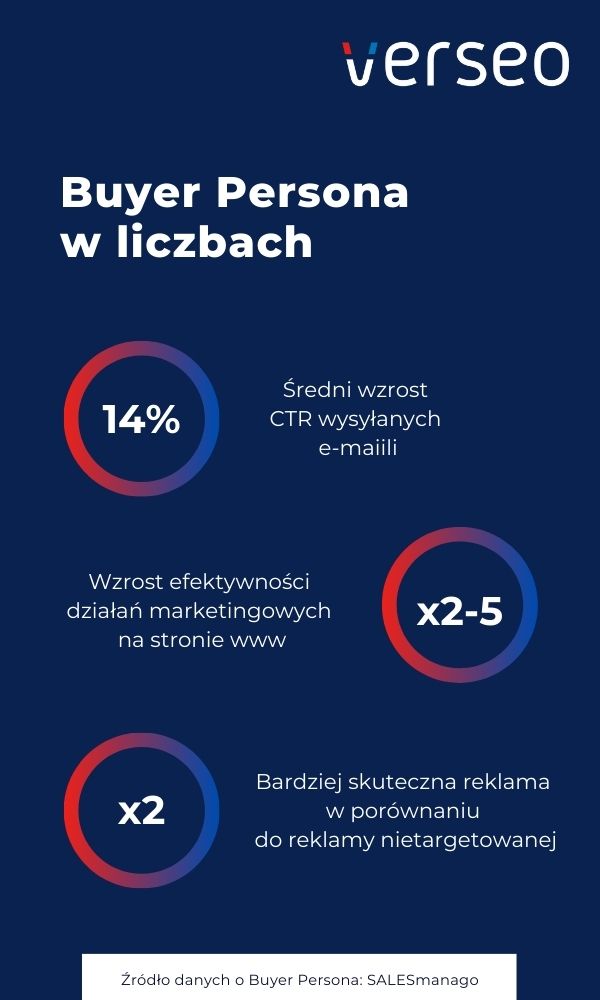
Buyer Persona – SALESmanago. Why is it worth creating? DATA
The answer to this question has already been provided, in a descriptive form, above. Now, however, we'll offer the essence that works best for visual learners. This is a brief explanation of why Buyer Personas are created. SALESmanago demonstrates with numbers how using this model translates into sales results.
 Buyer Persona data source: SALESmanago
Buyer Personas – How to Create Them? Good advice is always appreciated!
- Content first, form second – Graphic design is important, but the solid foundation and foundation is DATA. Proper data acquisition and analysis will help you understand your customer. Their needs, purchasing barriers, and motivators that influence purchasing decisions. Not sure how to ask about them directly? Answered in an interview he gave us. Krzysztof Rzepkowski, President of Sandler Training Polska. READ!
- Buyer Persona grows with your business – A customer model isn't created once and for all. Remember that a company evolves, and therefore its audience naturally changes as well. Periodically, perform an "x-ray" to ensure your proposed product or service still meets their expectations. This way, you'll never miss the moment of your customer's transformation, and consequently, overshoot your message. This could cost you dearly – literally.
- Throw away your premonitions – Your visions may differ from the reality. Generalizations and stereotyping distort the facts. Hold back your galloping fantasies – rely on reliable data.
Buyer Persona Institute – a methodology for influencing B2B customer decisions
Adele Revella has made persona creation a core part of her professional endeavors. The result is the Buyer Persona Institute (www.buyerpersona.com), which encompasses a comprehensive methodology for properly building personas, adapting products and marketing techniques to the actual needs of our audiences.
Ravella suggests that only quality interviews with customers (current and potential), careful questioning, and, above all, the ability to LISTEN, allow for drawing far-reaching conclusions that translate into a precise sales process. Techniques for conducting conversations, obtaining information, and truly listening to customer needs are also described in her book "Buyer Personas: How to Gain Insight into Your Customer's Expectations, Align Your Marketing Strategies, and Win More Business ." This book will teach you, among other things:
- How to collect and analyze data.
- Build three-dimensional profiles of real customers.
- How to classify needs.
- How to save (time and money) when creating Buyer Personas.
The concept of Buyer Personas presented by the book's author is based on five pillars of the shopping experience. These are:
- An impulse to action – that is, trying to find an answer to the question of what happened that made the customer consider purchasing a given product or service.
- Expected results What results do you want the investment to bring them? What did the customer want to achieve by choosing your offer? This knowledge allows you to build a message based on the individual benefits for the customer. It then becomes a ready-made solution to their specific pain. If you don't "do your homework" at this stage, you'll only ever talk about general benefits, which has significantly less impact!
- Decision-making barriers – based on the customer's attitudes (for example, his trust in the opinions about your product that he found online) or factors within the organization (for example, the lack of consent of the superior to continue the negotiations).
- Decision criteria – essential when building communication. Knowing them will help you highlight the product's strengths in your content, the most important from the customer's perspective.
- Shopping path – the steps taken by the recipient throughout the entire journey through the offer. From discovery to purchasing decision (positive or negative), including the context. At this stage, you'll learn who is involved in the final decision and to what extent.
Buyer Persona – template from HubSpot
HubSpot can also be a useful tool in the process of "walking in your customers' shoes." This inbound marketing, sales, and customer service software, which has been taking the market by storm since 2006, offers a Make My Persona option. HubSpot's Buyer Persona Templates are free templates that allow marketing, sales, and customer service teams to build customer profiles. The generator allows you to create professional, free buyer personas.
Using Buyer Persona templates, HubSpot supports the creation of an ideal customer profile. This makes it easier for your team to personalize and retain the data they collect. It's also valuable for streamlining your workflow.
Not everyone has to be your customer. You don't even want everyone to be! To grow your business, you need to define your ideal target audience and direct personalized messages to them. This will help you create more focused content that your audience is looking for. It will also make the work of marketers and salespeople easier!
Buyer Personas – SUMMARY
We hope that we have covered the topic of Byuer Personas comprehensively. Since this publication, and the topic itself, is quite extensive, we will summarize the most important information at the end.
A Buyer Persona is a fictional character embodying the characteristics of your ideal customer. However, it shouldn't be confused with an ideal customer profile, which in this case is supplemented with data provided by in-depth, face-to-face interviews. This provides additional insight into expectations, challenges, selection criteria, benefits, and the entire purchasing journey of our customer. Whether they decide to add a product to their virtual shopping cart or abandon it at the very end, feedback on what constituted a barrier to purchase will allow us to refine the entire process and avoid future failures.
Remember! No one can tell you more about the pros and cons of your offer than the client! To do this, you must set aside your preconceptions and personal opinions. Collect reliable data, ask questions, LISTEN (which isn't always obvious), and interpret the collected information appropriately. Everything will flow smoothly from there.
The information you gather will make your marketing and sales more effective. Communication will be personalized and targeted to a specific audience. You'll serve them the valuable content they're looking for and need. All kinds of blog posts, expert articles in the trade press, e-books, and other videos—still hot and served on a platter.
What's more, you'll be able to save a lot of money by investing only in channels that truly reach your customers. Just create a publishing schedule, a strategy, and… you're ready to go. With panache and the right flair. Good luck!
Summary
The above article covers the following topics:
A Buyer Persona is a detailed profile of an ideal customer—complete with demographics, behaviors, motivations, and challenges—that allows a company to understand exactly who is really buying its products or services.
Creating a Buyer Persona brings many benefits: it enables better tailoring of communications and offers to customer needs, optimization of marketing activities, more accurate targeting, and increased sales effectiveness.