When you search for an SEO audit online, you'll find both free and paid tools for DIY SEO audits, as well as various offers from SEO specialists. This variety of offers can raise questions like whether it's worth paying for something you can get for free and what type of audit my website needs. The answer is simple: a paid SEO compliance check is incomparably more thorough and detailed. Below is an example of what such an audit looks like at Verseo.
For this post, we selected a report created for a clothing brand that sells both online and in-store. This company offers women's and men's clothing, accessories, and footwear. This client commissioned us to conduct a comprehensive audit, and after receiving the audit, they signed a contract with us for website SEO.
What does an SEO audit include?
Our SEO audit report is 359 pages of valuable information about a website's strengths and weaknesses in terms of Google search engine optimization. It's provided with a table of contents and divided into sections to ensure clarity and ease of use for the client. For example, this e-commerce SEO audit report is divided into six main chapters:

This particular document was prepared by four experts, including the Head of SEO and a senior specialist. The conclusions presented here are based on their knowledge and experience, as well as data from numerous tools that analyze website visibility, such as Semstorm, Senuto, and Ahrefs. Let's now discuss the individual sections of the report in detail.
(The rest of the article can be found below the form)
Introduction
We understand that clients receiving reports primarily want to quickly review any detected errors and shortcomings, leaving the technical details to the developers. Therefore, the first part of the report is a synthesis of the information contained within, enriched with our recommendations. These include:
- The most important conclusions from the audit
Here, we presented the client with the biggest issues we found on their website – briefly, in bullet points, to give an idea of how many changes would be necessary to optimize the site . In this case, our specialists identified the following basic issues:
- a large number of technical errors that make indexing by robots difficult,
- a large number of non-existent subpages (404 error),
- poor visibility for industry phrases,
- incorrectly implemented language versions,
- incorrectly implemented SALESmanago causing duplicate content within the website,
- lack of product descriptions, categories and a visible content strategy,
- incorrectly implemented sitemap hindering correct indexing,
- incorrect mechanism for displaying stationary stores, making it impossible positioning of specific locations.
- Fixes requiring priority implementation
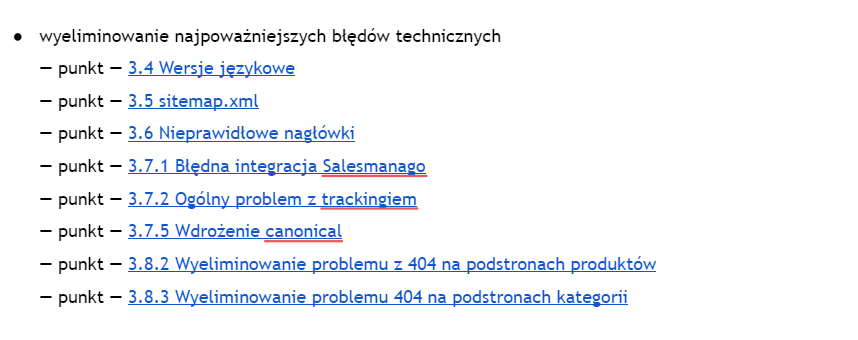
We then proceeded to highlight the errors that, in our opinion, are most detrimental to the website and should be addressed first. However, we have already addressed the more detailed analysis conducted later in the report and provided the client with links to the relevant sections of the document, as seen here:
Thanks to this, the client could immediately proceed to a more in-depth discussion of the problems, but at the same time received a clear checklist and could easily eliminate errors step by step, starting with the most urgent changes.
- Critical areas of change related to brand perception
Next, we discussed which of our proposed changes could impact the brand's image in the eyes of customers. We presented these in a separate section to emphasize that they require a deeper, strictly marketing-focused analysis. These are the types of changes that positively impact the website's position in search results, but may not align with the brand's vision for development.
For example, we emphasized that phrases that indicate product prices, such as those containing the words "cheap" or "low price," would convert well from an SEO perspective , but these phrases may conflict with the company's image being built by the marketing department. In other words, we outlined areas that require developing a collaborative strategy with the brand's PR team.
Google visibility analysis – an element of an SEO audit
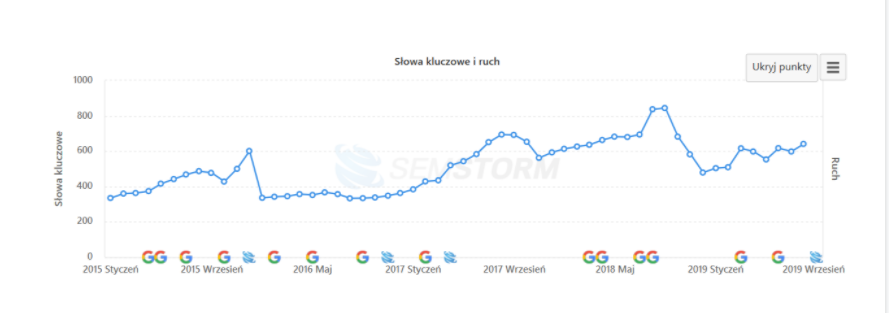
We then presented the client with the results of an analysis of their website's online visibility. We analyzed the 100 keywords that had generated the most traffic in recent months to reveal which search queries were leading users to the website. We noted that a staggering 99% of the site's visits came from branded searches—phrases containing the company's name. This meant the site was virtually invisible to users who had no prior experience with the brand.
As part of our visibility analysis, we also checked the number of keywords for which the client's website appeared in the top 10 and top 50 search results and compared these results with those from 12 months ago. Based on this, we could conclude that the website was experiencing declines of 11% in the top 50 and 23% in the top 10.
The next step in the report's development was to compare the client's website's visibility with that of its direct competitors. We identified several e-commerce sites with similar business profiles and conducted a comparative analysis. We examined the percentage of keywords in the TOP 10 and TOP 50, as well as the estimated traffic, for the client's website compared to competing brands. This revealed that the audited site had relatively low online visibility.
Based on the collected data, we recommended that the client significantly expand the website with content containing industry-specific phrases, create extensive category and product descriptions, and introduce changes to the structure of existing texts.
Technical optimization of the website
Page loading speed and language versions
The technical audit began with a focus on website loading speed. The PageSpeed Insight results were satisfactory, but we found significant room for optimization. We suggested, among other things:
- CSS and JS code minification,
- reducing the number of server requests by eliminating unnecessary files and combining smaller ones,
- implementing file caching by the user's browser,
- introduction of gzip compression.
We also recommended speeding up page generation by removing render-blocking resources, removing unused rules from stylesheets, and changing image file formats. All of this was done to eliminate factors that could slow down site loading as much as possible.
The audited website had two language versions, so we checked whether they were properly implemented and could be indexed correctly. We noted translation gaps that needed to be addressed, and automatic redirects from PrestaShop, the online store software, needed to be disabled.
Redirects and errors
We also discovered a fairly widespread problem with redirects on the site—temporary 302 redirects were being used extensively for content that had been permanently moved to a different URL. The 404 header was also incorrectly implemented on some nonexistent pages, and we were also alerted to the overall high number of 404 errors across the site. Over the course of 11 days of crawling, we gathered enough information to present the client with as many as 1,000 nonexistent pages—both product and category tabs. The solution we presented included switching from temporary to permanent redirects, introducing archived products to avoid 404 errors, and implementing permanent redirects for deleted categories.
We also discovered some false 404 errors on the client's website, caused by store locations being presented in JavaScript, which made search engine crawlers think they were indexing completely empty pages. In this case, it was advisable to create canonical tags.
Treści
Duplicate content and missed opportunities to increase visibility
A serious problem with the website in question was duplicate content caused by faulty integration with SALESmanago. The incorrect implementation of the tool led to the creation of subpages with identical content to existing tabs – this not only weakened the site's ranking but also distorted marketing statistics. To solve the problem of duplicate content , we recommended implementing canonical tags, which provide search engine crawlers with "indications" as to which subpages are original and should be indexed. We also advised disabling indexing of specific parameters in Google Search Console.
In the report, we also highlighted the website's untapped potential, meaning elements that weren't SEO- critical but could be more beneficial. Among other things, we noted the lack of subpages for individual brick-and-mortar stores in the client's network and the lack of links to other products in the specific product tabs. Product descriptions were also underutilized – they lacked, among other things, adequate textual content with product names, traffic-driving support with long-tail keywords, and information about available product variants.
Errors and shortcomings on category subpages
Next, we pointed out the lack of category descriptions – another area of untapped potential. The subpages contained only products, and we suggested enriching them with descriptions containing keywords relevant to the customer, which would generate more organic traffic. We also analyzed the URLs of these subpages and discovered that many of the names contained duplicates, which could be avoided with minor modifications and clarifications. We noticed that the category subpages lacked H1 headings and that the title tags were too generic, making it significantly more difficult to generate organic traffic.
Our analysis also uncovered additional SEO opportunities through category filters – some individual filters (for example, clothing size) could be used to increase traffic from long-tail keywords. However, we stipulated that only some filters should be indexed, and changes in this area should be made very carefully and only for individual filter values.
Supplementing the content
A content analysis of the website revealed a significant need for new content and expansion of existing content . Category descriptions were nonexistent, while product descriptions were too short and not optimized for keywords. In this regard, we advised the client to create a list of keywords valuable in their industry and infuse the website's content with them. We also recommended introducing a blog or advice section, which would be useful for several reasons:
- would be a natural place for long-tail phrases that would attract users directly from the search engine,
- would be used to present product boxes that generate additional conversions,
- would support internal linking on the website.
We also showed what such a blog could look like, listing the key elements it should contain. We also noted that introducing a blog would require developing a content strategy, including a plan for posting frequency, topics, keywords, text length and formatting, and so on.
Linking strategy
As part of the audit, we also reviewed the client's website's linking strategy and noted insufficient internal linking – many subpages required links to similar products, and the lack of a blog prevented linking to categories. The external link profile proved very strong – the site was frequently mentioned in texts on high-quality external portals. However, the analysis revealed that most links led to the store's main page, and strategic linking to category and product subpages using selected keywords was lacking – this is where we identified room for improvement.
Additionally, we noted that some external links led to subpages with 404 errors—these were, in effect, lost links that could be recovered by rebuilding the site according to our guidelines. We also demonstrated opportunities for expanding external linking and emphasized the need to coordinate marketing and SEO efforts in this area.
Audit Summary
To sum up the conducted audit, we noted that the introduction of both technical and content changes should be preceded by the development of an SEO strategy that will allow for the coordination of activities, the identification of the most important goals and, as a result, greater visibility of the website on the Internet.
FAQs about the content of SEO audits
An SEO audit is a detailed analysis of a website's compliance with Google's search engine requirements and user needs. Its primary goal is to identify technical, structural, and content errors that are blocking the website from achieving higher organic rankings, and to develop a plan to address them.
The technical section focuses on the "code" and architecture of the site. It analyzes elements such as:
- Website loading speed and its adaptation to mobile devices.
- Correct indexing of pages (e.g. elimination of 404 errors).
- Configuration files for search engine robots (sitemap.xml and robots.txt file).
- Connection security (presence of an SSL certificate) and correctness of the URL structure.
In the content layer, specialists assess the quality and uniqueness of the text on the website. They check for duplicate content (copies of content within the website or from other pages), whether headings (H1-H6) are logically arranged, and whether meta tags (Title and Description) are completed correctly and contain the appropriate keywords.
Yes. A full audit also analyzes the inbound link profile of your website. Our specialists check the number and—more importantly—the quality of links from external domains. This allows us to identify toxic links that can lead to Google penalties, and to plan a safe link-building strategy for your site.
A typical audit is a comprehensive and transparent report (usually in PDF format or as an interactive spreadsheet). It includes a prioritized list of detected issues (ranging from critical to minor) and specific implementation guidelines. The document is designed to ensure that the web developer or copywriter knows exactly what changes they need to make.
An audit is absolutely essential at the start of any new SEO campaign. However, it's worth repeating at several key points: before a planned website migration or redesign, in the event of a sudden and drastic drop in Google traffic, and as a preventative measure (e.g., once a year) to ensure your website is keeping up with the constantly changing search engine algorithms.
Summary
The above article covers the following topics:
- A paid SEO audit offers a much deeper and more detailed website analysis than free tools, which in practice helps companies effectively start the process of professional website positioning.
- A professional SEO audit report is a multi-page study of your website's health, prepared by experts and based on data from advanced tools, indicating specific directions for optimization for the Google search engine.
- The initial section of the SEO report provides a practical synthesis of the most important errors and priority fixes, which helps the client quickly implement key changes while ensuring consistency with the brand image.
- A comprehensive SEO audit identified numerous technical issues, errors in content structure, and untapped website sales potential, allowing us to develop a precise strategy to optimize loading speed, improve indexing, and expand content.
- Effectively increasing a website's visibility requires basing all technical and content changes on a coherent SEO strategy that coordinates activities and sets priority business goals.