
Contents
You are now reading:
Law firm advertising on the internet – SEO, Google Ads and social media strategies
Close
Lifting the ban on attorney advertising – what has changed in 2023?
For many years, attorneys in Poland were subject to a complete ban on advertising. Paragraph 23 of the Bar Code of Ethics stipulated that attorneys were prohibited from advertising or soliciting clients in a manner inconsistent with the dignity of their profession.
Lawyers promoting their services – for example, by using social media advertising – had to face disciplinary action and financial penalties.
The situation changed radically on May 26, 2023, when the Supreme Bar Council adopted a resolution during its plenary session abolishing all total bans on the use of commercial information by attorneys.
In the amended Code of Ethics, the term "advertising" has been replaced by the term "commercial information", which is defined as any form of communication aimed at promoting, directly or indirectly, the services or image of a lawyer.
(The rest of the article can be found below the form)
Fill out the form and schedule a call with an expert
We'll get to know your business and prepare a personalized quote for the optimal marketing mix. Completely free.
The controller of your personal data is Verseo, a limited liability company with its registered office in Poznań, at ul. Węglowa 1/3.
About Verseo
The Company's registered office is located in Poznań. The Company is entered in the Register of Entrepreneurs maintained by the District Court for Poznań – Nowe Miasto and Wilda in Poznań, 8th Commercial Division of the National Court Register, under KRS number: 0000910174, Tax Identification Number (NIP): 7773257986. You can contact us by mail at the address provided above or by email at: ochronadanych@verseo.pl
You have the right to:
- access to your data,
- rectification of your data,
- request deletion of data,
- processing restrictions,
- object to the processing of personal data,
- transfer of personal data,
- withdrawal of consent.
If you believe that we are processing your data contrary to legal requirements, you have the right to lodge a complaint with the supervisory authority – the President of the Personal Data Protection Office.
We process your data for the purpose of:
- handling your inquiry, pursuant to Article 6(1)(b) of the General Data Protection Regulation (GDPR);
- marketing purposes consisting in the promotion of our goods and services and ourselves in connection with the consent you have granted, pursuant to Article 6(1)(a) of the GDPR;
- securing or pursuing possible claims in connection with our legitimate interest, pursuant to Article 6(1)(f) of the GDPR.
Providing your data is voluntary . However, without it, you will not be able to send us a message, and we will not be able to respond to you.
We may transfer your data to trusted recipients:
- providers of tools for: website traffic analysis, sending marketing information.
- entities responsible for hosting (storing) the website and personal data.
We will process your data for the period of:
- necessary to achieve the specific purpose for which they were collected, and after its expiry for the period necessary to secure or pursue any claims
- in the case of data processing based on consent until its withdrawal. Withdrawal of consent does not affect the lawfulness of processing prior to withdrawal.
We do not process personal data in a way that would involve making solely automated decisions about you. More information regarding the processing of personal data can be found in our Privacy Policy.
The new regulations do not, however, mean complete freedom – commercial information must comply with the principles of the Code of Ethics for Advocates, must not undermine the dignity of the profession, and must be clearly marked as originating from an attorney and enable their unambiguous identification.
Comparative, unreliable, untrue, deceptive, inappropriate and intrusive advertising remains prohibited, and lawyers are also prohibited from cooperating with compensation law firms or creating unreasonable expectations as to the results of the legal assistance provided.
Law firm advertising – how to promote yourself online?
Now that the Supreme Bar Council has lifted the total ban on attorney advertising, what tools can law firms use to promote their services online?
Based on our experience, resulting from cooperation with over 150 law firms and legal advisors from all over Poland, we can say that there are a number of actions you can take if you want – as a lawyer – to appear in the Google search engine.
One of the basic tools is the Google Business Profile (Google business card), which increases the visibility of the law firm in local results – potential clients entering, for example, "divorce lawyer Kraków" can thus more easily find the law firm.
A professional website is equally important, as it serves as the foundation for building trust and online visibility. It can include contact information, a description of your practice, information about your team, and a legal blog that supports search engine optimization.
SEO does not bring immediate results, but the high position achieved in Google can be maintained for a long time and does not require continuous expenses like paid advertising.
For law firms looking for faster results, Google Ads campaigns are a good complement , allowing them to reach clients when they are actively seeking legal assistance and precisely define their target group.
Another effective channel is social media – on Facebook, LinkedIn or TikTok, lawyers can share legal advice, comment on current changes in the law, announce training courses or publish video materials.
However, it should be remembered that commercial information cannot contain evaluative content, promises of success, comparative advertising or appeal to emotions – all published content must be reliable, non-intrusive and not derogatory to the dignity of the legal profession.
What can commercial information look like in Google Ads?
For commercial information to be compliant with the Code of Ethics for Attorneys, several key principles must be followed:
- do not post any subjective opinions, comparisons to other law firms or evaluations of the services provided – slogans such as "the best", "the cheapest", "the most effective" or "specialist" are not allowed,
- use factual phrases in headlines and the content of the message, e.g. "lawyer Krakow", "law firm - criminal cases", "legal advice - inheritance law",
- do not promise or suggest to a potential client that the case will be won – commercial information must not create unreasonable expectations as to the results of the legal assistance provided,
- avoid being pushy when informing about your services,
- provide facts and factual information about the services provided, e.g. information about services provided to private individuals and businesses, the number of years of business activity or experience in a given field – instead of "99% satisfied customers", it is better to mention 15 years of experience in the profession,
- use subtle calls to action such as "Call us" or "Contact us" instead of pushy slogans like "Do you want a divorce? Call us, we'll solve your problem faster than others!",
- not to violate the dignity of the profession, the principles of camaraderie or attorney-client privilege – it is unacceptable to discredit other lawyers.
Below is an example of the content that may appear in search results:
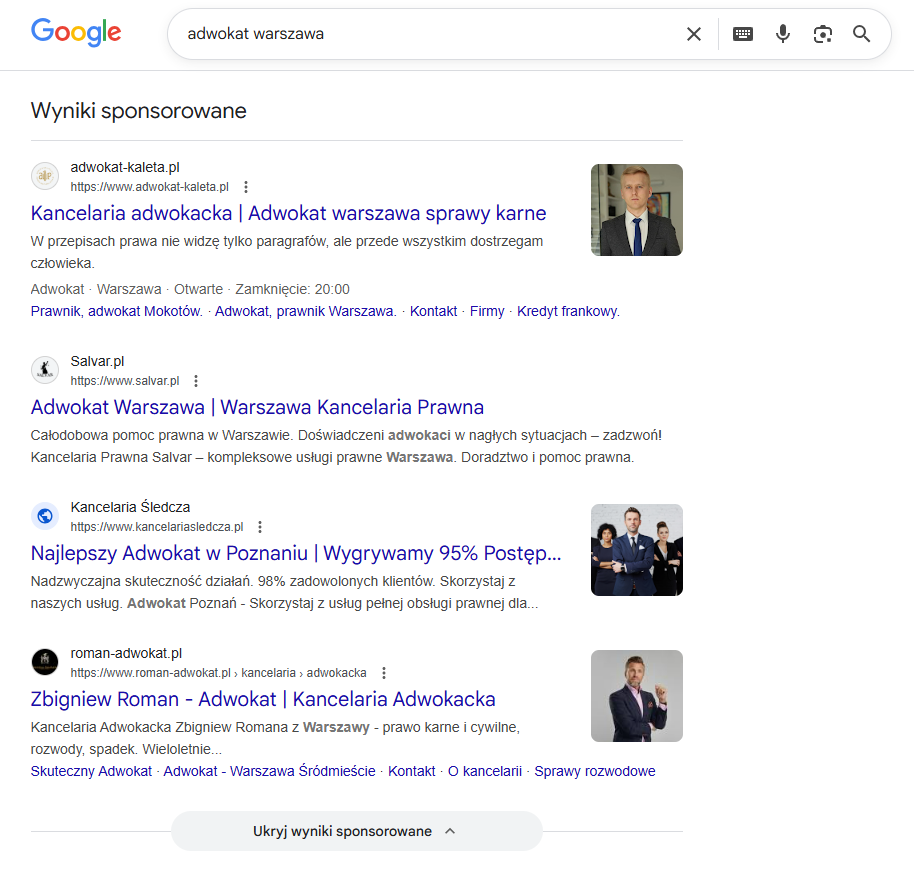
Figure 1. Example of Google search results for the keyword phrase: "lawyer Warsaw".
This format fully complies with professional ethics, as it's the internet user who initiates the search for information. The content of the ad should be factual and include basic information: the firm's name, location, scope of services, and contact information.
Law firms can also reach internet users through display ads displayed on Google partner sites. Banners can include the firm's logo, a short informative text, and encourage visitors to visit the website. This format is particularly effective in building firm brand recognition.
Please note that, in the case of legal services, there are significant limitations on remarketing—reminder ads displayed to people who have previously visited the firm's website. Google does not allow the collection of audience lists of individuals experiencing personal difficulties, victims of abuse, crime, or other traumatic events.
This means that in many cases—especially if the law firm specializes in criminal, compensation, or family law cases—the system may block the use of remarketing. This is a case-by-case decision that requires individual analysis.
Law firm advertising – summary
As you can see, preparing an advertisement, or rather, commercial information about a law firm's offerings, is neither impossible nor very complicated. By respecting the importance of the profession and paying attention to the elements mentioned above, you can gain a presence in Google search without breaking any applicable rules.
Writing informational notices that don't contain prohibited content isn't difficult. All you need to do is ensure the message is appropriate. Then, you can wait for calls and messages from internet users who have expressed a desire to receive such information and, in response, have attempted to contact the law firm.
Summary
The above article covers the following topics:
- From May 2023, lawyers may promote their services using commercial information, provided they maintain the dignity of their profession and adhere to certain ethical principles.
- Law firms can promote themselves online through Google business cards, website positioning, Google Ads campaigns and social media, provided they maintain reliability and professional ethics.
- Commercial information in Google Ads must be factual, free from value-laden slogans and promises of success, focusing solely on facts about experience and the scope of services.
- Creating ethical business information for a law firm on Google is a simple process, as long as you ensure the appropriate nature of the message and respect for the dignity of the legal profession.