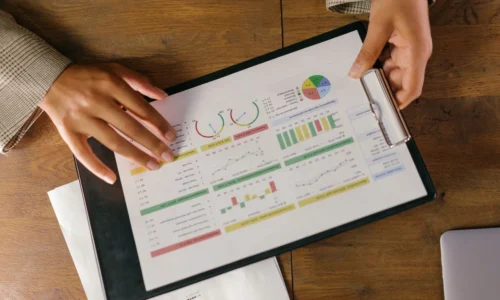
The business cycle is characterized by successive episodes of financial recovery and contraction. A period during which companies record excellent financial results and are eager to invest is called expansion. In contrast, when stock market indices plummet, unemployment rises, and consumers hold on to their wallets, recession arrives. However, these changes shouldn't be treated as a death sentence. Sometimes, a recession actually becomes an opportunity for cheaper acquisitions or more effective innovation. At the same time, not every sector of the economy reacts to downturns equally – luxury industries may rapidly lose customers, while other sectors, such as basic services, may still thrive. Awareness of the business cycle allows you to develop a balanced strategy and avoid making hasty decisions influenced by momentary sentiment.
Business cycle – definition and economic context
In economic theory, the business cycle refers to recurring fluctuations in economic activity, measured by indicators such as GDP growth, unemployment rates, and overall production and consumption . While these fluctuations were once thought to stem primarily from periodic investments in machinery and inventory, attention is now being paid to:
- globalization,
- demographic changes,
- social mood,
- political events.
All of this can combine to create an unpredictable whole. Companies and governments adopt various approaches to stabilizing the market, employing monetary policy instruments (such as interest rate manipulation) and fiscal policy instruments (e.g., tax cuts or increases). Typically, they aim to avoid excessively sudden spikes and downturns in economic activity.
In practice, the economy can still surprise even experienced analysts, as indicators and models don't always account for factors such as sudden global crises. Understanding market mechanisms is a task that requires regular checking of indicators and constant adjustment of strategies.
(The rest of the article can be found below the form)
Business cycle phases – a turning point for entrepreneurs
The business cycle consists of four main stages . It begins with expansion, characterized by low unemployment, rising corporate profits, and a general willingness to invest.
When the market situation reaches a certain maximum and the mood is almost euphoric, we can talk about the peak of the economic bull market.
Then comes a slowdown, which turns into a recession – companies experience declining sales, investors become more cautious, and some workers lose their jobs. If the recession deepens, it can develop into a deeper crisis, but more often, the market simply gradually rebounds, entering the next phase of recovery.
From a practical point of view, during periods of growth it is worth thinking realistically and not taking on excessive debt, and during periods of recession it is worth taking advantage of opportunities arising from lower prices or the availability of qualified staff.
Phases of the classical business cycle and reality
Economists often cite the phases of the classic business cycle, which were described in literature as early as the 19th century. Economies at that time were largely based on industry, and technological innovations like the steam engine sparked massive investment controversies, followed by corrections.
Today, new elements are emerging: digitalization, the growing importance of services, a stronger role for central banks, and unpredictable geopolitical events. At the same time, the very essence of the cycle remains similar. We still see the same stages: growth – peak – slowdown – trough – recovery. We've only enhanced them with instruments to minimize shocks, such as emergency bond purchases and special stimulus programs for businesses.
At the same time, many investors are learning that it's better not to succumb to collective enthusiasm and panic, as the economy, by its very nature, moves in waves. What has truly changed in recent decades is the pace of information flow, which in the age of the internet is incredibly rapid and can destabilize markets in just a few hours.
Business cycles – impact on the labor market
Economic fluctuations have a profound impact not only on the wallets of entrepreneurs and investors, but also on those seeking stable employment. During periods of expansion and recovery, the number of job offers increases, wages rise, and qualified professionals can expect better conditions. However, during a downturn, it can be harder to secure raises or promotions, and some companies conduct mass layoffs or cancel their most expensive projects.
From a labor market perspective, it's also important to note that employee turnover decreases during recessions, as people are less likely to change jobs during uncertain times. New candidates, in turn, are more likely to invest in upgrading their skills to increase their employability when the economy improves. This mechanism influences the supply and demand for skills, which in the long term shapes the structure of the labor market. Economic cycles can have a long-lasting impact on entire generations of workers—from fields of study to career preferences.
The economic cycle and investor decisions
Looking at the economic cycle, we can see that it pays to invest in a specific phase or exit it before the biggest downturn arrives. However, predicting a peak or trough is more difficult than it might seem – many investors make the mistake of assuming that a bull market will last forever, or conversely, they withdraw capital when the market is already on the verge of a rebound.
Planning should not only involve following charts and reports, but also analyzing social behavior, central bank policies, and technological advances.
Even a minor signal from a major trading partner can trigger a chain reaction, leading to a collapse in commodity markets and, subsequently, a decline in the profitability of businesses in a given sector. Therefore, companies that want to survive each phase of the cycle often strive to diversify their operations and maintain adequate cash reserves.
Economic cycles globally
A country's economic cycles are closely linked to the global situation . A recession in a major trading center is enough to rebound, and the countries producing semi-finished products or providing services also suffer. On the other hand, a favorable period in a major trading partner can translate into increased demand and increased revenues for local exporters. For this reason, globally operating companies closely monitor developments in various currency zones, analyze changes in commodity prices, and monitor declines or increases in demand worldwide.
It's also worth remembering that some markets are growing rapidly, offering stable investment opportunities, while others remain uncertain due to political conflicts or infrastructure shortages. Spreading investments across different regions can be one way to balance risk , especially when the domestic economy enters a recession.
The modern business cycle
The modern economic cycle is different than it was just a few decades ago. This is primarily due to state intervention and active central bank actions, such as bond purchases and lowering interest rates to stimulate credit and investment. Furthermore, the development of information technology, e-commerce , and broadly defined digitization have led to the emergence of new sources of income and changes in business models.
While previously, production indicators and warehouse inventories were primarily tracked, today digital platforms, online advertising , and streaming services also play a significant role. As a result, certain sectors of the economy are developing at an exceptionally rapid pace, almost breaking away from the traditional realities of the cycle.
A practical look at the business cycle
No one has a 100% surefire formula for navigating through all stages of the cycle without loss. Companies that manage to weather downturns often build their advantage through flexibility and the ability to anticipate trends. In times of good fortune, instead of maximizing debt, they set aside capital and invest in brand-building strategies.
One of the foundations can be effective online promotion and SEO , as even during a recession, the internet remains a vital sales channel. During a crisis, it's worth examining which market segments are most resilient and perhaps targeting them.
Conducting a cost audit, negotiating with suppliers, and considering external financing, provided it's well-secured, can also be very helpful. These decisions depend on individual circumstances, but understanding the mechanics of the economy definitely helps you choose the best time and method of action.
- In times of expansion, do not be afraid of innovation and investment in development,
- During the peak, be careful not to overestimate the capabilities of your business,
- As a recession approaches, consider securing your liquidity and costs,
- During the recovery phase, review what worked and what failed in the previous cycle.
In summary, business cycles are a natural phenomenon in market economies, and their role in company strategies cannot be overestimated . Each subsequent phase creates challenges, but also opportunities that – if properly exploited – can translate into stable company development. Understanding how these rhythmic changes operate, combined with the ability to flexibly adapt, is therefore one of the pillars of conscious business management.
Check out related articles
Frequently asked questions about the business cycle
The business cycle is a phenomenon characterized by repeated, alternating fluctuations in economic activity. Periods of rapid economic growth are inevitably followed by periods of economic slowdown. These changes are measured using macroeconomic indicators such as GDP (Gross Domestic Product), inflation, and unemployment.
In the classical economic model, four successive stages are distinguished:
- Recovery (boom): The economy begins to grow, unemployment falls, investment and consumption increase.
- Peak (boom): The moment of maximum overheating in an economy. Employment and production are at their highest levels, but this is often accompanied by high inflation.
- Crisis (recession/downturn): A noticeable decline in economic activity. Businesses cut production, unemployment rises, and consumers spend less.
- Bottom (Depression): The lowest point in the cycle. The economy reaches a minimum of activity, after which the process of recovery slowly begins.
The causes of cycles are usually divided into two groups:
- Internal (endogenous): Resulting from the very nature of the economy, e.g. overinvestment, central bank interest rate policies, changes in consumer demand.
- External (exogenous): Independent of market mechanisms, e.g., breakthrough technological innovations, wars, pandemics, natural disasters, or sudden commodity shocks (e.g., a drastic increase in oil prices).
To determine the stage of the business cycle, analysts examine so-called business cycle indicators. These include, in particular, GDP growth, price indices of goods and services (inflation/deflation), employment and unemployment rates, consumer sentiment (propensity to buy), and industrial production indicators.
Knowing where the economy is in its cycle is crucial when planning business and marketing strategies. During periods of recovery and boom, it's worth boldly investing, scaling the business, and introducing new products. In a recession, however, focus on cost optimization and maintaining financial liquidity, but also look for opportunities—for example, by taking advantage of competitors' budget cuts, you can acquire traffic more affordably and build a strong position for future growth.
Summary
The above article covers the following topics:
- what is the business cycle,
- phases of the business cycle,
- how changes in the economic situation affect employment,
- global economic fluctuations,
- what the modern business cycle looks like,
- how to use knowledge about business cycles in business.