Contents
You are now reading:
Snippet in SEO – what is it and why is it important for the visibility of your website?
Close
A snippet is a fragment of a page's description that appears in search results. Properly crafting it will help your site stand out and increase your chances of reaching more users. What is a snippet, and what are its types?
Snippet – what exactly is it?
A snippet is a short teaser of your website, visible in search results. Its basic elements are the URL and a short description of the page, intended to provide users with information about the site.
Rich snippet, regular snippet and featured snippet – the differences
Snippets can be divided into several types:
- regular (basic) – this is a classic snippet, which consists of a URL and a fragment of the page description, this is a snippet in its simplest form,
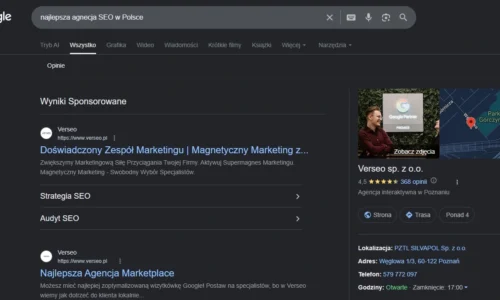
- rich snippets (so-called "rich" snippet) – this type allows the user to see additional resources and advantages of the website, thus increasing the chances of attracting them to that particular website. The results may display additional information, such as contact information, products, promotions, and more. This element requires the introduction of additional structured data (rich snippets) to present such results in the search engine.
- featured snippets (so-called "recommended/featured snippet") – appears first in search results, even before advertising links, the featured snippet takes a fragment of the page, showing it in the search results – it is a type of response to the user's needs and generating results based on the search intent, the featured snippet shows the results that are closest to the user's query.
Each type of snippet has its own unique properties and benefits that affect how the page appears in search results.
(The rest of the article can be found below the form)
Fill out the form and schedule a call with an expert
We'll get to know your business and prepare a personalized quote for the optimal marketing mix. Completely free.
The controller of your personal data is Verseo, a limited liability company with its registered office in Poznań, at ul. Węglowa 1/3.
About Verseo
The Company's registered office is located in Poznań. The Company is entered in the Register of Entrepreneurs maintained by the District Court for Poznań – Nowe Miasto and Wilda in Poznań, 8th Commercial Division of the National Court Register, under KRS number: 0000910174, Tax Identification Number (NIP): 7773257986. You can contact us by mail at the address provided above or by email at: ochronadanych@verseo.pl
You have the right to:
- access to your data,
- rectification of your data,
- request deletion of data,
- processing restrictions,
- object to the processing of personal data,
- transfer of personal data,
- withdrawal of consent.
If you believe that we are processing your data contrary to legal requirements, you have the right to lodge a complaint with the supervisory authority – the President of the Personal Data Protection Office.
We process your data for the purpose of:
- handling your inquiry, pursuant to Article 6(1)(b) of the General Data Protection Regulation (GDPR);
- marketing purposes consisting in the promotion of our goods and services and ourselves in connection with the consent you have granted, pursuant to Article 6(1)(a) of the GDPR;
- securing or pursuing possible claims in connection with our legitimate interest, pursuant to Article 6(1)(f) of the GDPR.
Providing your data is voluntary . However, without it, you will not be able to send us a message, and we will not be able to respond to you.
We may transfer your data to trusted recipients:
- providers of tools for: website traffic analysis, sending marketing information.
- entities responsible for hosting (storing) the website and personal data.
We will process your data for the period of:
- necessary to achieve the specific purpose for which they were collected, and after its expiry for the period necessary to secure or pursue any claims
- in the case of data processing based on consent until its withdrawal. Withdrawal of consent does not affect the lawfulness of processing prior to withdrawal.
We do not process personal data in a way that would involve making solely automated decisions about you. More information regarding the processing of personal data can be found in our Privacy Policy.
What data can a snippet contain?
A snippet may contain various data, including:
- information about current promotions, sales and prices,
- customer reviews and opinions,
- contact or other address details,
- information about product availability or the company.
Rich snippets in snippets can also be transferred to pages related to, for example, job offers, a blog, or other resources – it all depends on the specifics of the website and on what a given company mainly bases its conversions on, what goals are most important to it (acquiring qualified employees, e-commerce sales to B2C, arranging business meetings, booking appointments, etc.).
Why are snippets important and worth taking care of?
Snippets are a very important part of an SEO strategy – they are not without significance when it comes to website positioning.
Particularly important in this regard are rich snippets and featured snippets, which make a website stand out in search results . By providing additional information, such as ratings and prices, they attract users' attention and can increase clicks, which is crucial for website SEO.
Except that:
- attractively presented snippets (especially rich snippets) can significantly increase click-through rate (CTR),
- provide users with relevant information directly in search results, which helps them quickly find answers to their questions, which in turn affects positive user experience with the website,
- snippets can help the website stand out from the competition.
Maintaining snippets, including using structured data, helps search engines better understand a page's content and structure. Properly implementing structured data markup can support effective indexing and page presentation in search results.
How to prepare a good snippet?
Here are some tips to help you prepare an effective snippet:
- use structured data – these are special HTML tags that help search engines better understand the content of the page,
- take care of the meta title and description – remember to include keywords in them,
- use attributes for rich snippets – e.g. prices, reviews, opinions, available products, etc.
Content is also crucial in creating compelling snippets – ensure your page description is engaging, interesting, and includes keywords. Ensure valuable content that reflects the user's search intent.
Summary
The above article covers the following topics:
- Definition of a snippet, i.e. a fragment of a page displayed in search results
- Types of snippets (basic, enhanced, and highlighted) and characteristics of each
- Examples of information presented in snippets
- The importance of snippets for SEO strategy and click-through rate
- Practical tips for optimizing snippets