Hello, weary marketer! Each of us is under a hailstorm of responsibilities and constantly thinking about how to convert internet users into new customers. Sometimes it's worth pausing, reviewing your marketing efforts to date, and seeing what the latest research, statements, and statistics tell us about the market! In short, take a closer look at marketing trends.
Marketing Trends 2022 and Their Impact on Advertising Activities
Marketing trends are changing so rapidly that it's difficult to plan beyond six to 12 months. The pandemic, inflation, the shift of public services to the digital sphere, and the armed conflict in Ukraine are only accelerating the pace of change, which has long been in its infancy and suddenly had to come to fruition. So let's examine the marketing trends for 2022 and what to consider in our advertising efforts.
>> Sales Funnel – What is it? Definition and Example <
Marketing trend numero uno – does the crisis actually influence purchasing decisions?
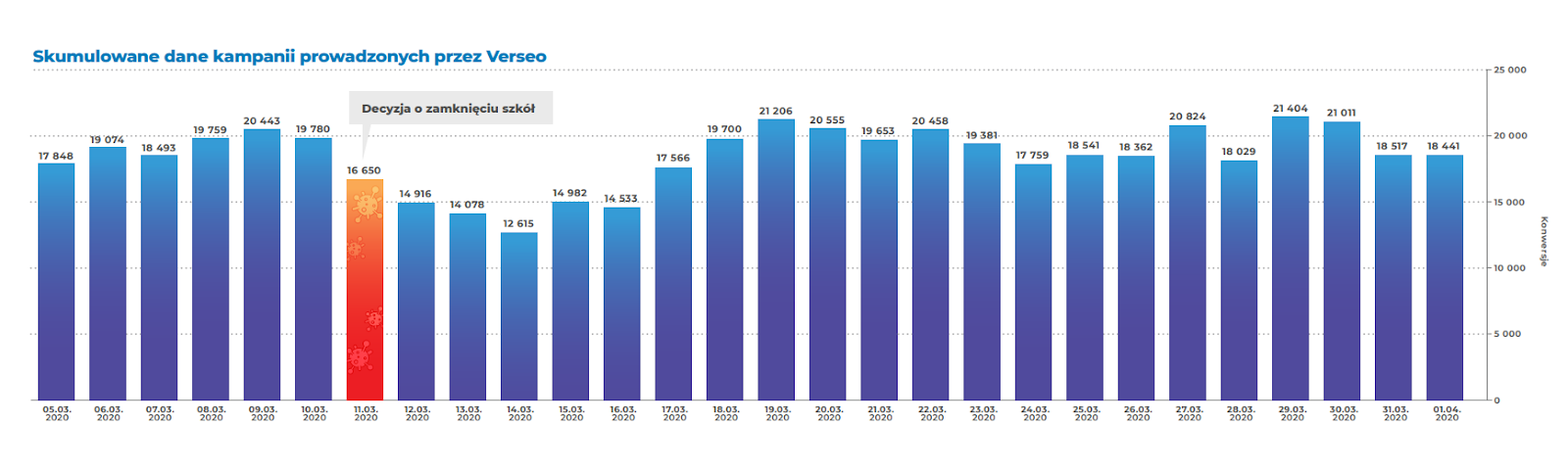
Much has been made of the pandemic as a catalyst for change in e-commerce. However, it turns out that the pandemic—viewed through the lens of performance campaigns—was more of a series of individual events that, in most cases, had a short-term impact on advertising campaigns than a single, long-term event. The average website was visited by the same number of internet users, or more.
(The rest of the article can be found below the form)
These included decisions to close schools, shops, and forests, and then gradually reopen them. At that time, advertisers made nervous decisions and limited marketing activities, stemming from a misunderstanding of consumer behavior. The decline in the value and quantity of purchases persisted for about a week after the government's key decisions, but it is difficult to assess to what extent this stemmed from consumer concerns about the future and to what extent from advertisers' decisions to limit advertising investments.
It's also important to remember that systems like Google Ads and Facebook Ads are also "victims" of marketing automation; they constantly "learn" from data and make decisions based on it. If we suspend their activities overnight or drastically reduce budgets, data consistency becomes compromised, and the system needs time to relearn consumer behavior.

As the chart shows, it's not worth making hasty decisions EVEN in situations as extraordinary as school closures. Consumers have often been forced to stay home with their children, and senior hours and limits on crowds in supermarkets have effectively convinced them to shop online. So why limit spending on paid advertising? There's no justification for such impulsive tactics, and it's important to remember not to make hasty decisions. Take action only after observing data for a longer period – for example, 30 days. Automating marketing activities allows for flexibility, but it also brings with it responsibility.
>> How to Sell More with Amazon and Google? GUIDE <
Marketing Trend 2 – We Don't Like Long Delivery, But...
But times are changing! 🙂 The five main factors that have contributed to the increasing delivery times over the last two years are:
- disrupted supply chains,
- raw material problems,
- rising transport costs,
- staffing problems (quarantines, hospitalizations),
- the increase in the number of courier shipments is disproportionate to the number of couriers.
The constant bombardment of information about logistical and production problems has made us somewhat more tolerant of delivery times. Of course, we don't want to wait more than two or three days for essential goods, cosmetics, or books, and that's understandable. However, we're increasingly accepting that clothes arrive after a week and cars can take up to a year, something that, just a few months ago, would have evoked a rather mild look of pity.
Customers want transparency and reliability of the data provided on your website. If you know that your shipments reach the customer on average within 4 days from the time of ordering, don't try to be pretentious by claiming delivery within 2-3 days. Even a day's delay can frustrate many customers, especially if they're buying a gift at the last minute.
Communicate the reason for the longer delivery.
Do you know that…
40% of respondents in the 2022 Chamber of Digital Economy report indicate that long delivery times are a barrier to purchasing. However, the 2022 Deloitte report suggests that 66% of respondents are prepared for long delivery times due to logistical issues.
Marketing Trend 3 – Dude
The PWN dictionary leaves no room for interpretation. A "dude" is someone from the same country, town, or area. Why am I writing about this? Because locality is starting to play a significant role, and it's hard to imagine marketing trends, content marketing, and social media without mentioning community building and a glocal society. A few numbers to help you understand:
- 51% of consumers admitted that in 2022 their economic involvement in local and small businesses is bigger than ever. PWC Report 2021
- 62% of respondents trust members of their communities more than advertising, CEOs, or institutions. Edelman Trust Barometer 2021
- 40% of consumers say they feel lonely, a feeling exacerbated by the pandemic and growing mental strain. IPSOS 2022
It seems we've finally understood – a purchase is an impact! It impacts our surroundings, our infrastructure, and our future. We're increasingly inclined to buy locally and increasingly value artisans. You could say history has come full circle. 🙂 What lessons does this hold for marketers?
Above all, leverage the community-building mechanism. Influencer marketing has brilliantly capitalized on the need to create groups, but this form is undergoing something of an authenticity crisis when it turns out that clothing made in Poland is actually made in China, and cosmetics are—despite assurances to the contrary—still tested on animals, just not in the EU. It's too early to declare influencer marketing extinct, but something is clearly starting to change in the critical approach to many opinion-formers. Influencer marketing has thus become known as just another form of business as usual, and after all, everyone wants authenticity.
>> Nonverbal Communication: Show me what you're not telling me. <
That's why we're currently seeing the creation of brand-focused groups in social media, managed by self-proclaimed brand ambassadors and driven by the community itself. Content marketing is no longer about planning, but about letting it create itself—in other words, familiar, beloved, and… devilishly difficult-to-launch user-generated content is resurfacing. However, the game is worth the effort.
When communicating your brand and content marketing, it's also good to emphasize local character, recipes, respect for the environment, and best practices. It's also worth reporting your impact on the environment, even if it's seemingly small things. Customers will appreciate what you do for the community. How do we know this? We're moving on to the next trend.
Trend 4 for 2022 – Buy Responsibly
The report from the HAVAS agency for 2022 clearly states that:
Again PWC in 2021 says:
It's not revolutionary that if we have a choice between buying a product A) for nothing and B) with an additional bonus, we'll choose the latter. We might simply be doing something good with the purchase, offsetting our environmental impact, or simply feeling better by satisfying an inner need.
However, it turns out that brands are poor at communicating their involvement in charitable causes and CSR strategies. It's worth testing such messages among your own audience and seeing if they positively impact consumer behavior on your website.
Marketing trend 5 – 55 years old game changer!
The pandemic and the shift of public administration services to the digital world are two key factors behind the fact that people over 55 are the fastest-growing age group online. This is a recent and highly underappreciated fact among marketing professionals, who have yet to recognize older people as one of their target groups. What do we know about them? The 2022 report by the Chamber of Electronic Commerce shows that:
- Unlike younger age groups, this group buys mainly when necessary.
- 52% of people over 55 years of age indicate that another person's opinion/advice is crucial for them when making a purchasing decision.
- For people under 55, the way they obtain product information is distributed evenly across all channels.
So what should we do? First, it's a good idea to transfer offline experiences to the digital world, giving older people the opportunity to consult their choices or somehow ensure that the purchase they've made is what others like them are choosing. To achieve this, it's worth creating a virtual consultant or creating graphics on product pages featuring people of a similar age who have already expressed their opinion on the product, are satisfied, and have highlighted the specific benefits of the solution.
>> Increasing your e-commerce conversion rate <
Trend 6 – Either big or nothing at all
According to Nielsen's 2022 annual report, social media spending among marketers worldwide increased by 53% in 2021. 2022 will be no different in terms of the dynamics of change. Nearly half of marketers worldwide want to increase spending on paid advertising and social media messaging. Quality content marketing will be equally important , and marketing activities will be based on hard data derived from analytical tools. Data collection is also an extremely important future competency for every marketer.
In addition, marketers declared that the most important goal to achieve this year will be to increase awareness and build the brand image among their recipients.
For experienced advertisers, reading the above statistics and declarations should immediately raise red flags. Budgets are growing faster than the time and advertising space we can buy. Paid channels are becoming more expensive, and potential customers are being exposed to messages from companies that deliver the same things you do, relatively more frequently than you can afford. What does all this mean? A mini-revolution, or the end of the shopping funnel!
Customers involuntarily consume gigabytes of information daily. Stimulated, inspired, and bombarded with advertising messages, we can't even predict when we'll be ready to purchase a product or use a service. In 2022, you won't be able to tell at what stage of the funnel the recipient of your content is.
Also, remember that your customer may be at the awareness stage with you, but may already be qualified for a sale in another company's communications. All of this means you now need to reach customers as inexpensively and frequently as possible. All of this is to increase the likelihood of being displayed to the customer when they're actually ready to make a purchase. It doesn't sound fancy, but it's effective. The marketer's task in such a setting is to provide fuel for customer return to your website, to entice them, and to find new avenues of communication that will potentially be even more effective.
>> Social Media Marketing – What is it? How to Choose the Right Media? <
Marketing and remarketing activities must be primarily based on frequency, not creativity. It's also worth considering the conclusions from the recently published second part of the book How Brand Grow, which argues that it's much easier to reach new customers and thus penetrate the market than to focus on building loyalty among existing customers.
Top Questions About Marketing Trends in 2022
Short-form video has become the foundation of communication. This trend was fueled by the enormous success of TikTok, which competitors quickly responded to by promoting formats like Instagram Reels and YouTube Shorts. In 2022, it was dynamic, vertical, and authentic video that engaged audiences the most and generated the greatest organic reach.
"Cookieless future" is the process of gradually moving away from third-party cookies, which for years allowed for the precise tracking of users online. Changes in privacy policies (e.g., Apple iOS) and Google's announcements have forced marketers in 2022 to focus on acquiring so-called first-party data—customer databases collected directly and with their explicit consent (e.g., through newsletter subscriptions or loyalty programs).
AI and automation have ceased to be considered a thing of the future and have become the norm. They have been implemented en masse to optimize advertising campaigns (e.g., smart bidding in Google Ads, Performance Max campaigns), while marketing automation systems have enabled increasingly precise, automatic personalization of messages sent to customers in real time.
In 2022, advertisers' attention shifted from big celebrities to micro- and nano-influencers. Although these creators have smaller followings (e.g., from a few thousand to tens of thousands), they cultivate an incredibly trusted, highly targeted, and engaged community. Collaborating with them has proven to be more authentic and often guarantees a higher return on investment (ROI).
Social commerce is a trend that sees social media intertwined with e-commerce. Instead of forcing users to leave apps and navigate to external storefronts, platforms like Facebook, Instagram, and Pinterest have begun to aggressively develop features that allow users to browse product catalogs and make purchases directly from posts or stories.
The modern customer's purchasing journey is no longer linear. Users can view an ad on their smartphone while riding the tram, inquire about details on Messenger, and ultimately make a purchase from their laptop at home. The omnichannel strategy aims to deliver a perfectly consistent message and excellent customer experience across all these touchpoints, blurring the lines between the online and offline worlds.
Summary
The above article covers the following topics:
- changes in marketing in 2022 and their impact on the effectiveness of advertising activities,
- whether the difficult economic situation changes the way we buy,
- customers' approach to delivery times,
- the process of building a community around the brand,
- localism as an important marketing trend,
- the growing importance of responsible purchasing,
- seniors as an increasingly important target group on the Internet,
- increasing investment in social media, the importance of analytics and quality content.