Contents
You are now reading:
Google has messed up SEO reports! How does removing the num 100 parameter affect the data?
In September 2025, the &num=100 parameter, which had been a fundamental tool for SEO specialists and marketers for years, disappeared from the search engine. The result? Google Search Console data looks different, with the number of impressions dropping, the average position rising… and it's easy to draw erroneous conclusions.
What does this really mean for your company? Have you lost visibility, or has your reporting method simply changed? And how can you analyze the results to avoid making bad decisions? Check out our summary and see what to look for to ensure your SEO reports continue to work for your business.
Parameter &num=100 – what is it?
The &num=100 parameter allowed the display of the full 100 results for a given query at once , instead of going through subsequent pages of 10 results.
This simple solution was crucial for both SEO specialists and analytics developers, as it allowed for a quick, comprehensive view of search results. This made it easy to see which sites were in the top 100 and what the competition was like . Over the years, this became a convenient standard of operation, and with Google's return to pagination in 2024, its role once again gained importance.
(The rest of the article can be found below the form)
Deprecation of parameter &num=100
On September 15, 2025, Google finally deprecated the &num=100 parameter. The first signs of its deprecation appeared between September 11 and 14, 2025. The parameter was removed to simplify the presentation of results, protect against mass data downloads by bots, and optimize loading performance. Manually entering &num=100 also stopped working.
Parameter rollback &num=100 a consequences for position monitoring tools
Shortly after the change was implemented , position monitoring tools like Senuto and Seostation noticed performance issues (unnatural jumps in visibility, problems with position reading) related to the parameter change. The tool's developers quickly resolved the issue, and data is now being collected correctly.
Implications for Google Search Console (GSC)
Google's removal of the &num=100 parameter had the greatest impact on the data presented in Google Search Console (GSC).
The standout effect is a significant drop in impressions , especially for positions outside the top 10 , meaning further down the list (e.g., 20+, 50+). Google Search Console no longer counts the long-tail results that were previously visible thanks to the &num=100 parameter. The number of keywords visible in reports has also decreased, meaning the reports now show a narrower range of queries.
Meanwhile, the average position for many pages has improved because it no longer considers the poor positions in the next hundreds of results, which previously lowered this statistic. As a result, reports may look different even without an actual change in search engine ranking.
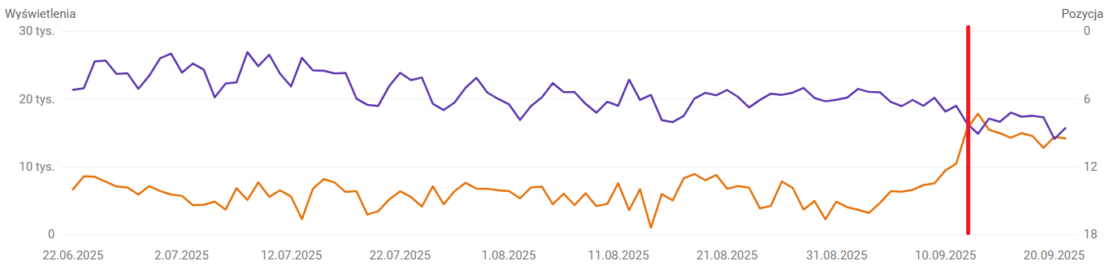
Examples of deviations observed in Google Search Console:


The charts show an increase in average position and a downward trend in the number of views.
Description:
Red vertical line on the chart it is the 12th day of September 2025. That is, the day on which the tests for withdrawing the parameter &num=100 began.
Purple line – number of views
Orange line – average position
Despite these adjustments, actual organic traffic and clicks remained relatively stable , demonstrating that a decline in GSC impressions does not mean a decline in actual site visibility.
What do these changes mean for Verseo customers?
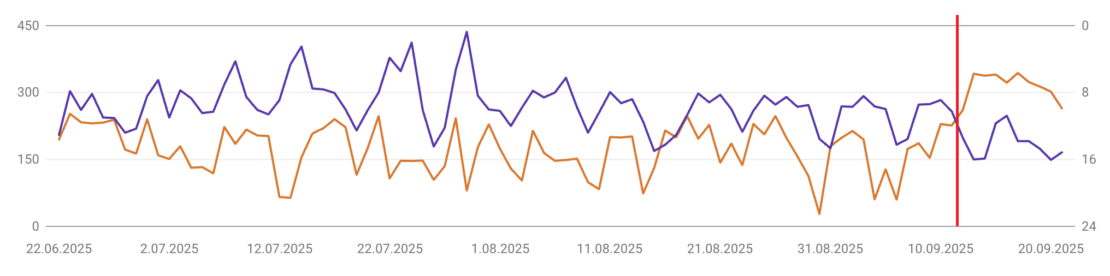
Removing this parameter results in temporarily incomplete reporting data and possible gaps in analysis. The SEO reports we provide in Looker Studio may show significant drops in impressions while simultaneously increasing average position (Clicks and Impressions tab):


The decline in impressions is natural and is due to the limitation of visible results to the top 10 per page, not to an actual decline in page visibility. Average position may improve because distant results are no longer taken into account.
Customer dashboard and position report
The position monitoring tool we use has implemented a temporary solution to ensure continued accurate reporting for the websites that are most financially significant to our clients (TOP 30). For phrases with a position above the TOP 30, Verseo displays a position of 100 in the client panel. This doesn't indicate a decrease in visibility, just a lack of data for phrases with a position <30 in search results.

How to analyze data in reports after changes?
Declines in GSC don't indicate a loss of website visibility, but rather a change in how data is reported . Focus on the top 10 results, as these are the ones that actually generate clicks, organic traffic, and ultimately, customers. Using data from multiple sources (such as Google Search Console, Google Analytics, and Semstorm) will help you monitor variations and avoid basing your data analysis solely on a single, potentially biased source.
FAQ about removing parameter num 100
This is a feature (a parameter added to the URL) that allowed displaying up to 100 search results on a single page, instead of the standard 10. For years, this facilitated the work of SEO specialists and analytical tools, providing a quick and comprehensive view of the competition's positions.
The parameter stopped working in mid-September 2025. Google decided to take this step to simplify the appearance of results, optimize search engine performance, and hinder mass data extraction (so-called scraping) by automated bots. Manually entering the parameter into the browser bar no longer works.
You may notice some strange fluctuations in your statistics. Because SEO bots no longer artificially trigger "impressions" for the entire top 100 results at once, GSC has seen a noticeable decline in the total number of impressions. Interestingly, this may result in an artificial increase in average position (because the algorithm has stopped averaging positions from distant locations).
The fluctuations in the charts visible in the Client Panel and reports (decreases in views, fluctuations in average position) are largely the result of technical changes on Google's part, not a real loss of visibility. The positions of key phrases in the TOP 10 remain verifiable and secure.
It's best to stop treating "views" and "average position" in GSC as the most important measure of success – these data are currently distorted. Instead, focus on hard business metrics: real organic traffic to the website (e.g., in Google Analytics 4), conversions achieved, and position stability for keywords that generate sales.
Summary
The above article covers the following topics:
- Removing the &num=100 parameter from Google Search changes the statistics in Search Console, which requires a new and more careful analysis of SEO reports.
- The &num=100 parameter allowed for displaying 100 search results on one page, which made it much easier for SEO specialists to quickly analyze the competition.
- Removing the &num=100 parameter changed the statistics in Google Search Console, artificially lowering the number of impressions and increasing the average position, but without affecting the actual organic traffic.
- Anomalies in Verseo reports are solely due to technical changes in Google, so the current analysis should be based on real traffic and TOP10 results.