Manually managing advertising campaigns consumes dozens of hours each month, yet it doesn't guarantee optimal results. Fortunately, Google Ads offers advanced mechanisms that take over routine tasks and allow you to focus on your business strategy.
Google Ads automation is now the standard for competitive advantage for advertisers. In this article, we explain how Google Ads automation works, its benefits, and what to watch out for when implementing it.
What exactly is automation in Google Ads?
Automation in Google Ads involves using machine learning and artificial intelligence algorithms to perform tasks that traditionally required manual work by a specialist.
The system analyzes massive amounts of data in real time – conversion history, user behavior, search context, time of day, device type, and dozens of other signals – and then makes decisions to optimize the campaign.
(The rest of the article can be found below the form)
AI in Google Ads is no longer limited to simple bidding. Current algorithms can independently select keywords based on landing page analysis, generate ad copy variants tailored to specific search queries, select the most effective headline and description combinations, and even direct users to the most relevant website pages.
It's worth emphasizing that automation doesn't mean completely relinquishing control. Advertisers still define their business goals, budget, target groups, and brand message. The system, however, can support analytical work and ongoing optimization of campaign parameters.
Where does automation save the most time?
Managing Google Ads campaigns has traditionally required daily monitoring of bids, analyzing search query reports, testing ad variants, and adjusting budgets. Automation eliminates much of this repetitive work.
Automated bidding strategies are the foundation of time savings. Instead of manually adjusting bids for hundreds of keywords, advertisers choose a goal—for example, maximizing conversions or a specific return on ad spend—and the system automatically adjusts bids in each auction.
The algorithm takes into account factors that humans cannot process in real time: the history of a specific user's behavior, the probability of conversion at a given moment, or the intensity of competition.
Responsive text ads automate creative testing. Advertisers provide a set of headlines and descriptions, and Google automatically combines them into various combinations and presents users with the variants that generate the best results. The system continuously learns which elements capture audience attention and lead to conversions.
Automating Google Ads reporting eliminates hours spent compiling data from various sources. Automatic alerts notify you of significant changes in your campaigns, and built-in recommendations highlight areas requiring attention. This allows the specialist to focus on interpreting results and making strategic decisions.
Smart Bidding Strategies – How Do They Work?
Smart Bidding uses machine learning to optimize bids at the individual auction level. The system analyzes contextual signals and predicts the likelihood that a given impression will lead to a conversion.
Maximizing conversions involves aiming to capture the most user actions possible within a given budget. Google Ads' Maximizing Conversions automatically raises bids in situations with high conversion potential and lowers them when the chances of success are low.
Maximizing conversion value is a strategy designed for online stores where individual transactions vary in value.
Instead of treating every order equally, the system prioritizes users who are more likely to make a purchase with a higher basket value. For e-commerce, this means the ability to automatically direct budgets to products and customers that generate higher revenue.
Target cost-per-acquisition (CPA) allows you to determine how much an advertiser is willing to pay for a single conversion. The system strives to generate as many conversions as possible while maintaining the target cost per unit.
Although Google recommends a minimum of 30 conversions per month for optimal stabilization, modern algorithms – thanks to AI Max and contextual signals – can effectively optimize bids even with a smaller data volume.
Figure 1. Conversion-based bidding settings (target CPA).
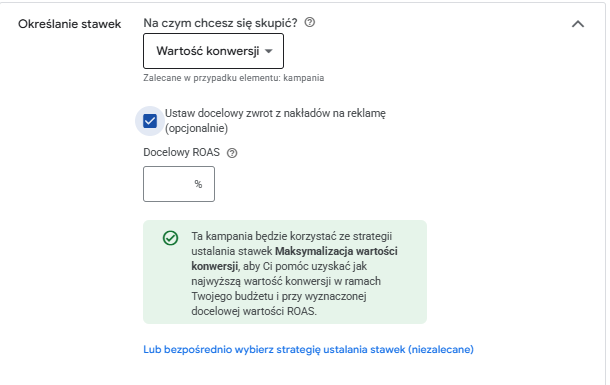
Target return on ad spend (ROAS) optimizes campaigns based on the value of generated transactions, not just their number. This is a suitable strategy for online stores with varying margins and value-added products or services.
Figure 2. Target return on advertising spend settings.
AI Max for Search – the next generation of search campaigns
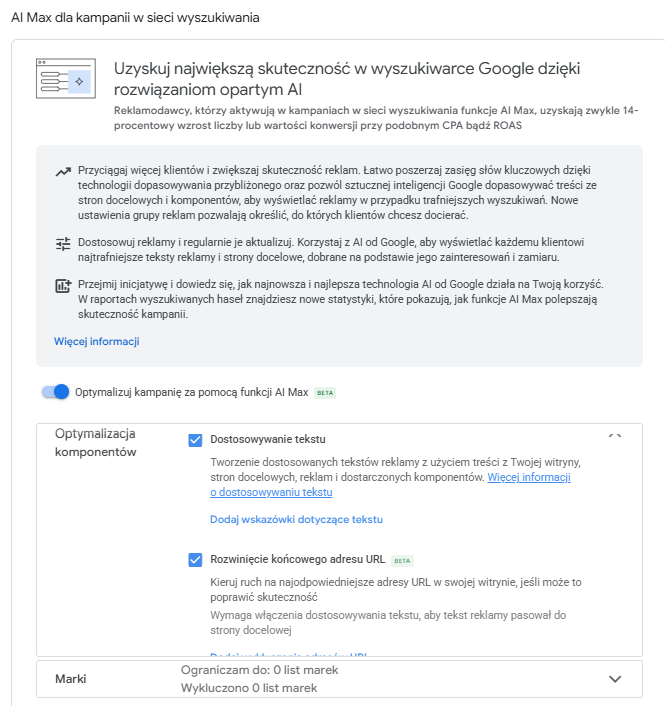
Figure 3. Campaign optimization settings using the AI Max function.
AI Max is a suite of features that can be incorporated into existing Search Network campaigns. It combines three mechanisms: broad match powered by semantic technology based on large language models, automatic ad copy personalization, and dynamic landing page selection.
Broad match in AI Max leverages both standard broad match technology and dynamic search engine advertising mechanisms. The system analyzes the advertiser's website content and automatically displays ads for search queries that are semantically related to the offer—even if those phrases aren't on the keyword list.
Personalization of ad text involves automatically generating variants of headlines and descriptions tailored to specific user queries. If someone is searching for a powder pink wedding dress, the system can generate a headline that specifically addresses that need, rather than displaying a generic ad about dresses.
Dynamic landing page selection directs users to the most relevant pages on your site. If the ad is for a specific product, the system may redirect them to that product's card rather than the category's home page.
Performance Max and multi-channel campaigns
Performance Max is a campaign type that automates reaching users across all Google channels: Search, YouTube, the Display Network, Gmail, Discover, and Maps. Advertisers provide resources—text, graphics, videos—and the system independently creates ads and selects where they appear.
Google Ads campaign optimization in Performance Max relies on audience signals that advertisers can provide. Information about previous customers or website visitors helps the algorithm find the right target audience more quickly.
A significant change is enhanced analytics – advertisers can see which search terms triggered ads, how the campaign is performing across channels, and which creative assets are generating the best results.
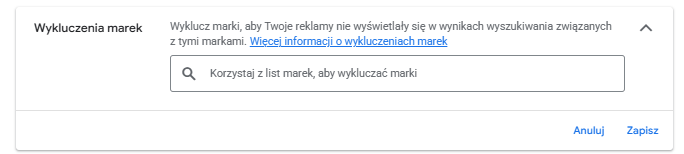
You can also add negative keywords via account-level exclusion lists or Brand Exclusions.
Figure 4. In the Signals section, you will find search terms that trigger ad impressions.
Figure 5. Options for excluding brands you don't want to see ads for.
Is it worth using Google Ads automation?
The benefits of automation in online marketing are tangible.
- First – above all, time savings: tasks that previously took several hours a day are performed automatically.
- Secondly, precision of optimization – algorithms process data faster and more accurately than humans, which translates into better results with the same budget.
- Thirdly, scalability – automation allows you to manage dozens of campaigns without a proportional increase in workload.
Automation is especially effective in campaigns with high data volumes. Machine learning algorithms need information to learn from – the more conversions and clicks, the more accurate the system's decisions.
For small campaigns with a few conversions per month, automated strategies may be less predictable.
Industry specifics should also be considered. In sectors with highly volatile demand—for example, seasonal sales or one-off events—algorithms may need time to adapt to new conditions. In such situations, it's worthwhile to combine automation with manual oversight.
Automation Pitfalls – What to Watch Out For?
The pitfalls of advertising campaign automation most often stem from over-reliance on the system. Algorithms optimize campaigns to meet defined goals, but they fail to understand the business context. If the goal is poorly defined or the conversion data imprecise, the system will strive for inappropriate results.
A common issue is the quality of the data fed into Google Ads . Automation relies on conversion data; if tracking is configured incorrectly, the algorithm will make erroneous decisions. Before enabling automated strategies, verify that your conversion tags are implemented correctly.
Losing control over placements poses another risk. In Performance Max campaigns, ads can appear across multiple channels, and advertisers have limited ability to exclude specific sites. It's important to regularly analyze placement reports.
A lack of historical data leads algorithms to rely on guesswork. New accounts or campaigns in niche industries may require a longer learning curve.
Balance between automation and control
Effective Google Ads campaign management involves finding the right balance between automation and manual oversight. Automation should handle routine, repetitive tasks, while humans focus on strategy, brand messaging, and interpreting results in the context of business goals.
It's worth regularly reviewing search term reports and adding negative keywords—even as algorithms increasingly understand user intent, missed matches still occur. Monitoring budgets remains crucial even with automated bidding strategies, as sudden changes in competition can cause costs to increase.
Figure 6. Search term reports – use them to find negative phrases.
Testing new features should be done gradually. Instead of enabling all automations at once, it's better to implement them one at a time and observe the impact on results.
Google Ads offers experimentation mechanisms that allow you to compare the performance of campaigns with and without automation enabled.
What does this mean for advertisers?
Google Ads automation is transforming the way advertising campaigns are run. It takes away time-consuming analytical and optimization tasks, allowing advertisers to focus on their business strategy. Intelligent bidding strategies, automated creative generation, and AI-powered omnichannel campaigns offer capabilities that were unattainable just a few years ago.
At the same time, automation doesn't absolve you of responsibility for results. It requires properly configured goals, good data quality, and regular monitoring of results.
Advertisers who can combine the power of algorithms with their own knowledge of the market and customers achieve the best results. Automation is a tool – its effectiveness depends on how it is used.
Frequently asked questions about automation in Google Ads
Automation is the use of machine learning algorithms and artificial intelligence to manage and optimize advertising campaigns. Google's systems analyze millions of signals in real time and independently make decisions, including selecting the appropriate click rate, combining ad copy, and displaying ads on specific target channels.
The main advantage is that it frees up specialist time. Instead of manually adjusting bids by a few cents, they can focus on strategy and business analysis. Furthermore, Google's algorithms can process data with a speed and precision unattainable by humans, taking into account device, location, time of day, and even user purchasing intent, ultimately maximizing return on investment (ROAS/ROI).
Absolutely not! This is one of the biggest and most expensive myths in the industry. Even though algorithms do the dirty work in fractions of a second, they still operate only within a human-defined framework. An SEM specialist must define the business goal, provide appropriate materials (text, graphics, video), oversee the algorithm's learning phase, and respond to anomalies. A campaign left to its own devices (set-and-forget errors) will quickly lead to budget burn.
Smart Bidding is a set of automated bidding strategies (e.g., Maximize Conversion Value, Target ROAS, Target CPA) that optimize bidding to drive sales or leads in every single auction. Instead of paying a pre-determined amount for each entry, the system pays more for users who are highly likely to make a purchase and significantly less (or not at all) for those who are just browsing.
Algorithms learn from data, so flawlessly configured conversion tracking (e.g., using Google Tag Manager and GA4) is absolutely essential. If you give the system the wrong goal (e.g., counting every click as a success rather than an actual sale), the machine will optimize the campaign to attract cheap and worthless traffic. Furthermore, for AI to function effectively, the ad account must have the appropriate history and data volume.
Automated rules are a type of simple "if…then" command that you can program in your Google Ads account to trigger a specific action when certain conditions are met. Examples? You can set up a rule that:
- It will automatically pause keywords that have spent over 100 PLN and have not resulted in any sales.
- It will increase your budget by 20% in campaigns with the highest conversion rates.
- It will only run special promotional ads on weekends. It's a great tool for protecting your budget and limiting losses 24/7.
Summary
The above article covers the following topics:
- Google Ads automation uses artificial intelligence to optimize your campaigns in real time, saving you time and increasing your ad performance while maintaining strategic control.
- Save time by taking over repetitive tasks like real-time bid optimization, testing ad combinations, and generating reports and alerts.
- Smart Bidding strategies use machine learning to automatically adjust bids in each auction, optimizing them for conversion volume, conversion value, cost per acquisition (CPA), or return on ad spend (ROAS).
- AI Max improves search campaigns by automatically matching ads to semantic queries, personalizing texts, and directing users to the most relevant website pages.
- Performance Max is a fully automated campaign type that, based on the provided resources and audience signals, independently optimizes ad display across all Google channels.
- Google Ads automation offers time savings, precise optimization, and easy scalability, but its effectiveness depends on large amounts of data and proper oversight in highly volatile industries.
- The main risks of automation are incorrect conversion data, poorly defined business goals, and limited control over where ads are displayed, which, given the small amount of data, can lead to suboptimal algorithm decisions.
- Effective advertising requires a balance between automating routine tasks and human oversight of strategy, data quality, and regular review of results to achieve the best business results.